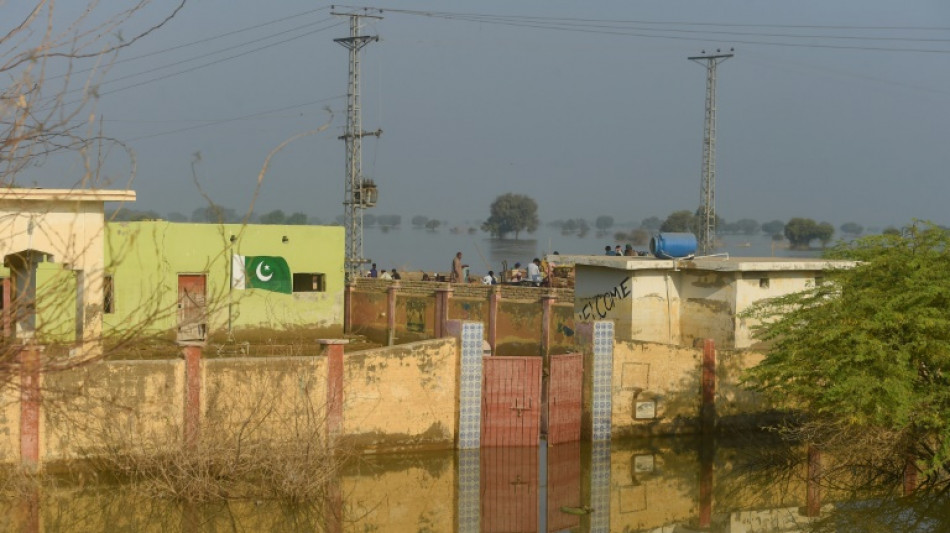
Pakistan seeks billions for flood recovery, climate resilience / Photo: Asif HASSAN - AFP

 Argentine judge orders suspension of Falklands oil project

 US Fed raises rates to tackle 'too high' inflation, irking Trump

 Turkey releases 106 protesters, jails more LGBTQ activists

 Candidate for UN chief calls for AI regulation akin to nuclear weapons

 'We're losing control,' AI pioneer Yoshua Bengio tells AFP

 IR-MED and Dice Technologies Announce collaboration to Evaluate and Advance Pressure-Injury Prevention Platform in Japan

 Watts, Pitt, Cruz to light up Spain's top film festival

 Toogood Gold's Table Mountain Sits in the Shadow of a Nevada Gold Rush

 MEXC July–August Security Report: 38.66M USDT in Risk Funds Intercepted, Futures Insurance Fund Hits 792M USDT

 Emporio Armani names Dario Vitale new creative director

 EU to ban social media for under 13s, curb access until 15

 Wildfires push endangered Sumatran elephants to brink: Indonesian NGO

 Bank of Japan set to raise rates under pressure from inflation, US

 EU chief to unveil social media, gaming curbs for under-15s

 'Resident Evil' film brings video game's ethos to the big screen

 GA-ASI Mojave First UAS To Complete Battlefield Short Field Ops

 Sanders, Bannon warn of AI dangers in rare US left-right alignment

 Empty benches as schools reopen in Venezuela's quake-hit Guaira

 Tiny English village holds 'independence' vote over asylum seeker housing

 US Treasury chief says to meet Chinese counterpart at weekend

 BingX Evolves into a Multi-Asset Trading Platform, Connecting Users to Global Opportunities

 International Trading Institute Expands Professional Trader Development Beyond the Master’s in Trading

 Lake Energy Secures $80 Million for U.S. Renewable Energy Expansion

 Stocks drop, oil climbs and Treasury yields hit 19-year high

 SkySail Strategies Outperforms Wall Street's 30-Year Risk Standard With Proprietary AI Inference Model

Pakistan will ask Monday for billions in international support towards its recovery from the aftermath of last year's devastating floods and to help it better resist climate change.
To meet the huge needs, Pakistan and the United Nations will co-host an international conference in Geneva, urging countries, organisations and businesses to step up with financial and other support towards a long-term recovery and resilience plan.
Pakistan Prime Minister Shehbaz Sharif and UN Secretary-General Antonio Guterres will kick off the one-day event, which will also feature speeches by a number of heads of state and government.
French President Emmanuel Macron, his Turkish counterpart Recep Tayyip Erdogan and European Commission chief Ursula von der Leyen will also address the conference via video link.
According to Pakistan's so-called Resilient Recovery, Rehabilitation and Reconstruction Framework, which it will officially present during Monday's conference, $16.3 billion will be needed in all.
Pakistan's government aims to cover half that amount with "domestic resources", including its development budget and through public-private partnerships.
But it is looking to the international community to cover the remainder, with the hope that Monday's conference will generate significant pledges of support.
Around 450 participants from some 40 countries have registered for the event, including representatives of the World Bank and several multilateral development banks.
- 'Pivotal moment' -
"The waters may have receded, but the impacts are still there," Achim Steiner, head of the UN development agency, told AFP ahead of the conference, describing the floods as "a cataclysmic event".
"There is a massive reconstruction and rehabilitation effort that needs to be undertaken."
The flooding, which killed more than 1,700 people and affected some 33 million others, still has not receded in some southern parts of the country.
The UN children's agency said Monday that as many as four million children were still living near contaminated and stagnant flood waters.
Millions of people remain displaced, and those who have been able to go back home are often returning to damaged or destroyed homes and mud-covered fields that cannot be planted.
Food prices have soared, and the number of people facing food insecurity has doubled to 14.6 million, according to UN figures.
The World Bank has estimated that up to nine million more people could be dragged into poverty as a result of the flooding.
"This is a pivotal moment for the global communities to stand with the people of Pakistan," Khalil Hashmi, the country's UN envoy in Geneva, told reporters.
But he emphasised that the conference would be "the beginning of a multiyear process".
Pakistan and the UN stress that Monday's event is broader than a traditional pledging conference, as it seeks to set up a long-term international partnership focused on recovery, but also on boosting Pakistan's climate resilience.
Pakistan, with the world's fifth-largest population, is responsible for less than one percent of global greenhouse gas emissions but is one of the most vulnerable nations to extreme weather caused by global warming.
The country "is essentially a victim of a world that is not acting fast enough on the challenge of climate change", Steiner said.
H.Müller--CPN