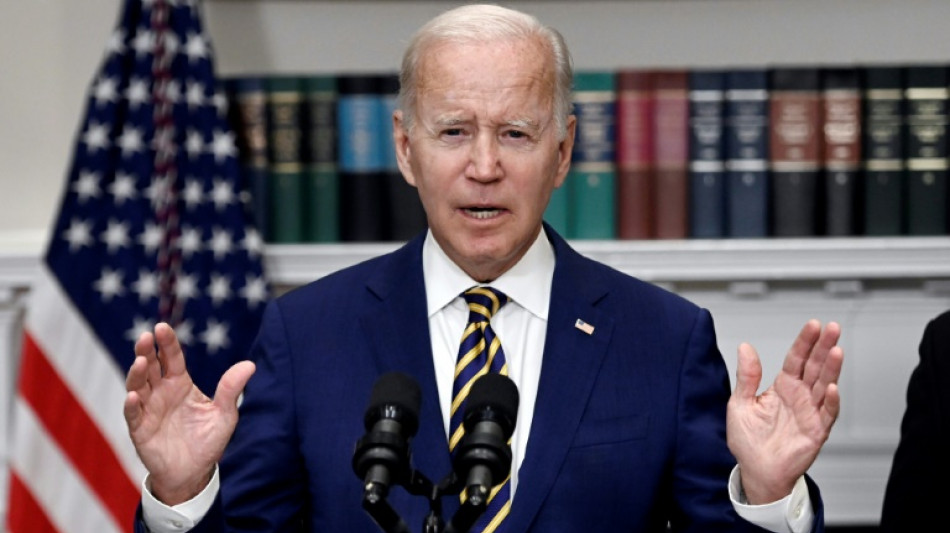
Biden announces relief for university debts / Photo: OLIVIER DOULIERY - AFP

 Lights out in Laos as electricity exports surge

 Steven Strogatz weighs AI mathematics advances and their consequences for researchers

 Anthropic boss calls for AI slowdown, Altman and Musk agree

 French IT giant Capgemini sells subsidiary after row over ICE links

 Quebec Brokerage Qubit Insurance Announces New Data on Coverage Shortfalls as Rebuilding Costs Rise

 Lady Gaga welcomes first child with fiance: US media

 Bhutan business bets on hazelnuts for farming future

 'Widow's Bay' and 'The Pitt' are favorites for Emmys night

 Coastal erosion forces cancellation of California music festival

 Argentina's Dirty War rears its head in Venice film

 UK lawmakers throw out bill to legalise assisted dying

 US inflation steady in August, fueling Fed rate hike expectations

 New York marks 25th anniversary of 9/11 attacks

 Nepal flood reconstruction bill to be $4.78 bn: foreign ministry

 JUMO and Standard Bank launch Social Finance Framework to scale inclusive finance in Africa

 Doomsday tech: could AI really kill us all?

 French comedy show 'Call my agent' makes film comeback

 It's all coming back: Celine Dion fans gear up for Paris return

 Researchers eye AI revolution in natural disaster forecasts

 US braces for inflation report that may push Fed to hike rates

 Musk threatens legal action over documentary

 Latin America fact-check group asks Meta not to replace verification practice

 AI Risks to Enter 60–80% of Liability and Cyber Insurance Underwriting by 2028, ScienceSoft Predicts

 Tribal Launches Campfire, Letting Business and Technical Teams Build on Salesforce Together

 Stocks fall as fresh oil surge fans inflation fears

President Joe Biden on Wednesday announced that most Americans trying to pay off university loans will get $10,000 forgiven in a bid to address the decades-old headache of massive educational debt across the country.
"In keeping with my campaign promise, my administration is announcing a plan to give working and middle class families breathing room," Biden said in a statement issued less than three months before midterm congressional elections, where the issue is seen as a vote winner for Democrats.
In a speech from the White House later, Biden called the assistance "a game changer."
"All this means people can finally start crawling out of that mountain of debt," he said. "When this happens, the whole economy is better off."
The proposed debt relief falls far short of some Democrats' goal of securing complete forgiveness, but is opposed by Republicans who argue that shaving any amount from loans is unfair to those who have already spent years saving to pay off their own debts.
There was also immediate debate over whether effectively giving millions of people a cash injection will stoke already rampant inflation.
Jason Furman, formerly the chief economic advisor in Barack Obama's White House, tweeted that "pouring roughly half trillion dollars of gasoline on the inflationary fire that is already burning is reckless."
Biden acknowledged he was "not going to make everybody happy" but defended the move as "economically responsible" and said studies showed there'd be no "meaningful effect on inflation."
The White House was unable to say how much the debt cancellations would cost, explaining that the amount will depend on how many people take up the deal.
At Howard University, a historically Black college, journalism student Amarie Betancourt said, "If everything goes through, that would be absolutely amazing."
Noting that Biden had promised student debt relief when he was running for the presidency, Betancourt, 20, said, "I think that's why a lot of people my age and within my generation voted for him."
- $1.6 trillion debt -
US colleges can often cost anywhere between $10,000 and $70,000 a year, leaving some graduates with crushing debt as they enter the workforce.
According to government estimates, the average debt for US college students when they graduate is $25,000, a sum many require years or even decades to pay back.
In total, some 45 million borrowers nationwide owe a collective $1.6 trillion, according to the White House.
Government data shows that 21 percent of borrowers eligible for relief are under 25 years old, but that more than a third are 40 or older, with five percent still holding college debt in old age.
Under the relief plan, $10,000 will be cut from all loans owed by people earning a salary of less than $125,000. For students who went to university with need-based government assistance known as Pell grants, the relief will be $20,000.
In all cases, the forgiveness will apply to students or former students who apply, rather than being automatic. The program is also only valid for people whose loans were taken out prior to June 30 of this year.
Meanwhile, a moratorium on loan repayments that was instituted during the Covid-19 pandemic will be extended to the end of the year, with installments restarting on December 31 -- reintroducing a revenue stream that Biden said would help offset the cost of the forgiveness program.
"It's going to be billions of dollars a month in payments coming into the federal government," Bharat Ramamurti, deputy director of the White House's National Economic Council, told reporters.
- 'Giant step forward' -
The plan was announced after months of consideration in the White House on how to thread the needle on an issue that has bedeviled successive administrations.
Biden has been under heavy pressure for months from the senior Senate Democrat, Majority Leader Chuck Schumer, and lawmakers from the left of the party to take action.
"With the flick of a pen, President Biden has taken a giant step forward in addressing the student debt crisis by cancelling significant amounts of student debt for millions of borrowers," Schumer said in a joint statement with leading liberal Senator Elizabeth Warren.
"The positive impacts of this move will be felt by families across the country, particularly in minority communities."
But Republican National Committee chair Ronna McDaniel called the plan a "bailout for the wealthy."
"As hardworking Americans struggle with soaring costs and a recession, Biden is giving a handout to the rich," she said.
"Biden's bailout unfairly punishes Americans who saved for college or made a different career choice, and voters see right through this short-sighted, poorly veiled vote-buy."
H.Meyer--CPN