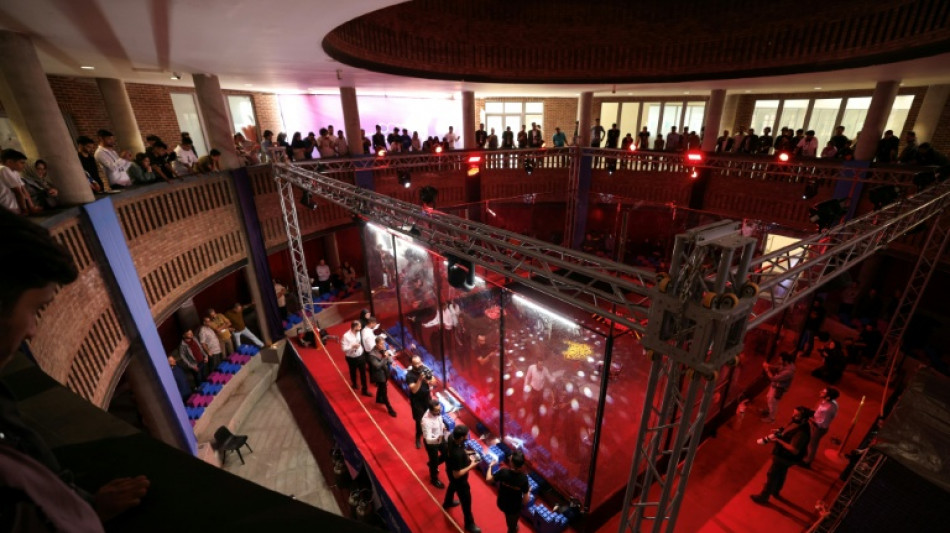
Iranian tech prodigies battle it out with robots / Photo: ATTA KENARE - AFP

 Lights out in Laos as electricity exports surge

 Steven Strogatz weighs AI mathematics advances and their consequences for researchers

 Anthropic boss calls for AI slowdown, Altman and Musk agree

 French IT giant Capgemini sells subsidiary after row over ICE links

 Quebec Brokerage Qubit Insurance Announces New Data on Coverage Shortfalls as Rebuilding Costs Rise

 Lady Gaga welcomes first child with fiance: US media

 Bhutan business bets on hazelnuts for farming future

 'Widow's Bay' and 'The Pitt' are favorites for Emmys night

 Coastal erosion forces cancellation of California music festival

 Argentina's Dirty War rears its head in Venice film

 UK lawmakers throw out bill to legalise assisted dying

 US inflation steady in August, fueling Fed rate hike expectations

 New York marks 25th anniversary of 9/11 attacks

 Nepal flood reconstruction bill to be $4.78 bn: foreign ministry

 JUMO and Standard Bank launch Social Finance Framework to scale inclusive finance in Africa

 Doomsday tech: could AI really kill us all?

 French comedy show 'Call my agent' makes film comeback

 It's all coming back: Celine Dion fans gear up for Paris return

 Researchers eye AI revolution in natural disaster forecasts

 US braces for inflation report that may push Fed to hike rates

 Musk threatens legal action over documentary

 Latin America fact-check group asks Meta not to replace verification practice

 AI Risks to Enter 60–80% of Liability and Cyber Insurance Underwriting by 2028, ScienceSoft Predicts

 Tribal Launches Campfire, Letting Business and Technical Teams Build on Salesforce Together

 Stocks fall as fresh oil surge fans inflation fears

Two machines resembling robotic vacuum cleaners sped around a ring colliding, shooting sparks and catching fire, as Iranian engineering students watched from behind plexiglass.
The dramatic clash was just one of many opportunities for competitors to go head-to-head at the country's Tech Olympics, to determine the future of its engineering talents.
Iran aspires to become a key regional player in emerging technologies, despite decades of international sanctions that have stifled its development.
The fields at this year's competition included robot battles, programming, artificial intelligence, as well as drones, cybersecurity and connected devices.
A few hours before his event, Alireza Hosseini put the final touches on combat robot Arash -- a rudimentary machine of wires and wheels without the appearance of a humanoid.
"What's more important than the design is the operator," the 21-year-old university student told AFP, referring to the person who remotely controls the robot.
"The design only represents a third of the work, but the operator decides how and where the robot attacks," said Hosseini, from Kerman in southern Iran.
Hosseini said his team of students in electrical engineering, electronics, computer science, mechanical engineering and design had been crowned Iran's robotics champion three times.
Launched last year at the government's initiative, the Tech Olympics serve as a talent pool for companies seeking potential recruits.
The coach of one team of under-18s appeared somewhat anxious before the start of the competition.
"Unfortunately, we started late, and the robot isn't quite ready yet," said Mr. Azizi, who did not give his first name.
- Iran's Silicon Valley -
Three referees were tasked with judging the robot fights, just like in wrestling, a sport at which Iran excels.
The collisions between machines produce sparks, and sometimes even balls of fire. Victory goes to the robot that disables its opponent.
The Tech Olympics take place on the outskirts of the capital Tehran, at the Pardis Technology Park -- nicknamed Iran's Silicon Valley -- where dozens of cutting-edge companies are located.
The organisers boast that they received more than 10,000 applications for the competition, which was whittled down to 1,000 spots in the elimination rounds.
A few foreign teams also participated. Iranian media mentioned more than a dozen countries ranging from neighbouring Iraq to far-away Romania.
Iran has invested sizable sums in emerging technologies, including robotics, with dozens of companies using them for a variety of applications.
In September, the country unveiled its first AI-powered robot, capable of accurately answering a wide range of legal questions, according to local media.
The military has also harnessed these technologies, including for its Aria combat robot, which uses AI to detect obstacles and move autonomously and was unveiled in September.
In 2021, veterinarians in Iran performed the first-ever remote surgery on a dog using Sina, a surgical robot entirely designed and manufactured domestically.
The Tech Olympics aims to prepare students for real-world situations.
Mohammad-Javad Asadolahi, a 21-year-old studying mechanical engineering at university, said he and his classmates designed a drone -- capable of taking off automatically and following a set trajectory -- from scratch using "60 to 70 percent Iranian technology".
"Our main difficulty was the lack of educational resources" in English and Persian, he said.
But "thanks to our knowledge and research, we have gradually succeeded".
Ch.Lefebvre--CPN