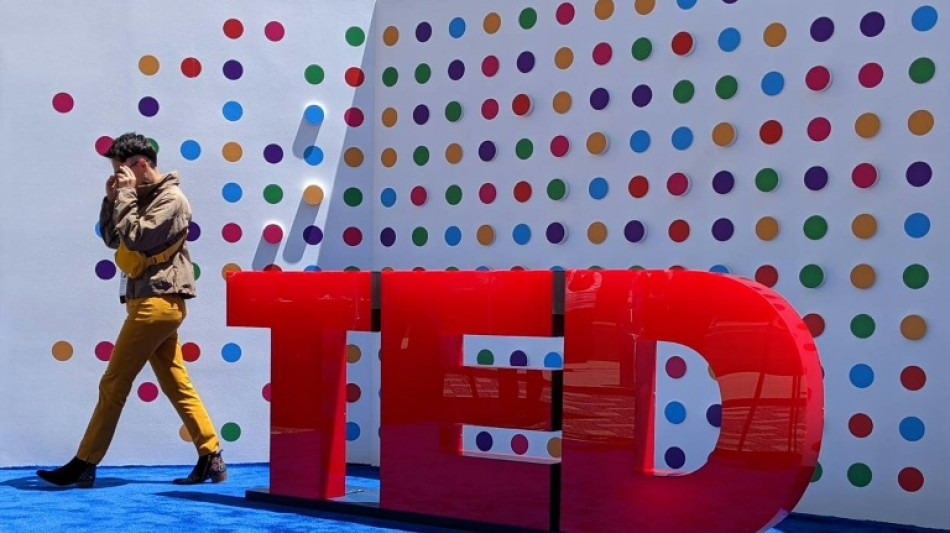
Exiting TED leader clings to tech optimism / Photo: Glenn CHAPMAN - AFP/File

 Lights out in Laos as electricity exports surge

 Steven Strogatz weighs AI mathematics advances and their consequences for researchers

 Anthropic boss calls for AI slowdown, Altman and Musk agree

 French IT giant Capgemini sells subsidiary after row over ICE links

 Quebec Brokerage Qubit Insurance Announces New Data on Coverage Shortfalls as Rebuilding Costs Rise

 Lady Gaga welcomes first child with fiance: US media

 Bhutan business bets on hazelnuts for farming future

 'Widow's Bay' and 'The Pitt' are favorites for Emmys night

 Coastal erosion forces cancellation of California music festival

 Argentina's Dirty War rears its head in Venice film

 UK lawmakers throw out bill to legalise assisted dying

 US inflation steady in August, fueling Fed rate hike expectations

 New York marks 25th anniversary of 9/11 attacks

 Nepal flood reconstruction bill to be $4.78 bn: foreign ministry

 JUMO and Standard Bank launch Social Finance Framework to scale inclusive finance in Africa

 Doomsday tech: could AI really kill us all?

 French comedy show 'Call my agent' makes film comeback

 It's all coming back: Celine Dion fans gear up for Paris return

 Researchers eye AI revolution in natural disaster forecasts

 US braces for inflation report that may push Fed to hike rates

 Musk threatens legal action over documentary

 Latin America fact-check group asks Meta not to replace verification practice

 AI Risks to Enter 60–80% of Liability and Cyber Insurance Underwriting by 2028, ScienceSoft Predicts

 Tribal Launches Campfire, Letting Business and Technical Teams Build on Salesforce Together

 Stocks fall as fresh oil surge fans inflation fears

Chris Anderson took over TED 25 years ago, when the internet was young and optimism abounded about the future it could deliver.
Since then, the New York-based conference series has become globally known for its trademark "talks" sharing big ideas for a better world, while the internet is increasingly seen as a maelstrom of misinformation and social division.
Anderson still sees technology, particularly artificial intelligence, as able to bring out the best in humanity, as he hands off leadership of the organization behind TED and its prestigious conferences to Khan Academy founder Sal Khan.
"Conversations about possibility, about what we can build together, have always been at the heart of TED," Anderson said in an interview with AFP.
"It's probably what the world needs now more than ever; it's the antidote to people throwing barbs at each other."
Anderson cited social media as "the single biggest contributor to our dysfunction and to the falling out of love with technology" for many.
He faulted ad-driven business models that tie profit to time people spend on tech platforms, no matter how disturbing or unhealthy the content holding their attention.
"These algorithms have found that the best way to lock people in is to make them see the world as frightening and to see the 'other' as threatening them," Anderson said.
"It's a tragedy."
Nonetheless, Anderson is a self-described optimist, confident that better things can be built.
- Tedsters -
The first Technology, Education, and Design (TED) gathering was held in Monterey, California in 1984.
The annual conferences were drawing about 500 people when Anderson's nonprofit Sapling Foundation took over in 2001.
The roster of "Tedsters" includes renowned scientists, Hollywood celebrities, influential artists, and founders of tech firms such as Amazon, Microsoft, Google, and Netflix.
"I felt I'd come home to that heroic group of people dreaming about the future and what the future could be," Anderson said.
"They absolutely loved it," he said of the atmosphere at TED.
Anderson, who had been a successful publishing entrepreneur, made the risky move of releasing videos of the talks for free online.
"It could have arguably wrecked the conference and stopped people from wanting to pay to come," Anderson said.
Instead, the opposite happened: as TED Talks spread around the world, so did interest in attending the conferences in person.
"It's completely thrilling seeing that TED didn't just have to be for 500 people -- it could be for many millions of people," Anderson said.
TED now produces podcasts, short video series, animated educational lessons (TED-Ed), and TV programs that are translated into more than 100 languages.
- Best and worst selves -
Anderson spearheaded the launch of the TEDx program, which lets local organizers host TED-style events, and brought young innovators into the fold with a fellowship program.
A TED Audacious Project backing "wishes" by people seeking to do good has generated more than $3 billion for projects to make the world more sustainable, just, or beautiful, according to organizers.
"The biggest thrill of TED has been discovering that the internet used the right way can be the most glorious gift," Anderson said.
Anderson, 68, touted Khan as an ideal successor to steward TED.
Khan will continue to lead his online learning platform while also helping shape TED's mission, particularly with AI.
"You could argue that AI used right is capable of helping people become their best selves," Anderson said, noting that education has long been central to TED.
"Whereas social media often helps people become their worst selves."
L.K.Baumgartner--CPN