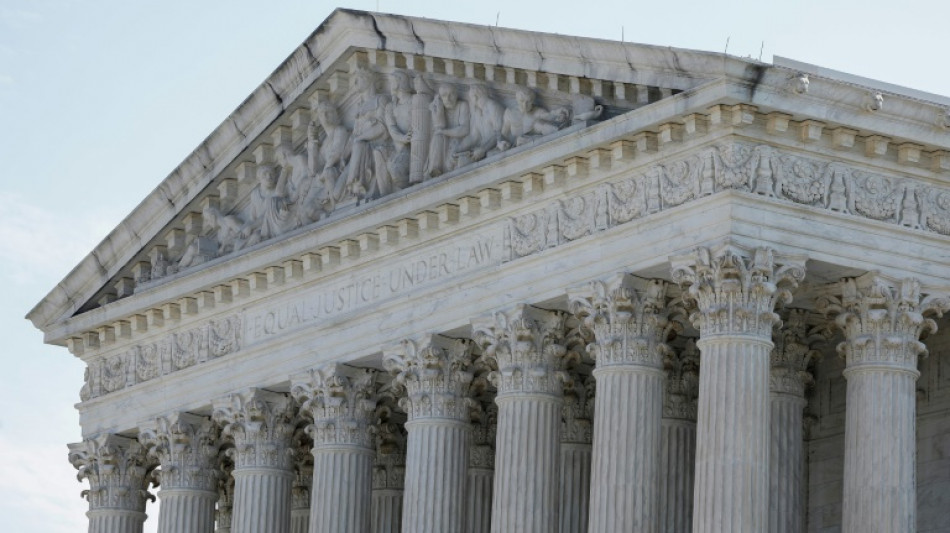
US Supreme Court weighs public funding of religious charter school / Photo: Anna Moneymaker - GETTY IMAGES/AFP

 Lights out in Laos as electricity exports surge

 Steven Strogatz weighs AI mathematics advances and their consequences for researchers

 Anthropic boss calls for AI slowdown, Altman and Musk agree

 French IT giant Capgemini sells subsidiary after row over ICE links

 Quebec Brokerage Qubit Insurance Announces New Data on Coverage Shortfalls as Rebuilding Costs Rise

 Lady Gaga welcomes first child with fiance: US media

 Bhutan business bets on hazelnuts for farming future

 'Widow's Bay' and 'The Pitt' are favorites for Emmys night

 Coastal erosion forces cancellation of California music festival

 Argentina's Dirty War rears its head in Venice film

 UK lawmakers throw out bill to legalise assisted dying

 US inflation steady in August, fueling Fed rate hike expectations

 New York marks 25th anniversary of 9/11 attacks

 Nepal flood reconstruction bill to be $4.78 bn: foreign ministry

 JUMO and Standard Bank launch Social Finance Framework to scale inclusive finance in Africa

 Doomsday tech: could AI really kill us all?

 French comedy show 'Call my agent' makes film comeback

 It's all coming back: Celine Dion fans gear up for Paris return

 Researchers eye AI revolution in natural disaster forecasts

 US braces for inflation report that may push Fed to hike rates

 Musk threatens legal action over documentary

 Latin America fact-check group asks Meta not to replace verification practice

 AI Risks to Enter 60–80% of Liability and Cyber Insurance Underwriting by 2028, ScienceSoft Predicts

 Tribal Launches Campfire, Letting Business and Technical Teams Build on Salesforce Together

 Stocks fall as fresh oil surge fans inflation fears

The US Supreme Court on Wednesday appeared to be leaning towards allowing public funding of a religious charter school in a case testing the historic separation of church and state.
Nearly all 50 US states allow charter schools, of which there are some 8,000 in the country.
They are government-funded but operate independently of local school districts and are not allowed to charge tuition or have a religious affiliation.
The Catholic Church in Oklahoma is vying to open the nation's first publicly funded religious charter school, Saint Isidore of Seville.
The Oklahoma Supreme Court ruled last year that the public funding mechanism for the proposed Catholic charter school in the central state was unconstitutional.
The separation between church and state is a bedrock principle in the United States, rooted in the First Amendment of the Constitution. The separation has been upheld in many Supreme Court decisions.
During oral arguments on Wednesday, conservative justices on the court however appeared open to allowing public funding of the school, a position backed by the administration of Republican President Donald Trump.
"All the religious school is saying is, 'Don't exclude us on account of our religion,'" said Justice Brett Kavanaugh, a conservative Trump appointee.
"Our cases have made very clear... you can't treat religious people and religious institutions and religious speech as second class in the United States," Kavanaugh said, adding that it "seems like rank discrimination against religion."
The three liberal justices disagreed.
"We're not going to pay religious leaders to teach their religion," said Justice Sonia Sotomayor, one of the three Democratic appointees.
Conservatives hold a 6-3 majority on the nation's highest court, but Justice Amy Coney Barrett, another Trump appointee, has recused herself from the case, possibly because of previous connections to parties in the case.
That leaves Chief Justice John Roberts, a conservative, as the potential swing vote.
A 4-4 decision would leave the Oklahoma Supreme Court's ruling in place.
- 'Dramatic effect' -
Gregory Garre, representing Oklahoma's attorney general, said a decision in favor of St Isidore would "not only lead to the creation of the nation's first religious public school," it would render unconstitutional the entire federal charter school program and the laws governing charter schools in 47 US states.
"This is going to have a dramatic effect on charter schools across the country," Garre said.
"Teaching religion as truth in public schools is not allowed," he added. "St Isidore has made clear that that's exactly what it wants to do in infusing its school day with the teachings of Jesus Christ."
The Supreme Court's conservatives have previously demonstrated support for extending religion into public spaces, particularly schools.
The court has issued a number of recent rulings blurring the boundaries between church and state, including a decision that a public high school football coach can lead his players in prayer.
The court has also allowed parents to use government vouchers to pay for the education of their children at private religious schools.
The case was brought by the conservative Alliance Defending Freedom (ADF), and the Supreme Court is expected to issue its ruling by the end of June.
Oklahoma's Republican superintendent Ryan Walters, the highest education official in the state, has been among those pushing for the establishment of the religious charter school.
Walters has ordered public schools in Oklahoma to teach the Bible, a move met with lawsuits by parents and teachers.
Nationally, there were more than 3.7 million students enrolled in 8,150 charter schools during the 2022-2023 school year, according to the National Alliance for Public Charter Schools.
M.Davis--CPN