Has US Education Dept impeded students? False claims by conservatives / Photo: ROBERTO SCHMIDT - AFP

 Lights out in Laos as electricity exports surge

 Steven Strogatz weighs AI mathematics advances and their consequences for researchers

 Anthropic boss calls for AI slowdown, Altman and Musk agree

 French IT giant Capgemini sells subsidiary after row over ICE links

 Quebec Brokerage Qubit Insurance Announces New Data on Coverage Shortfalls as Rebuilding Costs Rise

 Lady Gaga welcomes first child with fiance: US media

 Bhutan business bets on hazelnuts for farming future

 'Widow's Bay' and 'The Pitt' are favorites for Emmys night

 Coastal erosion forces cancellation of California music festival

 Argentina's Dirty War rears its head in Venice film

 UK lawmakers throw out bill to legalise assisted dying

 US inflation steady in August, fueling Fed rate hike expectations

 New York marks 25th anniversary of 9/11 attacks

 Nepal flood reconstruction bill to be $4.78 bn: foreign ministry

 JUMO and Standard Bank launch Social Finance Framework to scale inclusive finance in Africa

 Doomsday tech: could AI really kill us all?

 French comedy show 'Call my agent' makes film comeback

 It's all coming back: Celine Dion fans gear up for Paris return

 Researchers eye AI revolution in natural disaster forecasts

 US braces for inflation report that may push Fed to hike rates

 Musk threatens legal action over documentary

 Latin America fact-check group asks Meta not to replace verification practice

 AI Risks to Enter 60–80% of Liability and Cyber Insurance Underwriting by 2028, ScienceSoft Predicts

 Tribal Launches Campfire, Letting Business and Technical Teams Build on Salesforce Together

 Stocks fall as fresh oil surge fans inflation fears

Do American students really rank at the bottom of international comparisons and does the United States really spend more per pupil than any other country?
Those are the false claims made by President Donald Trump and his backers to justify shutting the Department of Education.
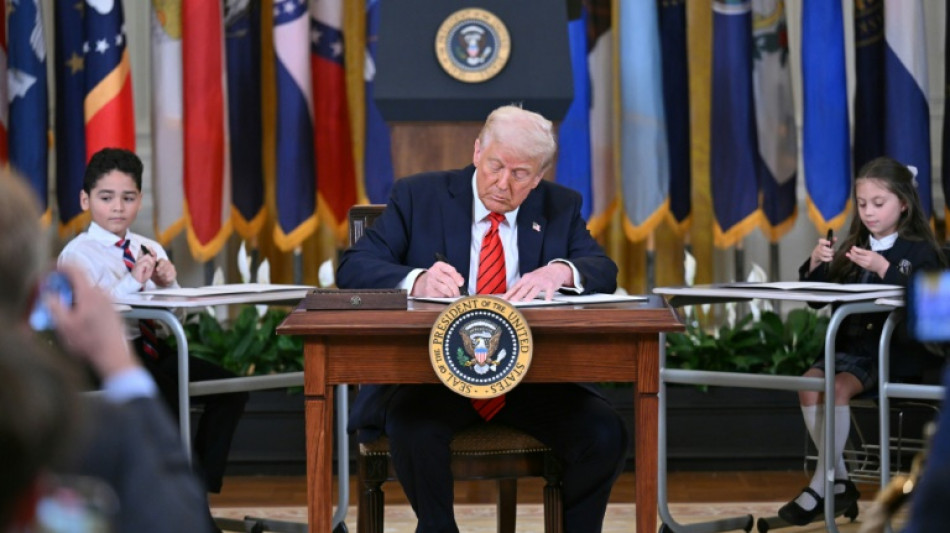
Trump signed an executive order on Thursday to close the department, which was created in 1979. While it cannot be shuttered without the approval of Congress, the department will likely be starved of funds and staff by the order.
The Trump administration had already sought to gut the department in early March by shedding almost 1,800 jobs, or about half of its staff, which according to Education Secretary Linda McMahon would help "our scores go up."
- Do US students really rank last? False -
"No matter how you cut it, the US is not scoring at the bottom of the international rankings," Nat Malkus, senior fellow and the deputy director of education policy at the conservative-leaning American Enterprise Institute, told AFP. "The US ranks in the middle of the pack on most international assessments."
Fifteen-year-old US students placed above average in reading and close to average in math on the Organisation for Economic Co-operation and Development's latest Programme for International Student Assessment (PISA) test.
Two other international tests, the PIRLS in 2021 for reading and the TIMSS in 2023 for science and mathematics, also place American kids within the average of the countries tested.
National tests did show a drop off after 2019, but that was partly attributed to disruptions caused by Covid shutdowns, with similar patterns seen in other countries.
But the picture is nowhere near as catastrophic as many of Trump's conservative supporters claim.
Nationally, in 2024, 76 percent of fourth-grade students (ages 9-10) and 61 percent of eighth-grade students (ages 13-14) met or exceeded the expected baseline in mathematics, according to National Assessment of Educational Progress (NAEP) results. In reading, they were 60 percent and 67 percent above the minimum, respectively.
It is also false that students "have fallen behind" since the creation of the DoE, a claim made by Republican Representative Byron Donalds of Florida.
For example, the average math proficiency of fourth-graders has increased by 24 points since 1990, and the average reading proficiency has not changed since 1992, according to the National Center for Education Statistics (NCES).
Malkus at the AEI said the "Department could improve how it supports US education" but cannot "be held responsible for student outcomes."
- Highest cost per student in the world? False -
Trump has claimed "we spend more per pupil than any other country in the world, and we're ranked at the bottom of the list."
He says his "dream" is to "move education into the states so that the states instead of bureaucrats working in Washington can run education" -- as proposed in the conservative "Project 2025" program that has guided the new administration.
But that's already the case. Each US state runs its own education system, with the DoE primarily responsible for administering student loans offered by the federal government, assisting disadvantaged students and enforcing rights.
While it does spend more per student than most countries, the United States ranked fifth in 2019 and sixth in 2021 in the OECD ranking for spending per primary and secondary student, far behind Luxembourg and Norway. And that spending is the responsibility of the states, with the federal government representing only about 13 percent of total funding.
"In the US only 4 percent of total federal spending is devoted to education, compared to about 10 percent on average in the countries in the OECD," said Fernando Reimers, a Harvard professor specializing in international education.
Several Democratic states, parents associations and the American Federation of Teachers (AFT) have all filed appeals against the dismantling of the department.
The AFT said in a press release that shutting the department will hurt "ten million students who rely on financial aid to go to college or pursue a trade" as well as "millions of students with disabilities and students living in poverty."
P.Kolisnyk--CPN