Phone bans sweep US schools despite skepticism / Photo: Jim WATSON - AFP

 Lights out in Laos as electricity exports surge

 Steven Strogatz weighs AI mathematics advances and their consequences for researchers

 Anthropic boss calls for AI slowdown, Altman and Musk agree

 French IT giant Capgemini sells subsidiary after row over ICE links

 Quebec Brokerage Qubit Insurance Announces New Data on Coverage Shortfalls as Rebuilding Costs Rise

 Lady Gaga welcomes first child with fiance: US media

 Bhutan business bets on hazelnuts for farming future

 'Widow's Bay' and 'The Pitt' are favorites for Emmys night

 Coastal erosion forces cancellation of California music festival

 Argentina's Dirty War rears its head in Venice film

 UK lawmakers throw out bill to legalise assisted dying

 US inflation steady in August, fueling Fed rate hike expectations

 New York marks 25th anniversary of 9/11 attacks

 Nepal flood reconstruction bill to be $4.78 bn: foreign ministry

 JUMO and Standard Bank launch Social Finance Framework to scale inclusive finance in Africa

 Doomsday tech: could AI really kill us all?

 French comedy show 'Call my agent' makes film comeback

 It's all coming back: Celine Dion fans gear up for Paris return

 Researchers eye AI revolution in natural disaster forecasts

 US braces for inflation report that may push Fed to hike rates

 Musk threatens legal action over documentary

 Latin America fact-check group asks Meta not to replace verification practice

 AI Risks to Enter 60–80% of Liability and Cyber Insurance Underwriting by 2028, ScienceSoft Predicts

 Tribal Launches Campfire, Letting Business and Technical Teams Build on Salesforce Together

 Stocks fall as fresh oil surge fans inflation fears

At a red-brick school in Virginia, Hayden Jones is one of 1,000 students banned from using their phones as part of a trial hoping to boost learning.
But the 12-year-old's verdict on the restrictions -- a shrug of his shoulders -- reflects the skepticism shared by some students and parents.
The phone ban at Twain Middle School is among a wave of measures implemented around the United States, and is part of a global movement replicated in Brazil, France and beyond.
Supporters believe restrictions will guard pupils from the apparent harms of smartphone use while at school, but opponents say the measures fail to prepare teenagers for the digital world they will inevitably enter.
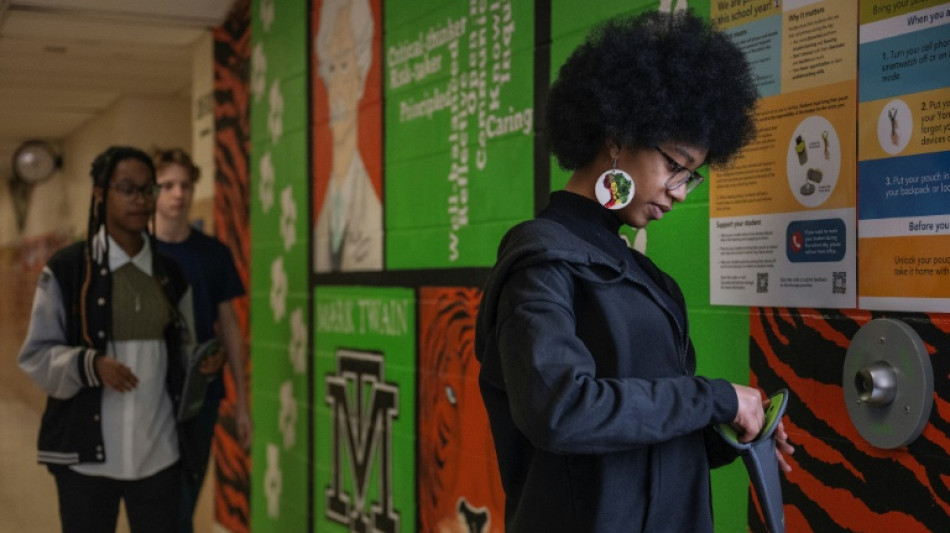
Since September, Jones must now place his Android phone in a magnetic pouch each morning, which is locked until the end of the school day as part of a pilot scheme this academic year.
Jones, speaking to AFP in a corridor lined with classrooms, said he hopes the ban will be gone by the time he starts eighth grade in September.
"I like being able to go to my locker and call my parents. That's a big concern for me," he said, adding that some pupils have found ways to still use their devices -- including by bringing a "dummy phone" to put in the pouch.
School principal Matthew Mough admitted that enforcing the ban -- and winning over students -- has proved challenging, though he said most follow the rules.
"The majority of kids who have phones don't love it," he said. "However, if you dig deeper with them in the conversation, they will acknowledge that it's helped them remain focused."
Mough said the phone ban has reduced classroom distractions, cyberbullying and instances of students meeting up to skip lessons.
- 'Heads in the sand' -
Cell phone bans come alongside research suggesting that social media use increases the likelihood of mental illnesses like anxiety and depression in young people.
Advocacy groups regularly cite these studies as justification for school phone bans, which have seen rare political consensus in a nation deeply divided on virtually every other political issue.
Around 76 percent of US public schools -- from liberal California to conservative Florida -- had some sort of ban on non-academic phone use, according to the latest Department of Education figures, with several state-wide measures also in place or under consideration.
They are largely backed by teachers, with the National Education Association saying 90 percent of its members support policies banning phones during lessons.
"The biggest problem is that kids aren't in a place developmentally where they're able to handle the type of technology that we're talking about," said Sabine Polak, co-founder of the Phone-Free Schools Movement, which backs full-scale phone bans.
Critics of the restrictions argue that educating children about the potential risks of social media and smartphone use is better than prohibition.
"The answer is not to just ban and put our heads in the sand," said Keri Rodrigues, president of the National Parents Union, which represents over 1,000 parent organizations in the United States.
She compared efforts to ban phones to "abstinence education," noting that failing to properly teach children about complicated issues such as sex has failed in the past.
"It's not effective, and frankly, it's dumb," Rodrigues told AFP. "What we need to do is equip our kids with the information, with the skills and the strategies they're going to need to navigate a digital future."
At the school in Virginia, Jones said the phone ban has not changed how he interacts with his device, still using it for games, social media and watching YouTube videos.
His one complaint about his phone? "Nothing really, honestly, I mean besides the fact that it weighs a ton in my pocket."
M.P.Jacobs--CPN