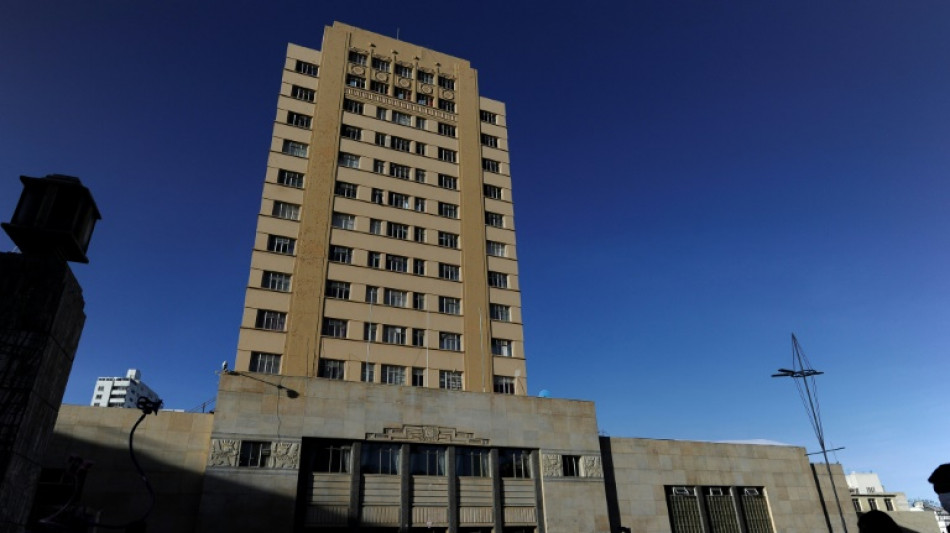
University tragedy brings to light 'dinosaur' student issue / Photo: JORGE BERNAL - AFP

 Lights out in Laos as electricity exports surge

 Steven Strogatz weighs AI mathematics advances and their consequences for researchers

 Anthropic boss calls for AI slowdown, Altman and Musk agree

 French IT giant Capgemini sells subsidiary after row over ICE links

 Quebec Brokerage Qubit Insurance Announces New Data on Coverage Shortfalls as Rebuilding Costs Rise

 Lady Gaga welcomes first child with fiance: US media

 Bhutan business bets on hazelnuts for farming future

 'Widow's Bay' and 'The Pitt' are favorites for Emmys night

 Coastal erosion forces cancellation of California music festival

 Argentina's Dirty War rears its head in Venice film

 UK lawmakers throw out bill to legalise assisted dying

 US inflation steady in August, fueling Fed rate hike expectations

 New York marks 25th anniversary of 9/11 attacks

 Nepal flood reconstruction bill to be $4.78 bn: foreign ministry

 JUMO and Standard Bank launch Social Finance Framework to scale inclusive finance in Africa

 Doomsday tech: could AI really kill us all?

 French comedy show 'Call my agent' makes film comeback

 It's all coming back: Celine Dion fans gear up for Paris return

 Researchers eye AI revolution in natural disaster forecasts

 US braces for inflation report that may push Fed to hike rates

 Musk threatens legal action over documentary

 Latin America fact-check group asks Meta not to replace verification practice

 AI Risks to Enter 60–80% of Liability and Cyber Insurance Underwriting by 2028, ScienceSoft Predicts

 Tribal Launches Campfire, Letting Business and Technical Teams Build on Salesforce Together

 Stocks fall as fresh oil surge fans inflation fears

After four people died in a Bolivian university stampede, an investigation into the role of a 52-year-old student has relaunched the debate over "dinosaur" students who never graduate.
On May 9, someone provoked panic in a crowded amphitheatre when they threw a tear gas grenade during a student assembly at the Tomas Frias university in the southern city of Potosi.
Four people died and 70 were injured in the ensuing stampede.
Soon after, it was revealed that student union leader Max Mendoza, 52, had played a part in organizing the assembly, sparking further controversy.
In his 33 years as a student, Mendoza has never graduated, claimed legislator Hector Arce, who brandished a notebook of the union leader's marks: since 1989 he had failed more than 200 subjects and received a grade of zero more than 100 times.
The president of the Bolivian University Confederation, Mendoza is alleged to have called the student general assembly in a bid to promote the interest of fellow leaders loyal to him.
The meeting turned fractious before the smoke bomb was thrown.
Mendoza was placed in pre-trial detention on May 21, accused of several offenses including abuse of office and embezzlement.
- 'Freeloaders' -
But Mendoza's case is merely the tip of the iceberg when it comes to the thousands of "dinosaurs" staying on seemingly forever at university.
The term has been used for years in universities before it caught on at a national level, says Beymar Quisberth, a sociology student at the San Francisco Xabier university in Sucre.
According to local media, many student leaders drag out their studies in order to maintain their roles and keep the associated benefits.
It is free to attend public universities in Bolivia, and students receive discounted health care.
But students also take on management roles that include salaries.
Mendoza pockets a monthly salary of 21,869 bolivianos (around $3,150), similar to that of a rector, for his role as head of the executive committee that coordinates Bolivia's higher education institutions.
Another person accused of being a "dinosaur," Alvaro Quelali, 37, is a student leader at the San Andres university in La Paz and has apparently been studying for 20 years.
In Bolivia "it's a business being a university manager. Why study (and graduate) when you have so many benefits," said Arce.
Many students have jobs and professions outside of university and merely register as a student in order to maintain their benefits, with no intention of actually studying.
Even if they fail the final exams, they can repeat the trick the next year.
"They're freeloaders, it's a disgrace," said Gabriela Paz, 20, a student at the Faculty of Law and Political Sciences.
"These people stay at university to keep receiving handouts," added Mateo Siles, 21.
- 'Deep crisis' -
San Andres university rector Oscar Heredia says it is not just student leaders but also ordinary students who remain at university for many years.
Of the university's more than 81,000 students, 23 percent have been there more than 11 years and 6.7 percent more than 20 years.
One thousand have even been there more than 30 years and around 100 more than 40 years.
"It's something that worries us, but it's a broad issue," Heredia told AFP.
Karen Apaza, an engineering student at San Andres, says she is campaigning against "these dinosaurs who live off the university for more than 20 years."
It is a familiar scene around the country.
The Gabriel Rene Moreno university in the city of Santa Cruz has 90,000 students, of whom three percent have been there more than 10 years.
Guido Zambrana, the professor of medicine at San Andres, says it is important "to recognize that we are going through a deep crisis."
He says it's time to wipe the slate clean and "dismantle the whole structure of corruption, bad management and the co-management (between students and teachers) that has been deteriorating for decades."
"University is obsolete, it's anachronistic and does not meet the current needs" of Bolivia.
X.Cheung--CPN