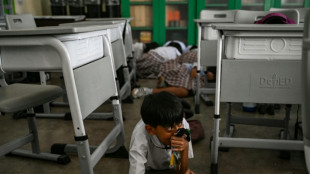
In war-torn Sudan, a school offers a second chance at education / Photo: Ebrahim Hamid - AFP/File

 Lights out in Laos as electricity exports surge

 Steven Strogatz weighs AI mathematics advances and their consequences for researchers

 Anthropic boss calls for AI slowdown, Altman and Musk agree

 French IT giant Capgemini sells subsidiary after row over ICE links

 Quebec Brokerage Qubit Insurance Announces New Data on Coverage Shortfalls as Rebuilding Costs Rise

 Lady Gaga welcomes first child with fiance: US media

 Bhutan business bets on hazelnuts for farming future

 'Widow's Bay' and 'The Pitt' are favorites for Emmys night

 Coastal erosion forces cancellation of California music festival

 Argentina's Dirty War rears its head in Venice film

 UK lawmakers throw out bill to legalise assisted dying

 US inflation steady in August, fueling Fed rate hike expectations

 New York marks 25th anniversary of 9/11 attacks

 Nepal flood reconstruction bill to be $4.78 bn: foreign ministry

 JUMO and Standard Bank launch Social Finance Framework to scale inclusive finance in Africa

 Doomsday tech: could AI really kill us all?

 French comedy show 'Call my agent' makes film comeback

 It's all coming back: Celine Dion fans gear up for Paris return

 Researchers eye AI revolution in natural disaster forecasts

 US braces for inflation report that may push Fed to hike rates

 Musk threatens legal action over documentary

 Latin America fact-check group asks Meta not to replace verification practice

 AI Risks to Enter 60–80% of Liability and Cyber Insurance Underwriting by 2028, ScienceSoft Predicts

 Tribal Launches Campfire, Letting Business and Technical Teams Build on Salesforce Together

 Stocks fall as fresh oil surge fans inflation fears

In a worn-down classroom in eastern Sudan, men and women watch attentively from a wood bench as a teacher scribbles Arabic letters on a faded blackboard.
Nodding approvingly in the corner is the school's 63-year-old founder Amna Mohamed Ahmed, known to most as "Amna Oor", which partly means lion in the Beja language of eastern Sudan.
She has spent the last three decades helping hundreds return to their education in Port Sudan, now the country's de facto capital.
The educator, who wears an orange headscarf wrapped neatly around her head, said she started the project in 1995 because of widespread illiteracy in her community.
"That's what pushed me to act. People wanted to learn -- if they didn't, they wouldn't have kept coming," she told AFP.
Ahmed's classes offer a second chance to those who missed out on formal education, particularly women who were denied schooling due to cultural or financial barriers.
- A fresh start -
For 39-year-old Nisreen Babiker, going back to school has been a long-held dream.
She left school in 2001 after marrying and taking on the responsibility of raising her younger siblings following her father's death.
"My siblings grew up and studied, and my children too," she said.
"I felt the urge to return to school. Even after all these years, it feels like I'm starting fresh," she told AFP.
Ahmed's school has also become a haven for those displaced by Sudan's ongoing conflict, which erupted in April 2023 between army chief Abdel Fattah al-Burhan and his former deputy Mohamed Hamdan Daglo, who leads the paramilitary Rapid Support Forces (RSF).
The war has killed tens of thousands, uprooted over 12 million, and driven swathes of the country into hunger and famine.
Maria Adam is among those who fled their homes after war broke out. She arrived in Port Sudan seeking safety and a better future.
"When I arrived in Port Sudan, I heard about this place and joined," said the 28-year-old, noting that she dropped out of school when she was 11.
- Changing lives -
"I want to finish my education so I can help my children," Adam told AFP.
Sudan's education system has been shattered by the conflict, with the United Nations estimating that over 90 percent of the country's 19 million school-age children now have no access to formal learning.
Across the nation, most classrooms have been converted into shelters for displaced families.
Even before the war, a 2022 Save the Children analysis ranked Sudan among the countries most at risk of educational collapse.
But the determination to learn remains strong at the Port Sudan school, where many students have gone on to enter high school and some have even graduated from university.
In one corner of the classroom, a mother joins her young son in a lesson, hoping to reshape both their futures.
"To watch someone go from not knowing how to read or write to graduating from university, getting a job, supporting their family -- that is what keeps me going," Ahmed said.
"They go from being seen as a burden to becoming productive, educated members of society," she added.
A.Levy--CPN