Mounting economic costs of India's killer smog / Photo: Money SHARMA - AFP

 Lights out in Laos as electricity exports surge

 Steven Strogatz weighs AI mathematics advances and their consequences for researchers

 Anthropic boss calls for AI slowdown, Altman and Musk agree

 French IT giant Capgemini sells subsidiary after row over ICE links

 Quebec Brokerage Qubit Insurance Announces New Data on Coverage Shortfalls as Rebuilding Costs Rise

 Lady Gaga welcomes first child with fiance: US media

 Bhutan business bets on hazelnuts for farming future

 'Widow's Bay' and 'The Pitt' are favorites for Emmys night

 Coastal erosion forces cancellation of California music festival

 Argentina's Dirty War rears its head in Venice film

 UK lawmakers throw out bill to legalise assisted dying

 US inflation steady in August, fueling Fed rate hike expectations

 New York marks 25th anniversary of 9/11 attacks

 Nepal flood reconstruction bill to be $4.78 bn: foreign ministry

 JUMO and Standard Bank launch Social Finance Framework to scale inclusive finance in Africa

 Doomsday tech: could AI really kill us all?

 French comedy show 'Call my agent' makes film comeback

 It's all coming back: Celine Dion fans gear up for Paris return

 Researchers eye AI revolution in natural disaster forecasts

 US braces for inflation report that may push Fed to hike rates

 Musk threatens legal action over documentary

 Latin America fact-check group asks Meta not to replace verification practice

 AI Risks to Enter 60–80% of Liability and Cyber Insurance Underwriting by 2028, ScienceSoft Predicts

 Tribal Launches Campfire, Letting Business and Technical Teams Build on Salesforce Together

 Stocks fall as fresh oil surge fans inflation fears

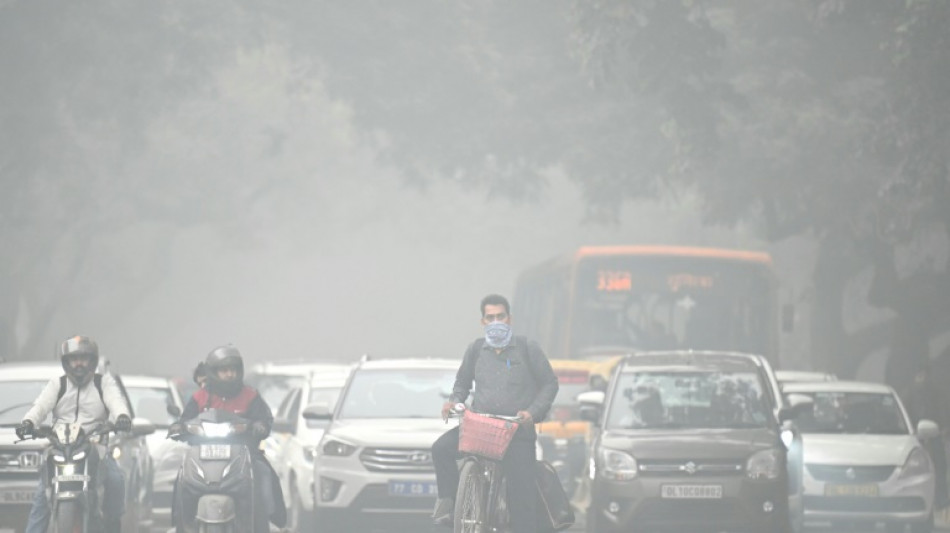
Noxious smog smothering the plains of north India is not only choking the lungs of residents and killing millions, but also slowing the country's economic growth.
India's capital New Delhi frequently ranks among the world's most polluted cities. Each winter, vehicle and factory emissions couple with farm fires from surrounding states to blanket the city in a dystopian haze.
Acrid smog this month contains more than 50 times the World Health Organization recommended limit of fine particulate matter -- dangerous cancer-causing microparticles known as PM2.5 pollutants, that enter the bloodstream through the lungs.
Experts say India's worsening air pollution is having a ruinous impact on its economy -- with one study estimating losses to the tune of $95 billion annually, or roughly three percent of the country's GDP.
The true extent of the economic price India is paying could be even greater.
"The externality costs are huge and you can't assign a value to it," said Vibhuti Garg, of the Institute for Energy Economics and Financial Analysis.
Bhargav Krishna of the Delhi-based research collective Sustainable Futures Collaborative said "costs add up in every phase".
"From missing a day at work to developing chronic illness, the health costs associated with that, to premature death and the impact that has on the family of the person," Krishna told AFP.
- 'Health and wealth hazard'-
Still, several studies have tried to quantify the damage.
One by the global consultancy firm Dalberg concluded that in 2019, air pollution cost Indian businesses $95 billion due to "reduced productivity, work absences and premature death".
The amount is nearly three percent of India's budget, and roughly twice its annual public health expenditure.
"India lost 3.8 billion working days in 2019, costing $44 billion to air pollution caused by deaths," according to the study which calculated that toxic air "contributes to 18 percent of all deaths in India".
Pollution has also had a debilitating impact on the consumer economy because of direct health-related eventualities, the study said, reducing footfall and causing annual losses of $22 billion.
The numbers are even more staggering for Delhi, the epicentre of the crisis, with the capital province losing as much as six percent of its GDP annually to air pollution.
Restaurateur Sandeep Anand Goyle called the smog a "health and wealth hazard".
"People who are health conscious avoid stepping out so we suffer," said Goyle, who heads the Delhi chapter of the National Restaurant Association of India.
Tourism has also been impacted, as the smog season coincides with the period when foreigners traditionally visit northern India -- too hot for many during the blisteringly hot summers.
"The smog is giving a bad name to India's image," said Rajiv Mehra of the Indian Association of Tour Operators.
Delhi faces an average 275 days of unhealthy air a year, according to monitors.
- 'Premature deaths' -
Piecemeal initiatives by the government -- -- that critics call half-hearted -- have failed to adequately address the problem.
Academic research indicates that its detrimental impact on the Indian economy is adding up.
A 2023 World Bank paper said that air pollution's "micro-level" impacts on the economy translate to "macro-level effects that can be observed in year-to-year changes in GDP".
The paper estimates that India's GDP would have been 4.5 percent higher at the end of 2023, had the country managed to curb pollution by half in the previous 25 years.
Another study published in the Lancet health journal on the direct health impacts of air pollution in 2019 estimated an annual GDP deceleration of 1.36 percent due to "lost output from premature deaths and morbidity".
Desperate emergency curbs -- such as shuttering schools to reduce traffic emissions as well as banning construction -- come with their own economic costs.
"Stopping work for weeks on end every winter makes our schedules go awry, and we end up overshooting budgets," said Sanjeev Bansal, the chairman of the Delhi unit of the Builders Association of India.
Pollution's impact on the Indian economy is likely to get worse if action is not taken.
With India's median age expected to rise to 32 by 2030, the Dalberg study predicts that "susceptibility to air pollution will increase, as will the impact on mortality".
H.Müller--CPN