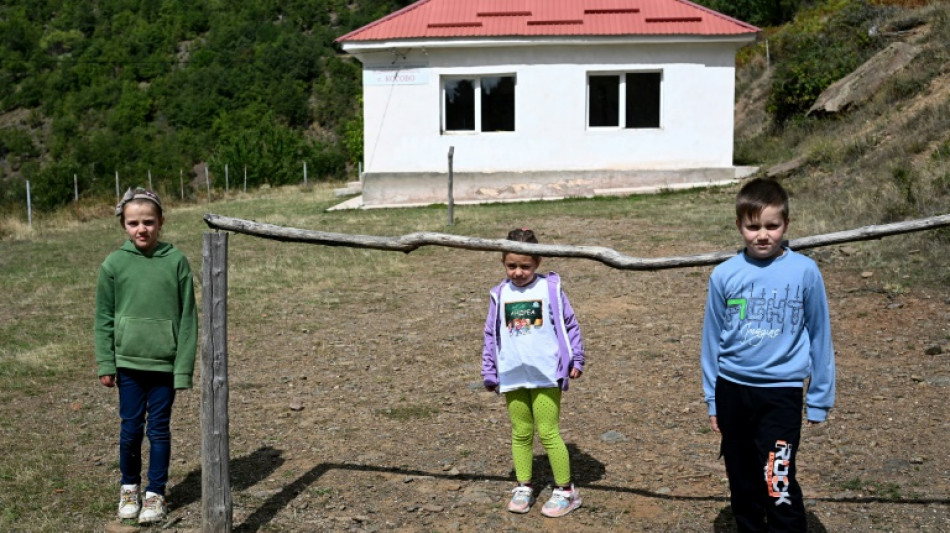
Rural schools empty in North Macedonia due to exodus / Photo: Robert ATANASOVSKI - AFP

 Lights out in Laos as electricity exports surge

 Steven Strogatz weighs AI mathematics advances and their consequences for researchers
 Anthropic boss calls for AI slowdown, Altman and Musk agree

 French IT giant Capgemini sells subsidiary after row over ICE links

 Quebec Brokerage Qubit Insurance Announces New Data on Coverage Shortfalls as Rebuilding Costs Rise

 Lady Gaga welcomes first child with fiance: US media

 Bhutan business bets on hazelnuts for farming future

 'Widow's Bay' and 'The Pitt' are favorites for Emmys night

 Coastal erosion forces cancellation of California music festival

 Argentina's Dirty War rears its head in Venice film

 UK lawmakers throw out bill to legalise assisted dying

 US inflation steady in August, fueling Fed rate hike expectations

 New York marks 25th anniversary of 9/11 attacks

 Nepal flood reconstruction bill to be $4.78 bn: foreign ministry

 JUMO and Standard Bank launch Social Finance Framework to scale inclusive finance in Africa

 Doomsday tech: could AI really kill us all?

 French comedy show 'Call my agent' makes film comeback

 It's all coming back: Celine Dion fans gear up for Paris return

 Researchers eye AI revolution in natural disaster forecasts

 US braces for inflation report that may push Fed to hike rates

 Musk threatens legal action over documentary

 Latin America fact-check group asks Meta not to replace verification practice

 AI Risks to Enter 60–80% of Liability and Cyber Insurance Underwriting by 2028, ScienceSoft Predicts

 Tribal Launches Campfire, Letting Business and Technical Teams Build on Salesforce Together

 Stocks fall as fresh oil surge fans inflation fears

Teacher Zarko Blazevski spends nearly an hour crossing empty mountain passes to reach his remote school with only three students in North Macedonia.
With a spiralling population decline, enrolments have plummeted and the future of schools such as the one where Blazevski has taught for nearly a decade is uncertain.
Located in the village of Kosovo -- which shares the same name as the neighbouring Balkan nation to the north -- Blazevski has however seen only the smallest fluctuations in numbers in the school.
"We first had four, later nine, which was the highest number. And now we have three students," Blazevski told AFP.
Since declaring independence in 1991, North Macedonia has seen vast chunks of its people emigrating amid a stagnating economy.
According to the last census conducted in 2021, it has just 1.8 million inhabitants, a drop of nearly 10 percent in less than two decades.
A report published in September by the Center for Civil Communications NGO said elementary schools have lost some 10,000 pupils in the past decade.
"The decrease of the number of students is especially seen in secondary education where in 10 years the number of students dropped by 20 percent," said the report, based on figures from the national statistical office.
The decline covers both rural communities and urban areas.
North Macedonia's new government, which was elected in June, has pledged to tackle this but it is an uphill task.
Led by the right-wing VMRO-DPMNE party, the government has created a ministry for social policy, demography and youth but has not spelt out how it plans to stem the exodus.
- No children, no future -
The effects are most visible in the countryside.
Abandoned villages and crumbling homes dot the mountainous landscape, where summer forest fires are often allowed to rage as they do not threaten inhabited areas.
At the remaining village and town schools, education officials are often faced with the difficult decision of whether to close, thereby forcing pupils to take lengthy commutes.
"It means a lot to them because they have school close to their home, they do not need to travel and at the same time they have their family near them," Blazevski says.
In Brest, just eight kilometres (five miles) south of Kosovo village, Jasmina Kuzmanovska runs a ramshackle school with only two students.
"I think there will be no other children in the village for the school to continue," Kuzmanovska said.
Kuzmanovska and others like her face the additional challenge of teaching children of a variety of ages in a single classroom, with different courses at different levels.
During one school year, she had seven students spread across five age groups.
"First I worked with one class, then another... that's how we managed the work," she told AFP.
Education Minister Vesna Janevska announced new plans to merge schools with small numbers of students but has yet to announce a start date.
But closing schools in places like Brest and Kosovo may signal the beginning of the end of their villages, warn educators.
"It would be great if these students, even though there are not many left, at least get to study until fifth grade where they are born," said Toni Stavreski, a school administrator in nearby Makedonski Brod.
"That will also help these villages to continue existing."
Y.Tengku--CPN