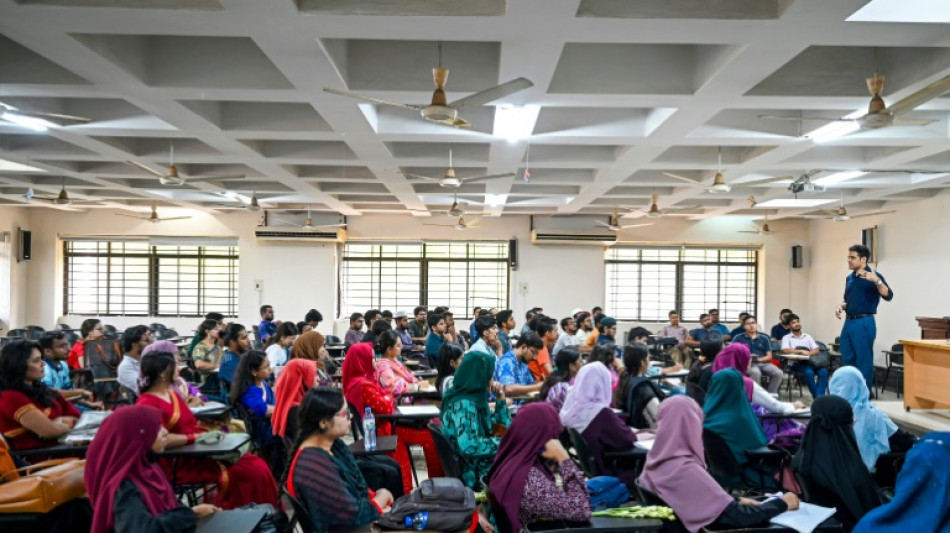
Classes resume at Bangladesh university at heart of protests / Photo: Munir UZ ZAMAN - AFP

 Lights out in Laos as electricity exports surge

 Steven Strogatz weighs AI mathematics advances and their consequences for researchers

 Anthropic boss calls for AI slowdown, Altman and Musk agree

 French IT giant Capgemini sells subsidiary after row over ICE links

 Quebec Brokerage Qubit Insurance Announces New Data on Coverage Shortfalls as Rebuilding Costs Rise

 Lady Gaga welcomes first child with fiance: US media

 Bhutan business bets on hazelnuts for farming future

 'Widow's Bay' and 'The Pitt' are favorites for Emmys night

 Coastal erosion forces cancellation of California music festival

 Argentina's Dirty War rears its head in Venice film

 UK lawmakers throw out bill to legalise assisted dying

 US inflation steady in August, fueling Fed rate hike expectations

 New York marks 25th anniversary of 9/11 attacks

 Nepal flood reconstruction bill to be $4.78 bn: foreign ministry

 JUMO and Standard Bank launch Social Finance Framework to scale inclusive finance in Africa

 Doomsday tech: could AI really kill us all?

 French comedy show 'Call my agent' makes film comeback

 It's all coming back: Celine Dion fans gear up for Paris return

 Researchers eye AI revolution in natural disaster forecasts

 US braces for inflation report that may push Fed to hike rates

 Musk threatens legal action over documentary

 Latin America fact-check group asks Meta not to replace verification practice

 AI Risks to Enter 60–80% of Liability and Cyber Insurance Underwriting by 2028, ScienceSoft Predicts

 Tribal Launches Campfire, Letting Business and Technical Teams Build on Salesforce Together

 Stocks fall as fresh oil surge fans inflation fears

Students returned to classes at Bangladesh's Dhaka University on Sunday after a weeks-long shutdown sparked by a student-led uprising that toppled autocratic prime minister Sheikh Hasina.
Tens of thousands demonstrated on campus and in the surrounding Shahbagh neighbourhood as protests against job quotas morphed into a nationwide struggle to end Hasina's 15 years of iron-fisted rule.
As the protests swelled in July, authorities shuttered the campus as part of a crackdown on the demonstrations that killed hundreds.
Several of the top student protest leaders were enrolled at the university, some of whom were snatched by plainclothes police and held in custody for several days.
On Sunday the lecture halls were full again, with students chatting in groups along tree-covered walkways and buying drinks and snacks at canteens.
"I feel so much better coming back to class after a long time," said Arpita Das, who studies political science.
"It was like a new students' reception as our teacher welcomed us in class with flowers."
Das said she was present during a pitched battle on campus in July, when protesters and students backing Hasina's Awami League party fought each other with rocks, sticks and iron rods.
"We were used to the routine of going to classes, study and exams," she said.
"We were in so much uncertainty about whether we could resume class again and complete our studies," she added.
Classes had started again in all but four or five departments said assistant proctor Mohammad Mahbub Quaisar, who was appointed after previous administrators loyal to Hasina resigned.
"Students are attending in a joyous mood," he said.
Hasina's government was accused of widespread abuses, including the mass detention and extrajudicial killing of political rivals.
More than 600 people were killed in the weeks leading up to Hasina's ouster in early August, according to a preliminary United Nations report that said the toll was "likely an underestimate".
Since her departure for exile in neighbouring India, cabinet ministers and other senior members of Hasina's party have been arrested, and her government's appointees have been purged from courts and the central bank.
In the leafy streets of the Shahbagh neighbourhood, colourful new murals exhort the public to "destroy the iron doors of prison" and celebrate Bangladesh's "rebirth".
"It was like we were in an oppressive era when we could not say anything," said masters student Kalimulla Al Kafi, 25, of the crackdown ordered by Hasina.
"Today it feels like I am attending classes with freedom."
"We can express ourselves freely."
P.Gonzales--CPN