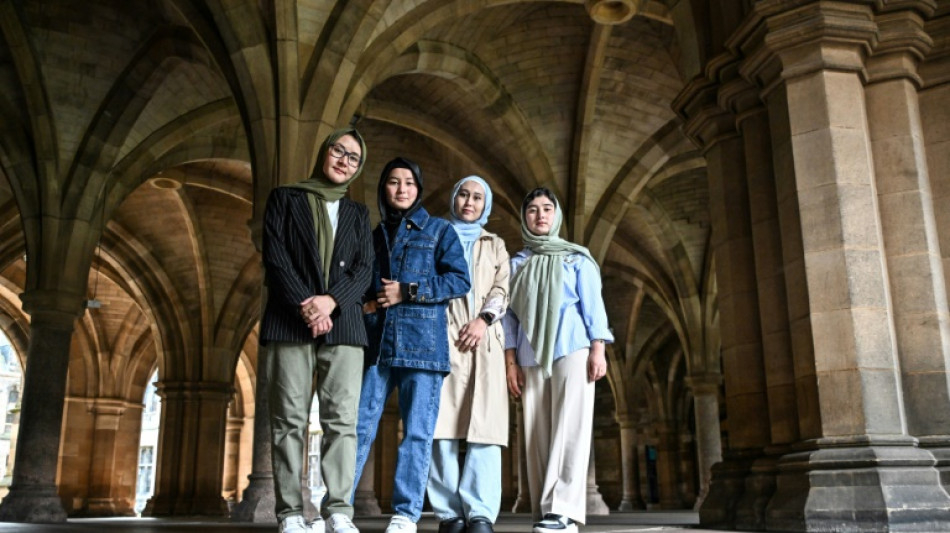
Afghan women continue medical studies in Scotland after Taliban ban / Photo: Andy Buchanan - AFP

 Lights out in Laos as electricity exports surge

 Steven Strogatz weighs AI mathematics advances and their consequences for researchers

 Anthropic boss calls for AI slowdown, Altman and Musk agree

 French IT giant Capgemini sells subsidiary after row over ICE links

 Quebec Brokerage Qubit Insurance Announces New Data on Coverage Shortfalls as Rebuilding Costs Rise

 Lady Gaga welcomes first child with fiance: US media

 Bhutan business bets on hazelnuts for farming future

 'Widow's Bay' and 'The Pitt' are favorites for Emmys night

 Coastal erosion forces cancellation of California music festival

 Argentina's Dirty War rears its head in Venice film

 UK lawmakers throw out bill to legalise assisted dying

 US inflation steady in August, fueling Fed rate hike expectations

 New York marks 25th anniversary of 9/11 attacks

 Nepal flood reconstruction bill to be $4.78 bn: foreign ministry

 JUMO and Standard Bank launch Social Finance Framework to scale inclusive finance in Africa

 Doomsday tech: could AI really kill us all?

 French comedy show 'Call my agent' makes film comeback

 It's all coming back: Celine Dion fans gear up for Paris return

 Researchers eye AI revolution in natural disaster forecasts

 US braces for inflation report that may push Fed to hike rates

 Musk threatens legal action over documentary

 Latin America fact-check group asks Meta not to replace verification practice

 AI Risks to Enter 60–80% of Liability and Cyber Insurance Underwriting by 2028, ScienceSoft Predicts

 Tribal Launches Campfire, Letting Business and Technical Teams Build on Salesforce Together

 Stocks fall as fresh oil surge fans inflation fears

When the Taliban banned women from attending university in Afghanistan, Zahra Hussaini thought her dream of becoming a doctor was over. Now, she is continuing her medical degree in Britain.
"Coming to Scotland, it changed everything. It has given me hope for a better future," the 20-year-old told AFP in Glasgow, where she arrived last month to resume her studies.
"I can become a doctor, I can become independent financially and I can serve my family, my community to the best of my ability," she added.
Hussaini is one of 19 female medical students from Afghanistan who landed in Scotland on August 21 following a three-year campaign by the Linda Norgrove Foundation.
Norgrove was a 36-year-old Scottish aid worker who was kidnapped by Islamist militants in Afghanistan and killed during a failed rescue attempt by US special forces in 2010.
The foundation, formed by her parents in her name, said that the students had often been confined to their homes since the Taliban issued its ban on women studying at universities in December 2022.
The Taliban authorities have implemented an austere interpretation of Islamic law since returning to power in Afghanistan in August 2021 following the withdrawal of US forces.
Women have borne the brunt of restrictions that the United Nations has labelled "gender apartheid".
"They didn't allow me to get my specialisation in Afghanistan," said 25-year-old medical student Fariba Asifi, who is also now studying at Glasgow University.
"Now I consider I am the luckiest person that I am here and I can continue my education and I achieve this opportunity to continue my education and follow my dream. I'm so excited and I'm really happy."
The woman arrived in Scotland after the devolved Scottish government in Edinburgh amended funding legislation to ensure that they would be treated like Scottish students and be eligible for free tuition.
Some are studying at St Andrews, Dundee and Aberdeen.
The foundation said it had to clear a number of hurdles for the women to make it to Scotland, including negotiating travel to Pakistan to apply for UK visas, organising English language tests and university interviews over Skype.
It also secured accommodation and UK bank accounts and said it had spent £60,000 ($79,000) in all.
"Finally, these 19 incredibly talented young women get their future back with the opportunity of a tremendous education and a career. The alternative for them in Afghanistan wasn't good," Linda's father John Norgove said in a statement.
Asifi said she hoped to be able to return to Afghanistan to work as a doctor one day.
"It's not a permanent situation, it's temporary, it will change and one day we will have a bright Afghanistan, a peaceful country.
"And one day, I'm pretty sure we will see all girls, all ladies can do, can get education, get working and getting their fun. And we should be optimistic we will have a bright Afghanistan. It's near."
video-pdh/phz/yad
O.Hansen--CPN