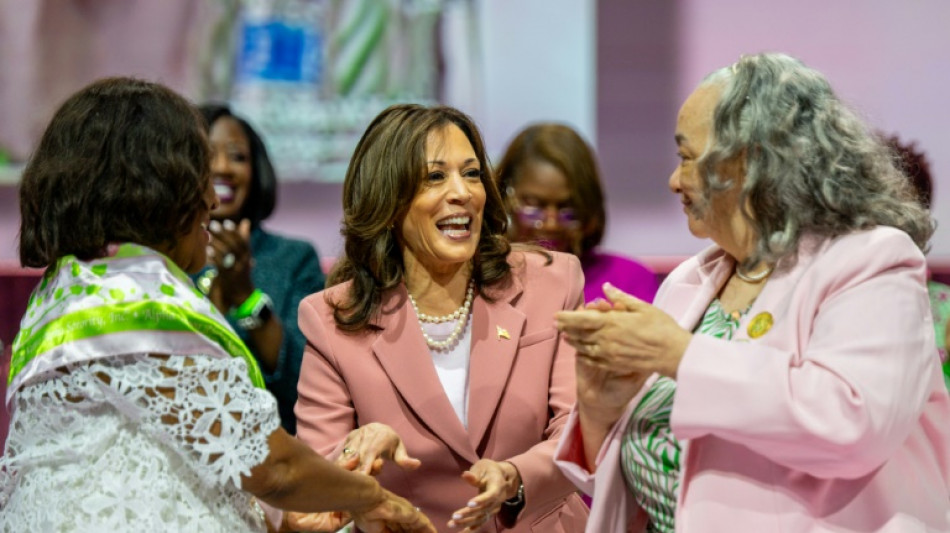
Black sororities could be key advantage for Harris campaign / Photo: Brandon Bell - GETTY IMAGES NORTH AMERICA/AFP/File

 Lights out in Laos as electricity exports surge

 Steven Strogatz weighs AI mathematics advances and their consequences for researchers

 Anthropic boss calls for AI slowdown, Altman and Musk agree

 French IT giant Capgemini sells subsidiary after row over ICE links

 Quebec Brokerage Qubit Insurance Announces New Data on Coverage Shortfalls as Rebuilding Costs Rise

 Lady Gaga welcomes first child with fiance: US media

 Bhutan business bets on hazelnuts for farming future

 'Widow's Bay' and 'The Pitt' are favorites for Emmys night

 Coastal erosion forces cancellation of California music festival

 Argentina's Dirty War rears its head in Venice film

 UK lawmakers throw out bill to legalise assisted dying

 US inflation steady in August, fueling Fed rate hike expectations

 New York marks 25th anniversary of 9/11 attacks

 Nepal flood reconstruction bill to be $4.78 bn: foreign ministry

 JUMO and Standard Bank launch Social Finance Framework to scale inclusive finance in Africa

 Doomsday tech: could AI really kill us all?

 French comedy show 'Call my agent' makes film comeback

 It's all coming back: Celine Dion fans gear up for Paris return

 Researchers eye AI revolution in natural disaster forecasts

 US braces for inflation report that may push Fed to hike rates

 Musk threatens legal action over documentary

 Latin America fact-check group asks Meta not to replace verification practice

 AI Risks to Enter 60–80% of Liability and Cyber Insurance Underwriting by 2028, ScienceSoft Predicts

 Tribal Launches Campfire, Letting Business and Technical Teams Build on Salesforce Together

 Stocks fall as fresh oil surge fans inflation fears

As Kamala Harris heads into the November presidential race against Donald Trump, a social club she joined in college four decades ago might just pay its biggest dividends yet.
"Whatever it is that she needs our coalitions to do, we're going to be there to help push it out and get it done," said Tanya Baham, a member of Harris's college sorority, in attendance at the recent Democratic National Convention.
Sororities and fraternities abound across US college campuses -- with their Greek-letter names, exclusive memberships, and promise of community, usually along same-sex lines.
But Harris's membership in Alpha Kappa Alpha, a historically Black sorority, provides her campaign a direct line to a network of 360,000 women across the country, many of whom are excited to see one of their own in the White House.
And the Democratic Party, which counts women and Black voters as key constituencies in their electoral base, is paying attention.
While the sorority itself is non-partisan, many, like Baham, are ready to individually tap their networks for fundraising and voter registration in an election that could come down to the wire.
"We're... going to make certain that our kiddos, the young folks, the old folks, get a chance to register and then get to the polls," said Baham, a social worker in Louisiana.
- Built-in network -
Harris joined AKA at Howard University, a historically Black school in Washington where the sorority was founded in 1908 -- the first such organization for Black undergraduate women in the United States.
Over the next few decades, more Black sororities and fraternities emerged, providing African American students refuge amid the scourge of American racism and also serving as bases for civil rights organizing.
AKA has chapters for both undergraduate students and college graduates, making it far more than just a college-level organization.
As vice president, Harris has hosted Black sorority and fraternity leaders at the White House, and ahead of rising to the top of the Democratic ticket she headlined AKA's convention in Texas, in July.
Later that month, within days of President Joe Biden ending his reelection bid, she was at a convention for another Black sorority, Zeta Phi Beta, in Indiana.
AKA members were among those on a "Win With Black Women" Zoom call which raised $1.5 million, and Glenda Glover, the sorority's former president, is leading outreach for Harris at the country's historically Black colleges.
In a historic first, AKA has alo formed a political action committee, used for fundraising for political candidates.
"We're just all ready to work and do this," Donna Miller, a county official in Illinois who was on the Zoom call, told the Chicago Sun-Times. "It invigorated so many people from young and old, across generations, across ethnicity."
- Tight-lipped -
But while AKA and other Black sororities provide a network for Harris to tap into, it is hard to gauge how much that will translate into actual votes come November.
The sorority and its members have generally been tight-lipped -- multiple members declined to speak with AFP about the election.
Some referred AFP to the sorority's headquarters, which did not respond to multiple requests for comment. A half dozen individual chapters also did not respond to requests for comment.
"Mobilization through sororities can't hurt," said Daniel Hopkins, a political scientist at the University of Pennsylvania.
But Hopkins cautioned that "there are only so many voters in the US in general who attend four-year colleges, who are members of these organizations."
And while African Americans are overwhelmingly Democratic voters, they have been peeling off from the party in recent years -- a decline that has mostly come from younger and infrequent voters, according to his research.
At the same time, Amanda Wilkerson, an assistant professor of higher education at the University of Central Florida who has studied Black voters, said organizations like Black sororities and fraternities are "hidden apparatuses," often ignored by polling or the media even as they've organized for previous elections, both nationally and locally.
Their members and alumni are well-versed in campaigning, she said, and the 2024 election isn't their first go-around.
Harris "is the first candidate of her kind to be able to leverage those networks of support," Wilkerson said. "But it's not altogether new."
S.F.Lacroix--CPN