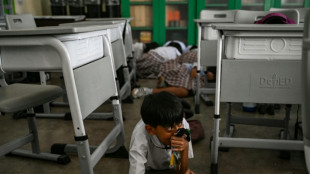
1.4 mn girls banned from Afghan schools since Taliban return: UNESCO / Photo: Sanaullah SEIAM - AFP

 Lights out in Laos as electricity exports surge

 Steven Strogatz weighs AI mathematics advances and their consequences for researchers

 Anthropic boss calls for AI slowdown, Altman and Musk agree

 French IT giant Capgemini sells subsidiary after row over ICE links

 Quebec Brokerage Qubit Insurance Announces New Data on Coverage Shortfalls as Rebuilding Costs Rise

 Lady Gaga welcomes first child with fiance: US media

 Bhutan business bets on hazelnuts for farming future

 'Widow's Bay' and 'The Pitt' are favorites for Emmys night

 Coastal erosion forces cancellation of California music festival

 Argentina's Dirty War rears its head in Venice film

 UK lawmakers throw out bill to legalise assisted dying

 US inflation steady in August, fueling Fed rate hike expectations

 New York marks 25th anniversary of 9/11 attacks

 Nepal flood reconstruction bill to be $4.78 bn: foreign ministry

 JUMO and Standard Bank launch Social Finance Framework to scale inclusive finance in Africa

 Doomsday tech: could AI really kill us all?

 French comedy show 'Call my agent' makes film comeback

 It's all coming back: Celine Dion fans gear up for Paris return

 Researchers eye AI revolution in natural disaster forecasts

 US braces for inflation report that may push Fed to hike rates

 Musk threatens legal action over documentary

 Latin America fact-check group asks Meta not to replace verification practice

 AI Risks to Enter 60–80% of Liability and Cyber Insurance Underwriting by 2028, ScienceSoft Predicts

 Tribal Launches Campfire, Letting Business and Technical Teams Build on Salesforce Together

 Stocks fall as fresh oil surge fans inflation fears

At least 1.4 million girls in Afghanistan have been denied access to secondary education since the Taliban returned to power in 2021, with the future of an entire generation now "in jeopardy", the United Nations' cultural agency said Thursday.
Access to primary education has also fallen sharply, with 1.1 million fewer girls and boys attending school, UNESCO said in a statement as the Taliban authorities marked three years since retaking Afghanistan on August 15, 2021.
"UNESCO is alarmed by the harmful consequences of this increasingly massive drop-out rate, which could lead to a rise in child labour and early marriage," the agency said.
"In just three years, the de facto authorities have almost wiped out two decades of steady progress for education in Afghanistan, and the future of an entire generation is now in jeopardy."
There are now nearly 2.5 million girls deprived of their right to education, representing 80 percent of Afghan school-age girls, the UN agency said.
The Taliban administration, which is not recognised by any other country, has imposed restrictions on women that the UN has described as "gender apartheid."
Afghanistan is the only country in the world to stop girls and women attending secondary schools and universities.
"As a result of bans imposed by the de facto authorities, at least 1.4 million girls have been deliberately denied access to secondary education since 2021," UNESCO said.
This represents an increase of 300,000 since the previous count carried out by the UN agency in April 2023.
UNESCO Director General Audrey Azoulay urged the international community to remain mobilised "to obtain the unconditional reopening of schools and universities to Afghan girls and women."
The number of primary pupils has also fallen. Afghanistan had only 5.7 million girls and boys in primary school in 2022, compared with 6.8 million in 2019, UNESCO said.
The UN agency blamed the drop on the authorities' decision to ban female teachers from teaching boys as well as the lack of incentive for parents to send children to school.
Enrolment in higher education in equally concerning, the statement said, adding that the number of university students had decreased by 53 percent since 2021.
"As a result, the country will rapidly face a shortage of graduates trained for the most highly-skilled jobs, which will only exacerbate development problems," UNESCO said.
M.P.Jacobs--CPN