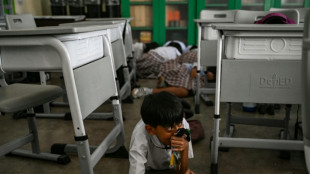
Chinese kindergartens pivot to senior care as population ages / Photo: Adek BERRY - AFP

 Lights out in Laos as electricity exports surge

 Steven Strogatz weighs AI mathematics advances and their consequences for researchers

 Anthropic boss calls for AI slowdown, Altman and Musk agree

 French IT giant Capgemini sells subsidiary after row over ICE links

 Quebec Brokerage Qubit Insurance Announces New Data on Coverage Shortfalls as Rebuilding Costs Rise

 Lady Gaga welcomes first child with fiance: US media

 Bhutan business bets on hazelnuts for farming future

 'Widow's Bay' and 'The Pitt' are favorites for Emmys night

 Coastal erosion forces cancellation of California music festival

 Argentina's Dirty War rears its head in Venice film

 UK lawmakers throw out bill to legalise assisted dying

 US inflation steady in August, fueling Fed rate hike expectations

 New York marks 25th anniversary of 9/11 attacks

 Nepal flood reconstruction bill to be $4.78 bn: foreign ministry

 JUMO and Standard Bank launch Social Finance Framework to scale inclusive finance in Africa

 Doomsday tech: could AI really kill us all?

 French comedy show 'Call my agent' makes film comeback

 It's all coming back: Celine Dion fans gear up for Paris return

 Researchers eye AI revolution in natural disaster forecasts

 US braces for inflation report that may push Fed to hike rates

 Musk threatens legal action over documentary

 Latin America fact-check group asks Meta not to replace verification practice

 AI Risks to Enter 60–80% of Liability and Cyber Insurance Underwriting by 2028, ScienceSoft Predicts

 Tribal Launches Campfire, Letting Business and Technical Teams Build on Salesforce Together

 Stocks fall as fresh oil surge fans inflation fears

Senior citizens sway to old-time tunes at a former kindergarten in northern China, as educators turn their sights away from children in the face of a rapidly ageing population and a baby bust.
Hundreds of millions of Chinese are set to enter old age in the coming decades while the country's chronically low birth rate leaves ever fewer people to replace them, official statistics show.
The crisis is already hitting the education sector, with thousands of preschools closing around the country as enrollments dry up.
But others are changing with the times -- such as a facility in Shanxi province, which has traded chortling children for a more mature cohort.
"(The problem) became particularly evident as the number of children continued to decrease," principal Li Xiuling, 56, told AFP.
"After my kindergarten emptied out, I thought about how to make the best use of it," she said.
Li's preschool was founded in 2005 and once served as many as 280 children, but closed last year.
It reopened in December as Impressions of Youth, a recreational centre for people of retirement age and above.
The space in the provincial capital Taiyuan boasts around 100 adult learners of music, dance, modelling and other subjects.
"It's quite a progressive idea," Li said. "They come to fulfil some of the dreams they had when they were young."
- 'I'm young again' -
On a rainy morning this month, a modelling instructor led a line of immaculately coiffed older women as they sashayed around the classroom in traditional cheongsam dresses and pink oil-paper parasols.
In another class, students sat in a semicircle beating African drums in time to soaring socialist songs.
He Ying, 63, said joining the centre had helped her overcome a post-retirement lack of confidence and meet new friends.
"I used to feel that my cultural life... was very impoverished, that there wasn't much meaning in going on living," she told AFP.
"(People here) are not just waiting to grow old."
Nearly 15,000 kindergartens closed in China last year as enrollments plunged by 5.3 million compared to 2022, according to government data.
In dusty, industrial Shanxi –- where the overall population is falling –- there were 78,000 more deaths than births last year.
The centre bears traces of its past, with bunkbeds and dinky writing desks lining the colourfully decorated walls of former classrooms.
For Yan Xi, who used to teach at the kindergarten but now leads classes for retirees, the shift has taken some getting used to.
"Little kids just believe whatever you say, but the elderly... have their own ways," she said.
"I have to think harder about how to communicate with them," Yan told AFP.
Several other facilities across China have found success by pivoting from preschool to senior education, according to local news reports.
Student Sun Linzhi, 56, said they met "a need for universities for the elderly".
Since joining the centre in Taiyuan, "I feel like I'm young again," she told AFP.
- 'Silver economy' -
China saw a significant rise in the senior population last year, adding nearly 17 million people aged 60 and above, according to official statistics.
That age group already makes up more than 20 percent of the population, a proportion that is expected to rise to nearly a third by 2035, according to the Economist Intelligence Unit, a research group.
Beijing plans to introduce a "relatively sound" national elderly care system by 2025, but the country lacks nursing homes and faces wide regional disparities in coverage.
Top leaders will likely discuss the future of what they call the "silver economy" at a key economic meeting in the capital next week.
The government estimates that products and services catering to the elderly -- from senior-friendly tourism to technology-driven medical care -- could be worth 30 trillion yuan ($4.13 trillion) by 2035.
But it has struggled to revive the plummeting birth rate, a major driver of China's mismatched demographics.
Li, the principal, said she felt nostalgic for the days when her school teemed with boisterous kids.
"I was very emotionally invested in it," she said, gesturing towards the disused bunks and desks. "We kept those as a kind of memento."
H.Müller--CPN