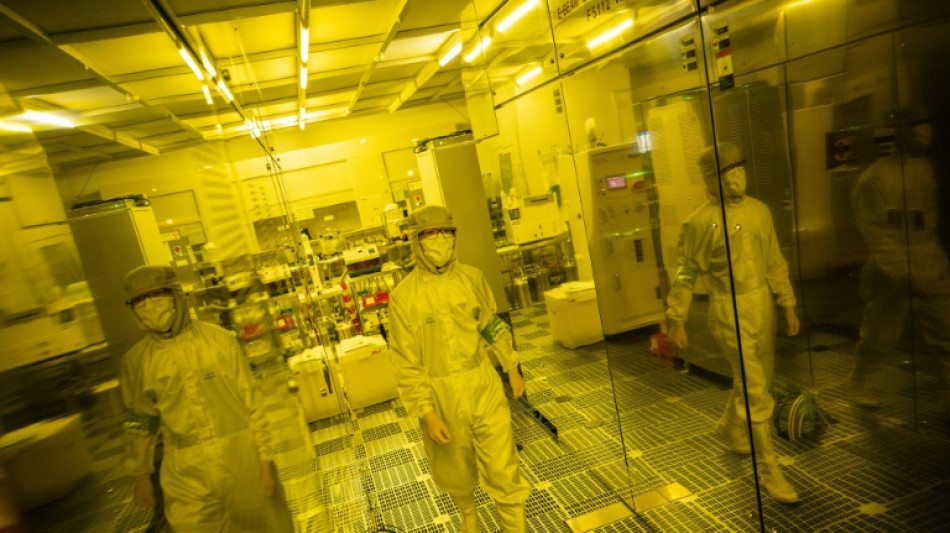
Inside a semiconductor 'clean room' at Japan's top university / Photo: Yuichi YAMAZAKI - AFP

 Lights out in Laos as electricity exports surge

 Steven Strogatz weighs AI mathematics advances and their consequences for researchers

 Anthropic boss calls for AI slowdown, Altman and Musk agree

 French IT giant Capgemini sells subsidiary after row over ICE links

 Quebec Brokerage Qubit Insurance Announces New Data on Coverage Shortfalls as Rebuilding Costs Rise

 Lady Gaga welcomes first child with fiance: US media

 Bhutan business bets on hazelnuts for farming future

 'Widow's Bay' and 'The Pitt' are favorites for Emmys night

 Coastal erosion forces cancellation of California music festival

 Argentina's Dirty War rears its head in Venice film

 UK lawmakers throw out bill to legalise assisted dying

 US inflation steady in August, fueling Fed rate hike expectations

 New York marks 25th anniversary of 9/11 attacks

 Nepal flood reconstruction bill to be $4.78 bn: foreign ministry

 JUMO and Standard Bank launch Social Finance Framework to scale inclusive finance in Africa

 Doomsday tech: could AI really kill us all?

 French comedy show 'Call my agent' makes film comeback

 It's all coming back: Celine Dion fans gear up for Paris return

 Researchers eye AI revolution in natural disaster forecasts

 US braces for inflation report that may push Fed to hike rates

 Musk threatens legal action over documentary

 Latin America fact-check group asks Meta not to replace verification practice

 AI Risks to Enter 60–80% of Liability and Cyber Insurance Underwriting by 2028, ScienceSoft Predicts

 Tribal Launches Campfire, Letting Business and Technical Teams Build on Salesforce Together

 Stocks fall as fresh oil surge fans inflation fears

To study semiconductors at Japan's top university, first you need the right clothes -- protective overalls, shoe covers, plastic gloves and a lightweight balaclava to keep your hair out of the way.
Then, surgical mask in place, you step inside an "air shower" to remove all the dust from your body that could potentially contaminate the precision equipment.
Now, you are ready to enter the University of Tokyo's clean room, a highly controlled space where microchips are handled.
Clean rooms, a vital part of semiconductor factories, are also found at such universities, where aspiring tech innovators conduct research.
Chips are an indispensable part of the modern economy, used in everything from smartphones to cars and weapons.
That has made them politically sensitive, with the industry frequently caught in the crossfire as the United States and China tussle over access to advanced tech.
Japan is also ramping up its efforts to revive its once-world-leading chip industry: the government has promised up to $25 billion in subsidies to help triple sales of domestically produced chips by 2030.
Taiwanese chip behemoth TSMC opened a semiconductor factory in southern Japan in February and is planning a second facility for more advanced chips.
And a multi-billion-dollar joint venture called Rapidus, involving Sony, Toyota, IBM and others, aims to mass produce next-generation logic chips in Japan from 2027.
Chip expert and University of Tokyo professor Tadahiro Kuroda said Japan's push into a sector where it was once dominant feels like "spring has returned".
At the university's 600 square-metre (6,500 square-foot) chip lab, filled with cutting-edge machines, students use tweezers to handle the delicate materials.
With pipettes, they drip a red liquid chemical onto gleaming, pristine silicon wafers designed to contain a dizzying number of tiny transistors.
PhD student Kei Misumi, 27, who regularly works in the clean room, told AFP he hopes such advanced technology will further enrich people's lives.
X.Wong--CPN