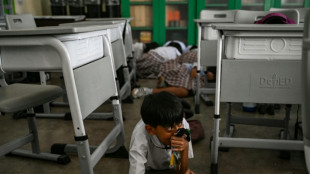
Kids study in overheated slum as Philippines shuts schools / Photo: Ted ALJIBE - AFP

 Lights out in Laos as electricity exports surge

 Steven Strogatz weighs AI mathematics advances and their consequences for researchers
 Anthropic boss calls for AI slowdown, Altman and Musk agree

 French IT giant Capgemini sells subsidiary after row over ICE links

 Quebec Brokerage Qubit Insurance Announces New Data on Coverage Shortfalls as Rebuilding Costs Rise

 Lady Gaga welcomes first child with fiance: US media

 Bhutan business bets on hazelnuts for farming future

 'Widow's Bay' and 'The Pitt' are favorites for Emmys night

 Coastal erosion forces cancellation of California music festival

 Argentina's Dirty War rears its head in Venice film

 UK lawmakers throw out bill to legalise assisted dying

 US inflation steady in August, fueling Fed rate hike expectations

 New York marks 25th anniversary of 9/11 attacks

 Nepal flood reconstruction bill to be $4.78 bn: foreign ministry

 JUMO and Standard Bank launch Social Finance Framework to scale inclusive finance in Africa

 Doomsday tech: could AI really kill us all?

 French comedy show 'Call my agent' makes film comeback

 It's all coming back: Celine Dion fans gear up for Paris return

 Researchers eye AI revolution in natural disaster forecasts

 US braces for inflation report that may push Fed to hike rates

 Musk threatens legal action over documentary

 Latin America fact-check group asks Meta not to replace verification practice

 AI Risks to Enter 60–80% of Liability and Cyber Insurance Underwriting by 2028, ScienceSoft Predicts

 Tribal Launches Campfire, Letting Business and Technical Teams Build on Salesforce Together

 Stocks fall as fresh oil surge fans inflation fears

Fourth-grader Ella Araza sat on a tiny plastic box in her Manila slum home, trying to finish her homework before the afternoon sun sent temperatures soaring to unbearable levels.
The Philippines shut down more than 47,000 schools nationwide from Monday, as the temperature in Manila crossed a record high, clocking 38.8 degrees Celsius (101.4 degrees Fahrenheit) at the weekend.
Over 7,000 were still closed on Thursday, including 10-year-old Ella's elementary school in the capital.
Many schools in the tropical country have no air conditioning and students must sweat it out in poorly ventilated classrooms but conditions at Baseco, Manila's infamous docklands slum, are even more desperate.
"The heat makes her lazy. Sometimes she fails to do her online homework," Ella's mother Cindella Manabat, 29, told AFP from the slum community that houses 65,000 residents inside half a square kilometre (124 acres).
In their tiny one-room dwelling, Ella squints at her mother's cell phone to decipher the day's lesson, which her teacher posts online.
The apartment, which has no running water, must be kept dark because Ella's younger brother, Prince, suffers from cerebral palsy and could be hit by an epileptic seizure.
Several doors down, sixth-grader Jalian Mangampo and her younger brother Sherwin lie on their shared single bed and try to finish their schoolwork on mobile phones.
-- More days of extreme heat --
The online lessons do not come cheap -- the siblings have to drop five pesos (nine US cents) into a neighbour's WiFi vending machine to gain three hours of internet access.
Their widowed mother, shopkeeper Richel Mangampo, 43, took on a high-interest loan to buy them an 8,500-peso ($148) mobile phone. A stranger earlier gifted the siblings another phone.
"The heat is terrible because the ceiling is so low," the mother said, pointing to the corrugated iron roofing that she has partly covered with a scrap of plywood to keep the heat at bay.
"We have to step outside from time to time just to be able to breathe."
But she does not allow her children to stay out too long because the blazing sun is not the only danger in Baseco.
"Out of nowhere youths armed with broken bottles would be going at each other after getting high sniffing glue," she said.
The state weather service has warned the extreme heat will persist for the next two weeks at least, meaning the students could be mostly stuck at home before the school year ends on May 31.
-- 'Prickly heat rash' --
Mangampo said she has her children bathe twice daily, once in the morning and a second before bedtime.
"It's so hot they have difficulty falling asleep," Mangampo said.
Manabat said Ella often complains because the family has just one electric fan that must be shared at night.
The mother and her three kids, including a year-old baby, sleep on the bed while her boyfriend, a house decorator, sleeps in his boxers on the floor. The front door stays open for ventilation.
"She (daughter) gets prickly heat rash at times," Manabat said, adding the irritation distracts Ella from her schoolwork.
But Mangampo, whose children also get rashes, avoids taking them to the doctor as it is too expensive.
"We bathe at sea on Sundays instead. The boils disappear in no time," she said, referring to nearby Manila Bay, declared by the government a "no swimming zone" years earlier due to extreme pollution.
S.F.Lacroix--CPN