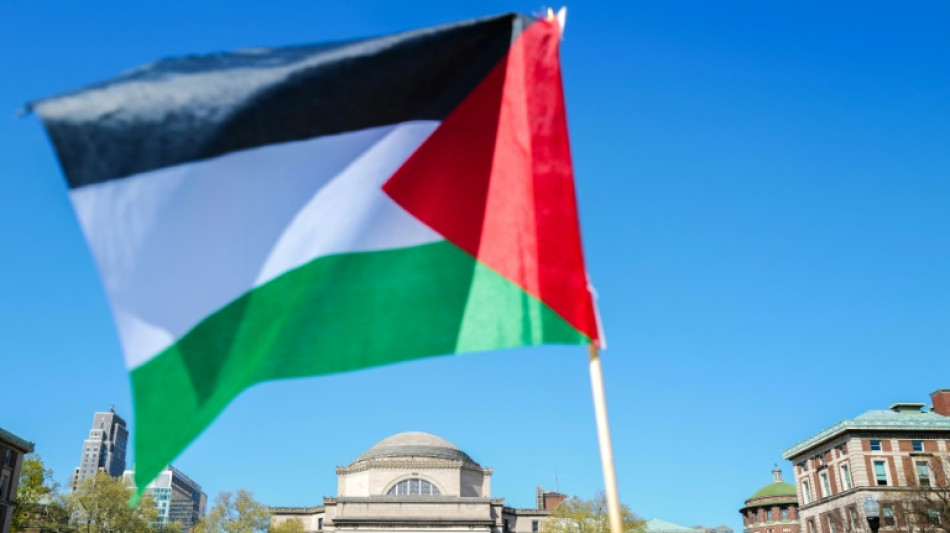
US student protesters dig in as Israel-Hamas war grinds on / Photo: CHARLY TRIBALLEAU - AFP

 Lights out in Laos as electricity exports surge

 Steven Strogatz weighs AI mathematics advances and their consequences for researchers

 Anthropic boss calls for AI slowdown, Altman and Musk agree

 French IT giant Capgemini sells subsidiary after row over ICE links

 Quebec Brokerage Qubit Insurance Announces New Data on Coverage Shortfalls as Rebuilding Costs Rise

 Lady Gaga welcomes first child with fiance: US media

 Bhutan business bets on hazelnuts for farming future

 'Widow's Bay' and 'The Pitt' are favorites for Emmys night

 Coastal erosion forces cancellation of California music festival

 Argentina's Dirty War rears its head in Venice film

 UK lawmakers throw out bill to legalise assisted dying

 US inflation steady in August, fueling Fed rate hike expectations

 New York marks 25th anniversary of 9/11 attacks

 Nepal flood reconstruction bill to be $4.78 bn: foreign ministry

 JUMO and Standard Bank launch Social Finance Framework to scale inclusive finance in Africa

 Doomsday tech: could AI really kill us all?

 French comedy show 'Call my agent' makes film comeback

 It's all coming back: Celine Dion fans gear up for Paris return

 Researchers eye AI revolution in natural disaster forecasts

 US braces for inflation report that may push Fed to hike rates

 Musk threatens legal action over documentary

 Latin America fact-check group asks Meta not to replace verification practice

 AI Risks to Enter 60–80% of Liability and Cyber Insurance Underwriting by 2028, ScienceSoft Predicts

 Tribal Launches Campfire, Letting Business and Technical Teams Build on Salesforce Together

 Stocks fall as fresh oil surge fans inflation fears

Yazen has slept on Columbia University's south lawn almost every night for more than a week now, one of several dozen students living at the prestigious school's "Gaza Solidarity Encampment."
The 23-year-old Palestinian-American has been splitting his days between his medical studies at Columbia's historic Butler Library, adjacent to the smooth green lawn, and the upkeep of the colorful tents on the school's main campus, in the heart of New York City.
Since last Monday, dozens of students and alumni have come together to express solidarity with Palestinians in Gaza, where Israel is waging war against militant group Hamas.
They are demanding Columbia divest from companies with ties to Israel -- and the demonstrations are spreading to other campuses around the United States.
A burgeoning number of protesters now keep vigil daily at Colombia, though numbers ebb and flow from the dozens to the hundreds as students join just for the day, leave to study -- or, in Yazen's case, go home to feed his cat.
"Millions of Palestinians in Gaza are sleeping out in the cold every single night without access to food and shelter," said Yazen, who did not give his surname.
"We have tents, they don't have tents," he said.
He's determined to stay, even after the university last week called in the police, leading to the arrest and suspension of more than 100 students.
"As a Palestinian, is it my responsibility to be here and show my solidarity with the people in Gaza? Absolutely," Yazen said.
- School 'made it worse' -
Universities have become the focus of intense cultural debate in the United States since Hamas's October 7 attack and Israel's overwhelming military response, as a humanitarian crisis grips the Palestinian territory of Gaza.
The protest at Colombia has hosted speakers and music performances, Islamic prayers and seder meals for the Jewish holiday of Passover, which began Monday.
But the Middle East conflict is inflammatory in the United States, and as the death toll in Gaza rises -- and university authorities up the pressure on the demonstrators to dismantle the encampment -- the mood on campus has become uneasy.
This week, in-person classes at Columbia were cancelled.
University authorities are caught between condemning anti-Semitism while allowing the protesters to exercise free speech.
But it is a thin line. Tensions reached their peak last week when university authorities called in the police, but it is not just the demonstrators who are feeling the heat.
Melissa Saidak, a Jewish graduate student at Columbia's School of Social Work, said the protest has also drawn throngs of more aggressive and often violent outsiders to Colombia's gates.
"A person was yelling at me, screaming at me, calling me a Zionist and a murderer. They were banging a pot or something," said Saidak, who wears a dog tag in solidarity with Israeli hostages in Gaza and Star of David around her neck.
"It was causing me a lot of physical pain, this was just me trying to get home."
She thinks Columbia is not doing enough to protect Jewish students -- particularly with being transparent and explicit about the harm done to them.
"School has continued to make it a lot worse," she said.
- 'What's necessary' -
University president Minouche Shafik had set a deadline of midnight Tuesday to resolve the unrest.
Immediately after that announcement, which came near midnight, hundreds more people flocked to the protest, their numbers spilling over the sidewalks and another lawn.
In a frenzied confusion, demonstrators rushed to clear the camp, carrying half-disassembled tents and bags of supplies away.
But then the deadline was extended for another 48 hours. By Wednesday morning the encampment had returned to regular programming.
For now -- despite the new looming deadline -- it shows no sign of letting up.
D.P., a 22-year-old student who only gave her initials and works security for the encampment, is among those who've decided to stay.
"It seems clear to me that it's what's necessary for this right now," she said.
"I can't stand the thought of not being at camp," she said. "I think that this whole place is only working because everyone is putting everything they have into it."
J.Bondarev--CPN