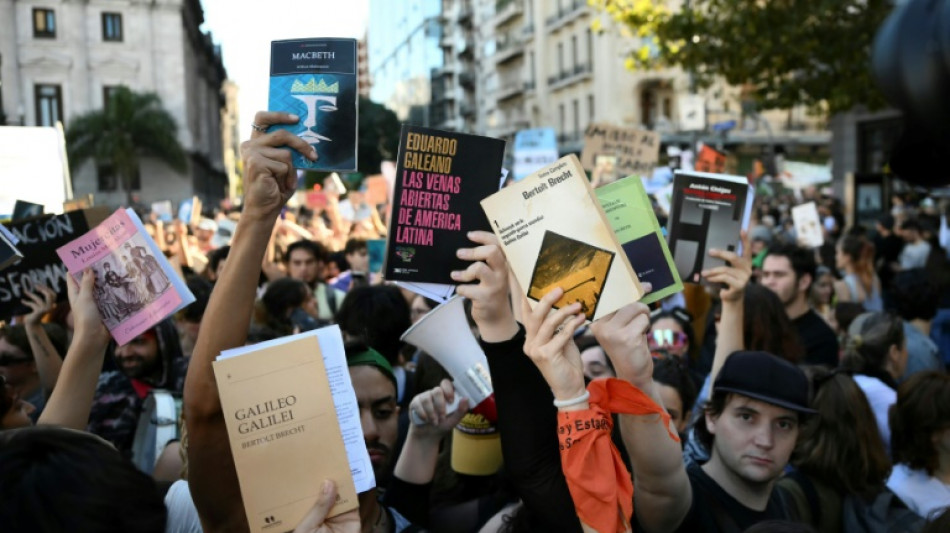
Large crowds march against Argentina public university cuts / Photo: Luis ROBAYO - AFP

 Lights out in Laos as electricity exports surge

 Steven Strogatz weighs AI mathematics advances and their consequences for researchers

 Anthropic boss calls for AI slowdown, Altman and Musk agree

 French IT giant Capgemini sells subsidiary after row over ICE links

 Quebec Brokerage Qubit Insurance Announces New Data on Coverage Shortfalls as Rebuilding Costs Rise

 Lady Gaga welcomes first child with fiance: US media

 Bhutan business bets on hazelnuts for farming future

 'Widow's Bay' and 'The Pitt' are favorites for Emmys night

 Coastal erosion forces cancellation of California music festival

 Argentina's Dirty War rears its head in Venice film

 UK lawmakers throw out bill to legalise assisted dying

 US inflation steady in August, fueling Fed rate hike expectations

 New York marks 25th anniversary of 9/11 attacks

 Nepal flood reconstruction bill to be $4.78 bn: foreign ministry

 JUMO and Standard Bank launch Social Finance Framework to scale inclusive finance in Africa

 Doomsday tech: could AI really kill us all?

 French comedy show 'Call my agent' makes film comeback

 It's all coming back: Celine Dion fans gear up for Paris return

 Researchers eye AI revolution in natural disaster forecasts

 US braces for inflation report that may push Fed to hike rates

 Musk threatens legal action over documentary

 Latin America fact-check group asks Meta not to replace verification practice

 AI Risks to Enter 60–80% of Liability and Cyber Insurance Underwriting by 2028, ScienceSoft Predicts

 Tribal Launches Campfire, Letting Business and Technical Teams Build on Salesforce Together

 Stocks fall as fresh oil surge fans inflation fears

Hundreds of thousands of Argentines took to the streets on Tuesday, protest organizers said, to voice outrage at cuts to higher public education under budget-slashing new President Javier Milei.
Joined by professors, parents and alumni from the economic crisis-riddled South American country's 57 state-run universities, students rose up "in defense of free public university education."
Labor unions, opposition parties and private universities backed the protests in Buenos Aires and other major cities such as Cordoba -- in one of the biggest demonstrations yet against the austerity measures introduced since Milei took office in December.
Police said around 100,000 people turned out Tuesday in the capital alone, while organizers put the number at closer to half-a-million -- paralyzing the city center for hours on end.
A teachers' union reported a million protesters countrywide.
Third-year medicine student Pablo Vicenti, 22, told AFP in Buenos Aires he was outraged at the government's "brutal attack" on the university system.
"They want to defund it with a false story that there is no money. There is, but they choose not to spend it on public education," he said.
Milei won elections last November vowing to take a chainsaw to public spending and reduce the budget deficit to zero.
To that end, his government has slashed subsidies for transport, fuel and energy even as wage-earners have lost a fifth of their purchasing power.
Thousands of public servants have lost their jobs, and Milei has faced numerous anti-austerity protests.
His government dismissed Tuesday's protests as "political."
- Under the poverty line -
Universities declared a financial emergency after the government approved a 2024 budget the same as the one for 2023, despite annual inflation approaching 290 percent.
On top of that, higher learning institutions say a near 500-percent monthly increase in energy costs has brought them to their knees.
"At the rate at which they are funding us, we can only function between two or three more months," said University of Buenos Aires (UBA) rector Ricardo Gelpi.
As the ire has built, Milei conceded a 70-percent increase in funding for public universities' operating expenses in March, to be followed by another 70 percent in May and a one-off grant to university hospitals.
Operating expenses exclude teacher salaries, which make up about 90 percent of a university budget.
"Of the four teaching categories, three have fallen under the poverty line," said the rector of the National University of San Luis, Victor Morinigo.
In a post on X over the weekend, Milei called into question how public universities spend their funds, and said the institutions "are used for shady business and to indoctrinate."
On Monday, presidential spokesman Manuel Adorni argued that Argentina's public education system has been declining for decades, with plunging rates of university passes.
Some 2.2 million people study in the public university system in a country where the poverty level has reached nearly 60 percent of the population, according to a recent study.
"Don't expect a way out through public spending," Milei warned on Monday, as he hailed Argentina's first quarterly budget surplus since 2008.
P.Kolisnyk--CPN