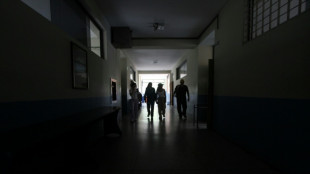
Thousands of Philippine schools suspend in-person classes due to heat / Photo: Ted ALJIBE - AFP

 Lights out in Laos as electricity exports surge

 Steven Strogatz weighs AI mathematics advances and their consequences for researchers
 Anthropic boss calls for AI slowdown, Altman and Musk agree

 French IT giant Capgemini sells subsidiary after row over ICE links

 Quebec Brokerage Qubit Insurance Announces New Data on Coverage Shortfalls as Rebuilding Costs Rise

 Lady Gaga welcomes first child with fiance: US media

 Bhutan business bets on hazelnuts for farming future

 'Widow's Bay' and 'The Pitt' are favorites for Emmys night

 Coastal erosion forces cancellation of California music festival

 Argentina's Dirty War rears its head in Venice film

 UK lawmakers throw out bill to legalise assisted dying

 US inflation steady in August, fueling Fed rate hike expectations

 New York marks 25th anniversary of 9/11 attacks

 Nepal flood reconstruction bill to be $4.78 bn: foreign ministry

 JUMO and Standard Bank launch Social Finance Framework to scale inclusive finance in Africa

 Doomsday tech: could AI really kill us all?

 French comedy show 'Call my agent' makes film comeback

 It's all coming back: Celine Dion fans gear up for Paris return

 Researchers eye AI revolution in natural disaster forecasts

 US braces for inflation report that may push Fed to hike rates

 Musk threatens legal action over documentary

 Latin America fact-check group asks Meta not to replace verification practice

 AI Risks to Enter 60–80% of Liability and Cyber Insurance Underwriting by 2028, ScienceSoft Predicts

 Tribal Launches Campfire, Letting Business and Technical Teams Build on Salesforce Together

 Stocks fall as fresh oil surge fans inflation fears

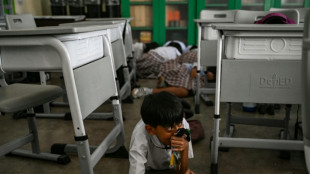
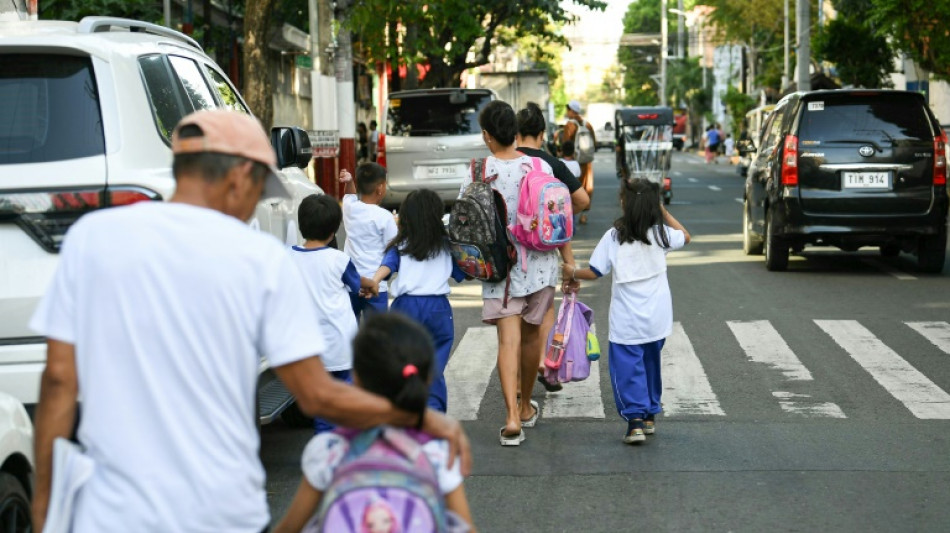
Thousands of schools in the Philippines suspended in-person classes Friday, the education department said, as parts of the tropical country endured dangerously high temperatures.
The months of March, April and May are typically the hottest and driest in the archipelago nation but conditions have been exacerbated by the El Nino weather phenomenon.
Many schools have no air conditioning, leaving students to swelter in crowded, poorly ventilated classrooms.
"Even my smartest student is not in the mood to answer questions because it's very hot," said Mayette Paulino, who teaches a grade two class of around 27 children near Manila.
She said "students feel tired and seem sleepy" as the heat intensified in the afternoon.
The Department of Education has issued an advisory giving school heads the power to decide when to switch to remote learning "in cases of extreme heat and other calamities".
Official figures for Friday showed 5,288 schools suspended in-person classes, affecting more than 3.6 million students.
That was higher than the 4,769 schools on Thursday.
Some schools have reduced class hours to avoid teaching during the hottest times of the day.
Bheapril Balbin, 37, whose two young children attend a primary school near Manila, supported the decision for students to stay home during the hot weather.
"The heat is too much, my children couldn't take it," Balbin told AFP.
"Some of their classmates got sick, they had a headache because of the extreme heat. My youngest has an asthma, extreme heat is bad for him."
The heat index was expected to reach the "danger" level of 42 or 43 degrees Celsius (107.6-109.4 degrees Fahrenheit) in several areas of the country on Friday, the state weather forecaster said.
In Manila, the heat index was forecast to hit the "extreme caution" level of up to 40C (104F), when heat cramps and exhaustion are possible.
The country's heat index measures what a temperature feels like, taking into account humidity.
Friday's actual maximum temperature in Manila was 35.5C (95.9F).
"The heat will get worse because we're not yet at the peak of the summer season," Lorie Dela Cruz of the state weather forecaster told AFP, noting the first half of May was usually the hottest period.
She said the actual temperature was "within the normal range" for this time of year.
Nearly 300 schools in Manila had remote learning on Friday.
The central regions of the main island of Luzon were the hardest hit, with more than 1,600 schools suspending in-person classes.
Save the Children Philippines chief Alberto Muyot said on Wednesday the extreme heat meant "children are simply unable to concentrate in the classroom and their health is also at risk".
Y.Jeong--CPN