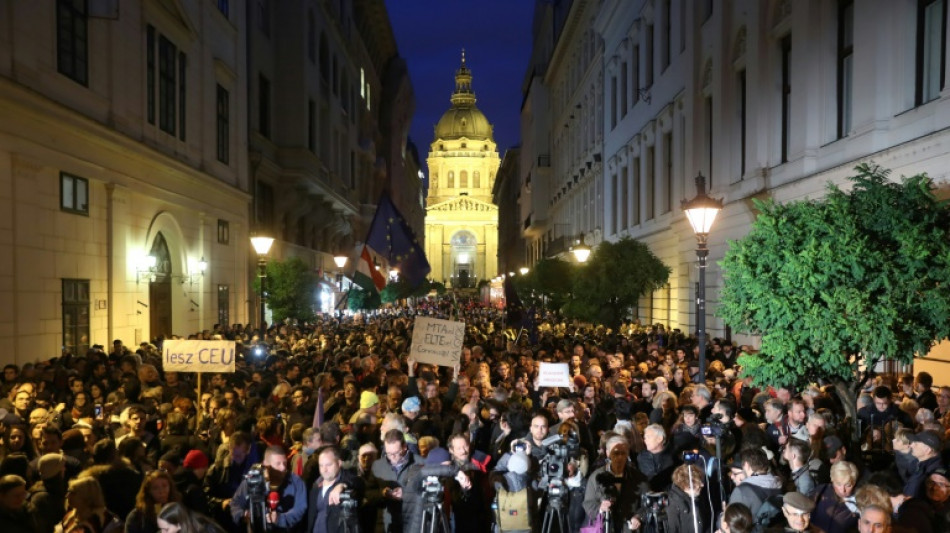
Academic freedom declining globally, index finds / Photo: FERENC ISZA - AFP/File

 Lights out in Laos as electricity exports surge

 Steven Strogatz weighs AI mathematics advances and their consequences for researchers

 Anthropic boss calls for AI slowdown, Altman and Musk agree

 French IT giant Capgemini sells subsidiary after row over ICE links

 Quebec Brokerage Qubit Insurance Announces New Data on Coverage Shortfalls as Rebuilding Costs Rise

 Lady Gaga welcomes first child with fiance: US media

 Bhutan business bets on hazelnuts for farming future

 'Widow's Bay' and 'The Pitt' are favorites for Emmys night

 Coastal erosion forces cancellation of California music festival

 Argentina's Dirty War rears its head in Venice film

 UK lawmakers throw out bill to legalise assisted dying

 US inflation steady in August, fueling Fed rate hike expectations

 New York marks 25th anniversary of 9/11 attacks

 Nepal flood reconstruction bill to be $4.78 bn: foreign ministry

 JUMO and Standard Bank launch Social Finance Framework to scale inclusive finance in Africa

 Doomsday tech: could AI really kill us all?

 French comedy show 'Call my agent' makes film comeback

 It's all coming back: Celine Dion fans gear up for Paris return

 Researchers eye AI revolution in natural disaster forecasts

 US braces for inflation report that may push Fed to hike rates

 Musk threatens legal action over documentary

 Latin America fact-check group asks Meta not to replace verification practice

 AI Risks to Enter 60–80% of Liability and Cyber Insurance Underwriting by 2028, ScienceSoft Predicts

 Tribal Launches Campfire, Letting Business and Technical Teams Build on Salesforce Together

 Stocks fall as fresh oil surge fans inflation fears

Just one in three people live a nation that guarantees the independence of universities and research, according to an annual index warning that academic freedom is declining worldwide, particularly in Russia, China and India.
Attacks on freedom of expression, interference at universities and the imprisonment of researchers are just some ways that "academic freedom globally is under threat," the index said.
The Academic Freedom Index -- based on input from more than 2,300 experts in 179 countries -- was published last month as part of a report on democracy by the V-Dem Institute at Sweden's University of Gothenburg.
It measures changes in higher education and research over the last half century by looking at five different indicators: freedom of research and teaching; of academic exchange; of academic and cultural expression; of institutional autonomy and campus integrity.
Katrin Kinzelbach, professor at Germany's University of Erlangen-Nuremberg and one of the organisers of the index, told AFP that 171 states have ratified a human rights treaty which commits them to respect the freedom of scientific research.
But because of recent "significant deteriorations" in countries with large populations, "only every third person in the world today lives in a country where research and higher education enjoys a high degree of freedom," she said.
Accounting for the world's growing population, the proportion of people living in nations with academic freedom is comparable to 1973, she added.
"Now, 45.5 percent of the world's population -- 3.6 billion people -- live in 27 countries where academic freedom is completely restricted," the report said.
- 'From bad to worse' -
Significant declines were particularly seen in India, China and Russia -- the first, second and ninth most populous nations -- which Kinzelbach called "clear examples of autocratisation".
"Academic freedom has fallen dramatically" in India since Prime Minister Narendra Modi took power in 2014, she said.
Kinzelbach cited the example of British-Indian academic Nitasha Kaul, a politics professor at the UK's University of Westminster denied entry to India for a conference last month.
In Russia and China, "academic freedom was never great, and it has now deteriorated from bad to worse," Kinzelbach said.
Perhaps more surprisingly, the index found academic freedom had also fallen in the United States since 2019, which Kinzelbach called "a shock for many academics".
She emphasised both society and the political system in the US were "highly polarised".
"University campuses have become arenas where this polarisation unfolds," she said, calling for "calm, evidence-based debates on campus -- including about highly divisive issues."
Most European countries had very high academic freedom according to the index, with Hungary scoring the lowest rate followed by Poland.
However Kinzelbach said Poland's score will likely improve under the new government of Prime Minister Donald Tusk.
P.Schmidt--CPN