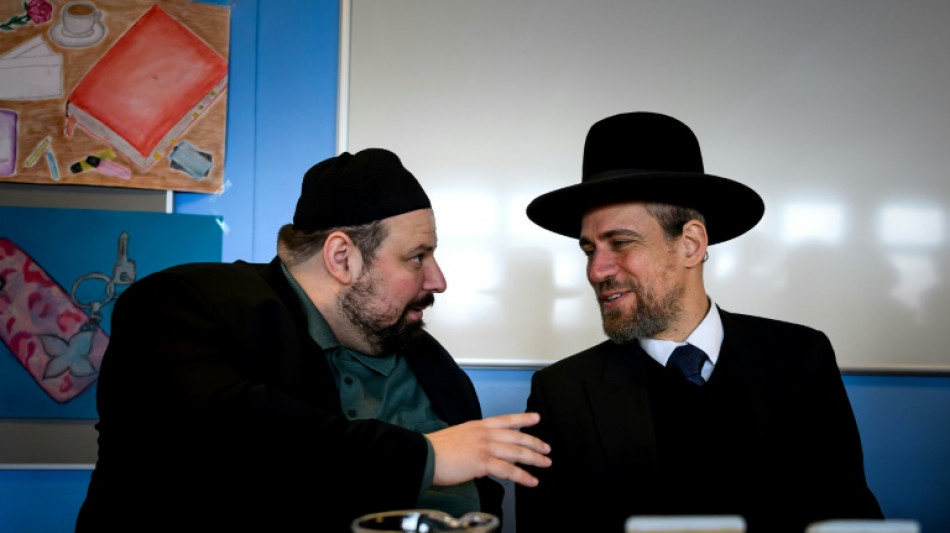
The imam and rabbi confounding stereotypes in Austria / Photo: Joe Klamar - AFP

 Lights out in Laos as electricity exports surge

 Steven Strogatz weighs AI mathematics advances and their consequences for researchers

 Anthropic boss calls for AI slowdown, Altman and Musk agree

 French IT giant Capgemini sells subsidiary after row over ICE links

 Quebec Brokerage Qubit Insurance Announces New Data on Coverage Shortfalls as Rebuilding Costs Rise

 Lady Gaga welcomes first child with fiance: US media

 Bhutan business bets on hazelnuts for farming future

 'Widow's Bay' and 'The Pitt' are favorites for Emmys night

 Coastal erosion forces cancellation of California music festival

 Argentina's Dirty War rears its head in Venice film

 UK lawmakers throw out bill to legalise assisted dying

 US inflation steady in August, fueling Fed rate hike expectations

 New York marks 25th anniversary of 9/11 attacks

 Nepal flood reconstruction bill to be $4.78 bn: foreign ministry

 JUMO and Standard Bank launch Social Finance Framework to scale inclusive finance in Africa

 Doomsday tech: could AI really kill us all?

 French comedy show 'Call my agent' makes film comeback

 It's all coming back: Celine Dion fans gear up for Paris return

 Researchers eye AI revolution in natural disaster forecasts

 US braces for inflation report that may push Fed to hike rates

 Musk threatens legal action over documentary

 Latin America fact-check group asks Meta not to replace verification practice

 AI Risks to Enter 60–80% of Liability and Cyber Insurance Underwriting by 2028, ScienceSoft Predicts

 Tribal Launches Campfire, Letting Business and Technical Teams Build on Salesforce Together

 Stocks fall as fresh oil surge fans inflation fears

More than 150 students crowded into a room at an Austrian high school to hear an unlikely duo speak -- imam Ramazan Demir and rabbi Schlomo Hofmeister.
The two men's talks, educating students about their religions, have taken on additional pertinence since the October 7 Hamas attack on Israel and Israel's subsequent relentless bombing of Gaza.
Since then Austria has seen a rise in both anti-Semitic and anti-Muslim acts, as elsewhere in Europe.
"We must separate religion from politics," rabbi Hofmeister, 48, told the students, while imam Demir, 38, nodded in support.
"This is not a religious war, it is a political conflict, a terrible conflict that must not impact our communities here in Europe," Hofmeister added.
The two volunteers are in high demand because "just our friendship alone defies stereotypes", according to Demir.
Their diaries are packed until June, with the pair visiting some 30 Austrian schools.
During last week's two-hour discussion at a high school in a working-class suburb of the capital, questions came thick and fast from the students aged 16 to 18.
A livestream allowed those unable to get a seat in the large hall to hear them explain how Jews and Muslims pray to the differences between kosher and halal.
- Talk on 'equal footing' -
The two bearded men -- one wearing a kufi cap, the other a wide-brimmed fedora hat -- met 10 years ago during an inter-religious project and have since worked together, travelling to Turkey, Israel and the Palestinian territories.
The Gaza war has not affected their friendship, they say.
"We want there to be peace, without any ifs and whens," Demir said, while Hofmeister added that he was "glad they started to cooperate so early on to be able to address the current crisis."
The war started when Hamas attacked Israel on October 7, resulting in the deaths of about 1,160 people in Israel, mostly civilians, according to an AFP tally of official Israeli figures.
But concern has mounted amid the high civilian death toll from Israel's retaliatory campaign, now at almost 30,000, according to the health ministry in Hamas-run Gaza.
The Vienna school where the pair were speaking has 1,200 students of 63 different nationalities, although none identify as Jewish.
At each break, numerous students crowd around the duo, who use humour to lighten the atmosphere.
"It's interesting to see how similar religions are," 17-year-old Estella Dolas told AFP.
Austria is a majority Catholic country, with Muslims making up around 8 percent of the population. Only 0.1 percent -- just 5,400 people -- declared themselves as Jewish in the 2021 census.
School director Inge Joebstl, 55, said the rapport and respect between the two men, who spoke "on an equal footing", made the students more receptive.
Especially since many of them will otherwise look for answers on social networks where "self-proclaimed experts converted two years ago explain to them what Islam is", warned Demir.
"After we leave, the students may not remember everything we told them," admitted Hofmeister.
"But they will remember that an imam and a rabbi came to their school and that they got along well."
M.Anderson--CPN