Taiwan's TSMC to help train German students for semiconductor careers / Photo: Sam Yeh - AFP

 Lights out in Laos as electricity exports surge

 Steven Strogatz weighs AI mathematics advances and their consequences for researchers

 Anthropic boss calls for AI slowdown, Altman and Musk agree

 French IT giant Capgemini sells subsidiary after row over ICE links

 Quebec Brokerage Qubit Insurance Announces New Data on Coverage Shortfalls as Rebuilding Costs Rise

 Lady Gaga welcomes first child with fiance: US media

 Bhutan business bets on hazelnuts for farming future

 'Widow's Bay' and 'The Pitt' are favorites for Emmys night

 Coastal erosion forces cancellation of California music festival

 Argentina's Dirty War rears its head in Venice film

 UK lawmakers throw out bill to legalise assisted dying

 US inflation steady in August, fueling Fed rate hike expectations

 New York marks 25th anniversary of 9/11 attacks

 Nepal flood reconstruction bill to be $4.78 bn: foreign ministry

 JUMO and Standard Bank launch Social Finance Framework to scale inclusive finance in Africa

 Doomsday tech: could AI really kill us all?

 French comedy show 'Call my agent' makes film comeback

 It's all coming back: Celine Dion fans gear up for Paris return

 Researchers eye AI revolution in natural disaster forecasts

 US braces for inflation report that may push Fed to hike rates

 Musk threatens legal action over documentary

 Latin America fact-check group asks Meta not to replace verification practice

 AI Risks to Enter 60–80% of Liability and Cyber Insurance Underwriting by 2028, ScienceSoft Predicts

 Tribal Launches Campfire, Letting Business and Technical Teams Build on Salesforce Together

 Stocks fall as fresh oil surge fans inflation fears

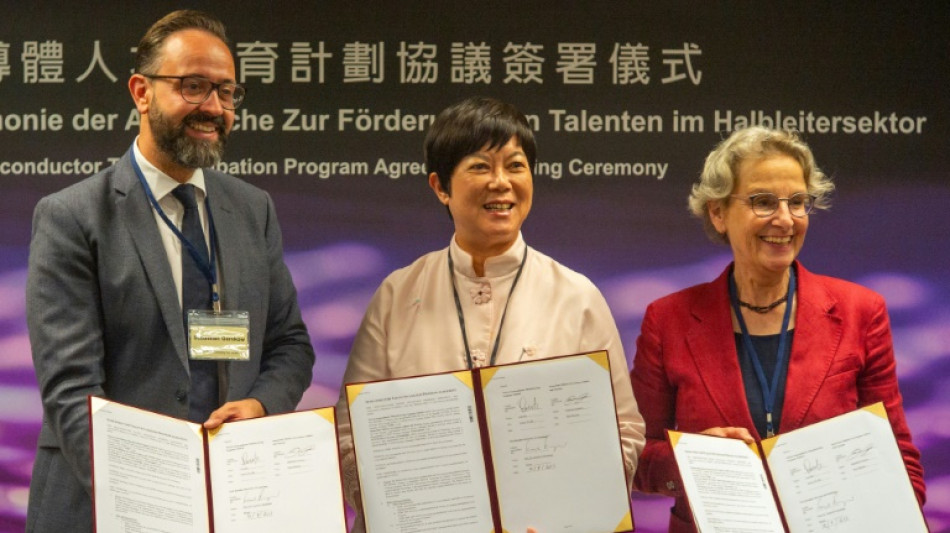
Germany's Saxony state signed an agreement with Taiwanese chip giant TSMC on Tuesday to train German students in an effort to meet the growing demand for workers in the semiconductor sector.
A shortage of skilled workers including in the crucial chip sector has emerged as a major challenge for Germany, Europe's largest economy, as vast cohorts of older employees retire.
Last month, the Taiwan Semiconductor Manufacturing Company -- which controls more than half of the world's chip output -- announced a new $3.8 billion chip factory in Saxony's capital Dresden.
The agreement, signed between TSMC, Saxony and the Dresden University of Technology (TU Dresden) "is specifically designed to train German STEM students for careers in the semiconductor industry", the Taiwanese firm said in a statement.
Up to 100 high-achieving students from the state will come to Taiwan for a six-month exchange programme and "collaborate with Taiwan's top universities", it added.
The first students are expected in February 2024, according to TSMC.
Market research has shown a demand for more than one million skilled workers in the chip industry, said Lora Ho, TSMC's senior vice president of human resources.
"We are preparing in advance for the shortage of talents that may come shortly and strengthening semiconductor education is the most critical way to resolve the global shortage of technical talents."
Construction of TSMC's Dresden facility, which will be focused on automotive chips, is scheduled to begin next year, with production starting by the end of 2027.
It is expected to create around 2,000 direct high-tech jobs.
"We know companies from the semiconductor field (are) facing problems with finding enough talents," Sebastian Gemkow, Saxony's State Minister for Science, told AFP.
"That's why we started very early to structure this process so TSMC and later ESMC will have all the employees that it needs," he said, referring to the European Semiconductor Manufacturing Company.
ESMC is a joint venture between TSMC, Germany's Bosch and Infineon, and Dutch firm NXP that will build the Dresden plant.
TSMC's production has expanded beyond Taiwan as Western powers lines have raised concerns about the chip industry -- critical for the modern global economy -- being centred on an island that China claims as its territory.
Beijing has ramped up political and military pressure on the island in recent years, adding to fears about the global semiconductor supply chain.
M.García--CPN