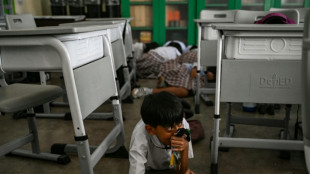
Polish school offers Ukraine teens 'semblance of normalcy'

 Lights out in Laos as electricity exports surge

 Steven Strogatz weighs AI mathematics advances and their consequences for researchers

 Anthropic boss calls for AI slowdown, Altman and Musk agree

 French IT giant Capgemini sells subsidiary after row over ICE links

 Quebec Brokerage Qubit Insurance Announces New Data on Coverage Shortfalls as Rebuilding Costs Rise

 Lady Gaga welcomes first child with fiance: US media

 Bhutan business bets on hazelnuts for farming future

 'Widow's Bay' and 'The Pitt' are favorites for Emmys night

 Coastal erosion forces cancellation of California music festival

 Argentina's Dirty War rears its head in Venice film

 UK lawmakers throw out bill to legalise assisted dying

 US inflation steady in August, fueling Fed rate hike expectations

 New York marks 25th anniversary of 9/11 attacks

 Nepal flood reconstruction bill to be $4.78 bn: foreign ministry

 JUMO and Standard Bank launch Social Finance Framework to scale inclusive finance in Africa

 Doomsday tech: could AI really kill us all?

 French comedy show 'Call my agent' makes film comeback

 It's all coming back: Celine Dion fans gear up for Paris return

 Researchers eye AI revolution in natural disaster forecasts

 US braces for inflation report that may push Fed to hike rates

 Musk threatens legal action over documentary

 Latin America fact-check group asks Meta not to replace verification practice

 AI Risks to Enter 60–80% of Liability and Cyber Insurance Underwriting by 2028, ScienceSoft Predicts

 Tribal Launches Campfire, Letting Business and Technical Teams Build on Salesforce Together

 Stocks fall as fresh oil surge fans inflation fears

Stuck to the door of one Warsaw high school is the sign "Laskavo prosimo do shkoli", or "Welcome to school" in Ukrainian, along with the flags of Poland and Ukraine.
Chattering in Russian and Ukrainian, teenagers who have just fled their wartorn homeland use magnetic key cards to enter and are welcomed again with a large yellow-blue flag and the slogan "Slava Ukraini" or "Glory to Ukraine".
It is their first day of school in Poland, where the 13- to 15-year-olds have sought shelter since Russia invaded their country.
Divided into two groups of 20, they are greeted by their new teacher, who shuttles from one classroom to the other throughout the lesson.
From the Ukrainian city of Lviv, a refugee just like them, Mariana Druchek, lays out the plan for the day and passes out a maths test.
"Uh oh," comes the response. Viktoria, 16, and 15-year-olds Polina and Zoriana are in a panic.
"It's on things we covered three years ago, in grade eight -- I forgot it all," said Viktoria, to which the others chime in with "same".
But they relax soon enough. By break time, they are all smiles, saying the atmosphere is "really good" and "positive" and "the class and school in general are all right".
It is as if their mad dash out of Kyiv with barely any luggage -- to the backdrop of bombs and blasts -- was already fading somewhat into the distance.
But the sense of danger is still there.
"We're afraid the Russians will even make their way over here, because everything is possible," Viktoria told AFP.
- 'Education and peace' -
Limanowski High School has been able to accommodate the new students and hire new teachers thanks to funding from the mayor's office.
On day one, Renata Kozlowska, a city official for the school's neighbourhood of Zoliborz, came to welcome the teenagers.
She told them that "all of Poland is with you" and stressed that they have the right to "an education and peace".
The teenagers -- who come from various cities, including Kyiv, Zhytomyr, Lutsk and Ivano-Frankivsk -- will follow a pared-down version of Poland's curriculum, including English, Polish, history, maths, physics and gym.
The classes will be taught by Ukrainian teachers who themselves had fled the war, with a bilingual educator at the helm of each group.
"What's most important is to offer them some semblance of normalcy and quiet," the school's principal Andrzej Wyrozembski told AFP.
Druchek, who crossed into Poland with her three children just after the invasion, agrees.
"It's not a matter of maintaining their knowledge levels, but to make sure they have psychological support and friends, that they know that everyone wants to help," she said.
- 54,000 Ukrainians enrolled -
Janusz, a Polish student at Limanowski, said he is all for the initiative, calling it "cool" to have welcomed the Ukrainians into their school.
"It means they can keep going to school and won't be thinking non-stop about what's going on in Ukraine," he added.
While the new students will be attending separate classes from their Polish counterparts, the school is keen on helping them integrate.
Each Ukrainian will be partnered up with a Pole their age to join for after-school activities and the like.
Limanowski is the first school in town to have launched such a programme, but others are due to follow soon.
Wyrozembski stressed that it was his teachers who took the lead on the initiative once refugees began flooding Poland.
But he too had his reasons to get involved: when Nazi Germany attacked Poland in September 1939, his father fled Warsaw for Lviv, which was a Polish city at the time.
Since the invasion began, nearly 54,000 Ukrainian children have been enrolled in Polish schools, Education Minister Przemyslaw Czarnek said Wednesday.
For Wyrozembski, the most important thing now would be to set up special schools for Ukrainian students aged 16 and 17, who would normally be preparing for a final exam before college.
Were they to switch to the Polish curriculum now and prepare for the equivalent testing here, it would "put them back three or four years," he said.
A.Leibowitz--CPN