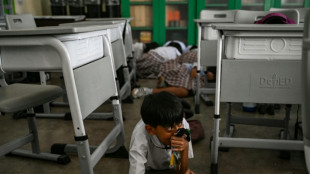
US school test scores haven't recovered since pandemic / Photo: Robyn Beck - AFP/File

 Lights out in Laos as electricity exports surge

 Steven Strogatz weighs AI mathematics advances and their consequences for researchers

 Anthropic boss calls for AI slowdown, Altman and Musk agree

 French IT giant Capgemini sells subsidiary after row over ICE links

 Quebec Brokerage Qubit Insurance Announces New Data on Coverage Shortfalls as Rebuilding Costs Rise

 Lady Gaga welcomes first child with fiance: US media

 Bhutan business bets on hazelnuts for farming future

 'Widow's Bay' and 'The Pitt' are favorites for Emmys night

 Coastal erosion forces cancellation of California music festival

 Argentina's Dirty War rears its head in Venice film

 UK lawmakers throw out bill to legalise assisted dying

 US inflation steady in August, fueling Fed rate hike expectations

 New York marks 25th anniversary of 9/11 attacks

 Nepal flood reconstruction bill to be $4.78 bn: foreign ministry

 JUMO and Standard Bank launch Social Finance Framework to scale inclusive finance in Africa

 Doomsday tech: could AI really kill us all?

 French comedy show 'Call my agent' makes film comeback

 It's all coming back: Celine Dion fans gear up for Paris return

 Researchers eye AI revolution in natural disaster forecasts

 US braces for inflation report that may push Fed to hike rates

 Musk threatens legal action over documentary

 Latin America fact-check group asks Meta not to replace verification practice

 AI Risks to Enter 60–80% of Liability and Cyber Insurance Underwriting by 2028, ScienceSoft Predicts

 Tribal Launches Campfire, Letting Business and Technical Teams Build on Salesforce Together

 Stocks fall as fresh oil surge fans inflation fears

American 13-year-olds continue to struggle academically in the wake of the pandemic, especially in mathematics, according to official data out Wednesday.
The National Assessment of Educational Progress (NAEP), a project that has been monitoring test scores since 1969, tested students in late 2022, finding reading and math scores significantly dropped compared to late 2019.
Average math scores have risen significantly since the assessments first began, but have now dropped to levels last seen in 1990, with declines more pronounced among lower-performing students.
"US students are struggling across the board. Educators, policymakers, and families need to work together urgently and decisively to address this generation's learning needs," said Beverly Perdue, National Assessment Governing Board chair.
The assessment, which relies on nationally representative samples, revealed several additional concerns, including that the number of 13-year-olds who said they read for fun hit an all time low.
Just 14 percent read for fun every day, down three points from 2020 and 13 points from 2012.
Among lower-performing students, 42 percent said they never or hardly ever read for fun.
Absenteeism was also up, with the percentage of students who missed five or more days doubling since the last assessment.
Research has shown shuttering schools during Covid-19 lockdowns hit those from lower-income families and ethnic minorities the hardest.
The pandemic also worsened learning outcomes, including increases in students seeking mental health services, school violence and disruption, cyberbullying, and nationwide teacher and staff shortages.
D.Avraham--CPN