Putin digs in as evacuation corridors agreed in Ukraine

 Lights out in Laos as electricity exports surge

 Steven Strogatz weighs AI mathematics advances and their consequences for researchers

 Anthropic boss calls for AI slowdown, Altman and Musk agree

 French IT giant Capgemini sells subsidiary after row over ICE links

 Quebec Brokerage Qubit Insurance Announces New Data on Coverage Shortfalls as Rebuilding Costs Rise

 Lady Gaga welcomes first child with fiance: US media

 Bhutan business bets on hazelnuts for farming future

 'Widow's Bay' and 'The Pitt' are favorites for Emmys night

 Coastal erosion forces cancellation of California music festival

 Argentina's Dirty War rears its head in Venice film

 UK lawmakers throw out bill to legalise assisted dying

 US inflation steady in August, fueling Fed rate hike expectations

 New York marks 25th anniversary of 9/11 attacks

 Nepal flood reconstruction bill to be $4.78 bn: foreign ministry

 JUMO and Standard Bank launch Social Finance Framework to scale inclusive finance in Africa

 Doomsday tech: could AI really kill us all?

 French comedy show 'Call my agent' makes film comeback

 It's all coming back: Celine Dion fans gear up for Paris return

 Researchers eye AI revolution in natural disaster forecasts

 US braces for inflation report that may push Fed to hike rates

 Musk threatens legal action over documentary

 Latin America fact-check group asks Meta not to replace verification practice

 AI Risks to Enter 60–80% of Liability and Cyber Insurance Underwriting by 2028, ScienceSoft Predicts

 Tribal Launches Campfire, Letting Business and Technical Teams Build on Salesforce Together

 Stocks fall as fresh oil surge fans inflation fears

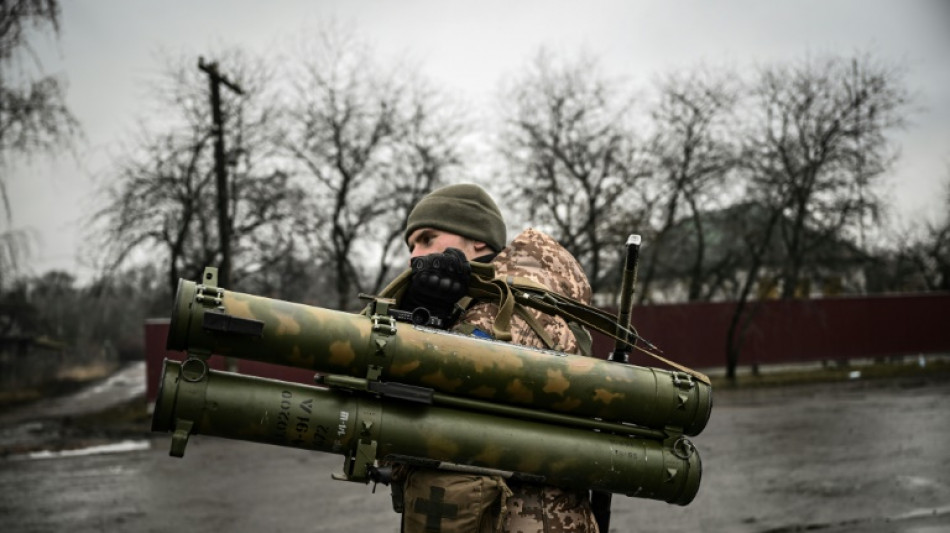
Russia's invasion of Ukraine is "going to plan", President Vladimir Putin said Thursday despite fierce resistance and deepening international isolation, as Kyiv won precious agreement from Moscow on a humanitarian corridor for terrified civilians to flee.
It was not immediately clear how any corridor will work, but the urgency was underscored by growing fears that, as Russia captured its first major city and dozens more people died, the fighting could be about to enter a deadly new phase.
Like Putin, Ukraine's President Volodymr Zelensky showed no sign of backing down eight days into the conflict, vowing that Russia would learn the meaning of the word "reparations" and calling on the West to up its military assistance.
"If we are no more then, God forbid, Latvia, Lithuania, Estonia will be next," he told a news conference, adding that direct talks with Putin were "the only way to stop this war".
The vast majority of the international community has rallied behind determined Ukrainians and their social media savvy government since Putin invaded on February 24, making Russia a global outcast in the worlds of finance, diplomacy, sport and culture.
Western analysts say the invading forces have become bogged down -- but warn that the early failures could lead to a frustrated Moscow deciding to unleash all its power on Ukraine.
Putin's comments Thursday did nothing to dispel that fear.
He said Russia was rooting out "neo-Nazis", adding in televised comments that he "will never give up on (his) conviction that Russians and Ukrainians are one people".
French President Emmanuel Macron, who spoke to Putin Thursday, believes "the worst is to come," an aide said.
- 'Maybe it's hell' -
While a long military column appears stalled north of Ukraine's capital Kyiv, Russian troops seized Kherson, a Black Sea city of 290,000 people, after a three-day siege that left it short of food and medicine.
At least 13 civilians and nine Ukrainian soldiers were killed.
Russian troops are also pressuring the port city of Mariupol east of Kherson, which is without water or electricity in the depths of winter.
"They are trying to create a blockade here, just like in Leningrad," Mariupol mayor Vadym Boichenko said, referring to the brutal Nazi siege of Russia's second city, now re-named Saint Petersburg.
In the northern city of Chernihiv, 33 people died Thursday when Russian forces hit residential areas, including schools and a high-rise apartment block.
And Ukrainian authorities said residential areas in the eastern city of Kharkiv had been "pounded all night" by indiscriminate shelling, which UN prosecutors are investigating as a possible war crime.
Many Ukrainians were digging in.
Volunteers in industrial hub Dnipro were making sandbags and collecting bottles for Molotov cocktails as they prepared for an onslaught.
In Lviv, volunteers organised food and supplies to send to other cities and produced home-made anti-tank obstacles after watching YouTube tutorials.
But for others, the worst has already come.
Oleg Rubak's wife Katia, 29, was crushed in their family home in Zhytomyr, west of Kyiv, by a Russian missile strike.
"One minute I saw her going into the bedroom. A minute later there was nothing," Rubak, 32, told AFP amid the ruins in the bitter winter chill.
"I hope she's in heaven and all is perfect for her," he said, in tears.
Gesturing at the pile of rubble, he said what remained was "not even a room, it's... maybe it's hell."
- 'We left everything' -
Meanwhile the tide of stunned refugees continues, with Ukrainians appearing in their thousands at train stations in neighbouring European countries to be welcomed by volunteers handing them water, food and giving them medical treatment.
Both the EU and the United States said they would approve temporary protection for all refugees fleeing the war -- numbered by the United Nations at more than one million and counting.
"We left everything there as they came and ruined our lives," refugee Svitlana Mostepanenko told AFP in Prague.
The fear of igniting all-out war with nuclear-armed Russia has put some limits on Western support for Ukraine, though a steady supply of weaponry and intelligence continues.
The main lever used to pressure Russia globally has been sanctions, piled on by the West.
The ruble has gone into free-fall, while Russia's central bank -- whose foreign reserves have been frozen in the West -- imposed a 30-percent tax on all sales of hard currency, following a run on lenders by ordinary Russians.
The unfolding financial costs were underlined as ratings agencies slashed Russia's debt rating and turmoil deepened on markets more broadly. European and US stocks slid and oil prices approached $120 per barrel.
On Thursday the United States and Britain made the financial penalties personal, targeting the oligarchs and their families who surround Putin, slapping them with travel bans and vowing to seize their yachts and private jets.
Russia is also being gradually cut off from the worlds of commerce, sport and culture.
It lost the right to host Formula One races Thursday while the International Paralympic Committee banned Russians and Belarusians from the Beijing Winter Games.
And Putin's invasion has seen some eastern European countries lean even harder West, with both Georgia and Moldova applying for EU membership on Thursday.
- Russia protests -
Despite efforts to stamp out dissent, a growing gulf appears to be opening between Putin and his people.
Russian authorities have imposed a media blackout on the fighting and two liberal media groups -- Ekho Moskvy radio and TV network Dozhd -- said they were halting operations, in another death-knell for independent reporting in Putin's Russia.
Nearly 7,000 Russian scientists, mathematicians and academics signed an open letter "strongly" protesting the war, while oil giant Lukoil called for an immediate end to fighting.
"Russians -- welcome to hell," the makeshift banner declares.
burs-st/ec
St.Ch.Baker--CPN