Afghan universities reopen but women still barred / Photo: Wakil KOHSAR - AFP

 Lights out in Laos as electricity exports surge

 Steven Strogatz weighs AI mathematics advances and their consequences for researchers

 Anthropic boss calls for AI slowdown, Altman and Musk agree

 French IT giant Capgemini sells subsidiary after row over ICE links

 Quebec Brokerage Qubit Insurance Announces New Data on Coverage Shortfalls as Rebuilding Costs Rise

 Lady Gaga welcomes first child with fiance: US media

 Bhutan business bets on hazelnuts for farming future

 'Widow's Bay' and 'The Pitt' are favorites for Emmys night

 Coastal erosion forces cancellation of California music festival

 Argentina's Dirty War rears its head in Venice film

 UK lawmakers throw out bill to legalise assisted dying

 US inflation steady in August, fueling Fed rate hike expectations

 New York marks 25th anniversary of 9/11 attacks

 Nepal flood reconstruction bill to be $4.78 bn: foreign ministry

 JUMO and Standard Bank launch Social Finance Framework to scale inclusive finance in Africa

 Doomsday tech: could AI really kill us all?

 French comedy show 'Call my agent' makes film comeback

 It's all coming back: Celine Dion fans gear up for Paris return

 Researchers eye AI revolution in natural disaster forecasts

 US braces for inflation report that may push Fed to hike rates

 Musk threatens legal action over documentary

 Latin America fact-check group asks Meta not to replace verification practice

 AI Risks to Enter 60–80% of Liability and Cyber Insurance Underwriting by 2028, ScienceSoft Predicts

 Tribal Launches Campfire, Letting Business and Technical Teams Build on Salesforce Together

 Stocks fall as fresh oil surge fans inflation fears

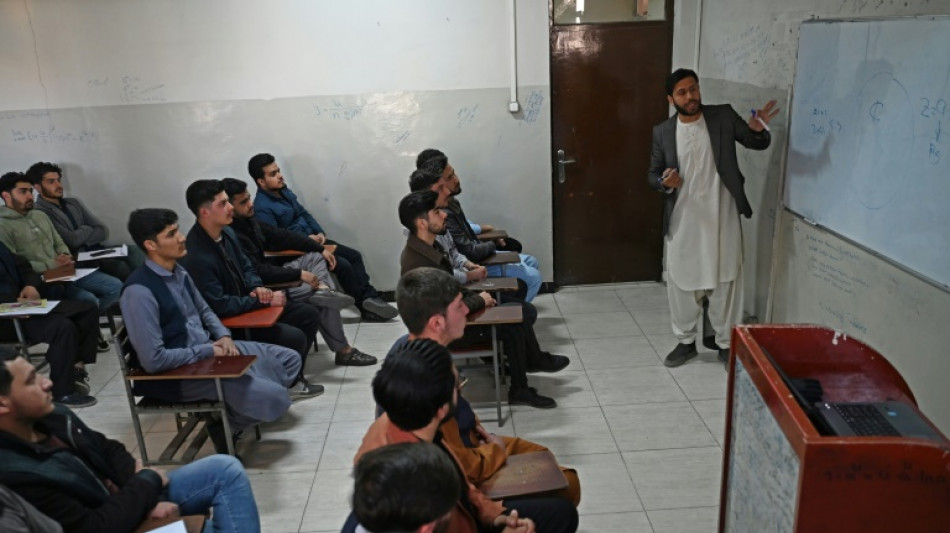
Male students trickled back to their classes Monday after Afghan universities reopened following a winter break but women remain barred by Taliban authorities.
The university ban is one of several restrictions imposed on women since the Taliban stormed back to power in August 2021 and has sparked global outrage -- including across the Muslim world.
"It's heartbreaking to see boys going to the university while we have to stay at home," said Rahela, 22, from the central province of Ghor.
"This is gender discrimination against girls because Islam allows us to pursue higher education. Nobody should stop us from learning."
The Taliban government imposed the ban after accusing women students of ignoring a strict dress code and a requirement to be accompanied by a male relative to and from campus.
Most universities had already introduced gender-segregated entrances and classrooms, as well as allowing women to be taught only by female professors or old men.
"It's painful to see that thousands of girls are deprived of education today," Mohammad Haseeb Habibzadah, a student of computer science at Herat university, told AFP.
"We are trying to address this issue by talking to lecturers and other students so that there can be a way where boys and girls could study and progress together."
Ejatullah Nejati, an engineering student at Kabul University, Afghanistan's largest, said it was a fundamental right of women to study.
"Even if they attend classes on separate days, it's not a problem. They have a right to education and that right should be given to them," Nejati said as he entered the university campus.
Several Taliban officials say the ban on women's education is temporary but, despite promises, they have failed to reopen secondary schools for girls, which have been closed for more than a year.
They have wheeled out a litany of excuses for the closure, from a lack of funds to the time needed to remodel the syllabus along Islamic lines.
The reality, according to some Taliban officials, is that the ultra-conservative clerics advising Afghanistan's supreme leader Hibatullah Akhundzada are deeply sceptical of modern education for women.
Taliban authorities have effectively squeezed women out of public life since retaking power.
Women have been removed from many government jobs or are paid a fraction of their former salary to stay at home.
They are also barred from going to parks, fairs, gyms and public baths, and must cover up in public.
Rights groups have condemned the restrictions, which the United Nations called "gender-based apartheid".
The international community has made the right to education for women a sticking point in negotiations over aid and recognition of the Taliban government.
No country has so far officially recognised the Taliban as Afghanistan's legitimate rulers.
Y.Jeong--CPN