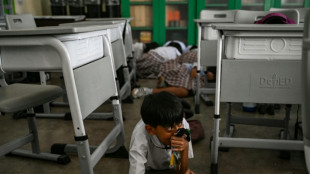
ChatGPT maker fields tool for spotting AI-written text / Photo: Lionel BONAVENTURE - AFP

 Lights out in Laos as electricity exports surge

 Steven Strogatz weighs AI mathematics advances and their consequences for researchers

 Anthropic boss calls for AI slowdown, Altman and Musk agree
 French IT giant Capgemini sells subsidiary after row over ICE links

 Quebec Brokerage Qubit Insurance Announces New Data on Coverage Shortfalls as Rebuilding Costs Rise

 Lady Gaga welcomes first child with fiance: US media

 Bhutan business bets on hazelnuts for farming future

 'Widow's Bay' and 'The Pitt' are favorites for Emmys night

 Coastal erosion forces cancellation of California music festival

 Argentina's Dirty War rears its head in Venice film

 UK lawmakers throw out bill to legalise assisted dying

 US inflation steady in August, fueling Fed rate hike expectations

 New York marks 25th anniversary of 9/11 attacks

 Nepal flood reconstruction bill to be $4.78 bn: foreign ministry

 JUMO and Standard Bank launch Social Finance Framework to scale inclusive finance in Africa

 Doomsday tech: could AI really kill us all?

 French comedy show 'Call my agent' makes film comeback

 It's all coming back: Celine Dion fans gear up for Paris return

 Researchers eye AI revolution in natural disaster forecasts

 US braces for inflation report that may push Fed to hike rates

 Musk threatens legal action over documentary

 Latin America fact-check group asks Meta not to replace verification practice

 AI Risks to Enter 60–80% of Liability and Cyber Insurance Underwriting by 2028, ScienceSoft Predicts

 Tribal Launches Campfire, Letting Business and Technical Teams Build on Salesforce Together

 Stocks fall as fresh oil surge fans inflation fears

Creators of a ChatGPT bot causing a stir for its ability to mimic human writing on Tuesday released a tool designed to detect when written works are authored by artificial intelligence.
The announcement came amid intense debate at schools and universities in the United States and around the world over concerns that the software can be used to assist students with assignments and help them cheat during exams.
US-based OpenAI said in a blog post Tuesday that its detection tool has been trained "to distinguish between text written by a human and text written by AIs from a variety of providers."
The bot from OpenAI, which recently received a massive cash injection from Microsoft, responds to simple prompts with reams of text inspired by data gathered on the internet.
OpenAI cautioned that its tool can make mistakes, particularly with texts containing fewer than 1,000 characters.
"While it is impossible to reliably detect all AI-written text, we believe good classifiers can inform mitigations for false claims that AI-generated text was written by a human," OpenAI said in the post.
"For example, running automated misinformation campaigns, using AI tools for academic dishonesty, and positioning an AI chatbot as a human."
A top French university last week forbade students from using ChatGPT to complete assignments, in the first such ban at a college in the country.
The decision came shortly after word that ChatGPT had passed exams at a US law school after writing essays on topics ranging from constitutional law to taxation.
ChatGPT still makes factual mistakes, but education facilities have rushed to ban the AI tool.
"We recognize that identifying AI-written text has been an important point of discussion among educators, and equally important is recognizing the limits and impacts of AI generated text classifiers in the classroom," OpenAI said in the post.
"We are engaging with educators in the US to learn what they are seeing in their classrooms and to discuss ChatGPT’s capabilities and limitations."
Officials in New York and other jurisdictions have forbidden its use in schools.
A group of Australian universities have said they would change exam formats to banish AI tools and regard them as cheating.
OpenAI said it recommends using the classifier only with English text as it performs worse in other languages.
H.Meyer--CPN