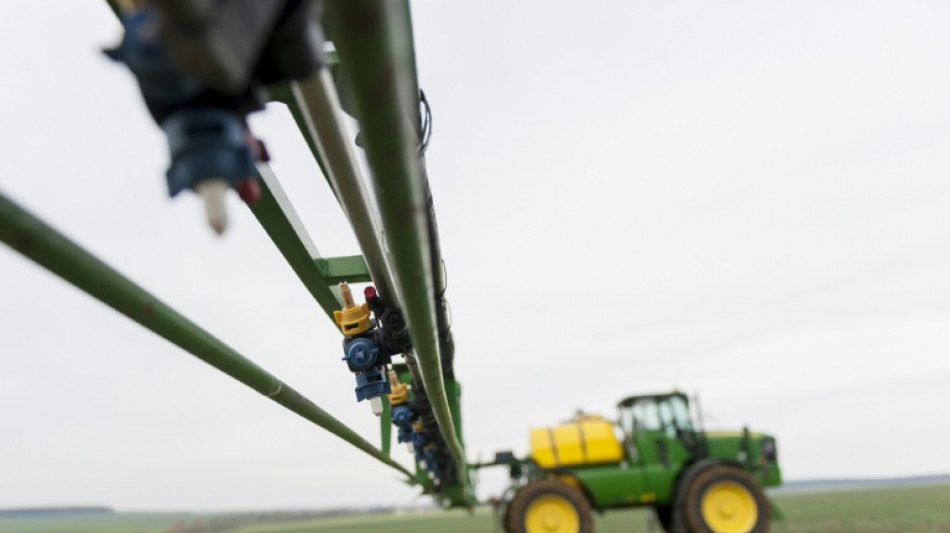
War disrupts fertiliser supplies, puts food security at risk / Photo: Jean Christophe VERHAEGEN - AFP

 Bank of Japan hikes rates to 31-year high to battle inflation

 AI doomsday warnings unlikely to slow IPOs but questions linger

 In Brazil's Amazon, the hunt for oil fuels hopes and fears

 Baby orangutans in India expose 'frightening' scale of trafficking

 Oversight Board blasts 'inadequate' Meta safeguards for AI deepfakes

 Harry makes first public appearance since return to UK

 Princess Diana's brother makes new explosive claims against Charles

 Trump admin overhauls key protection for endangered species

 Mbappe draws political fire over Ceuta t-shirt controversy

 Third malaria death in Germany from outbreak tied to Frankfurt airport

 AtlasClear Holdings Reports Preliminary Fiscal 2026 Revenue of Approximately $20.1 Million, Up 85%; Revenue Plus Interest Income of Approximately $21.9 Million

 'Another arrow to the quiver': World Bank posts record private capital mobilization

 Ireland to boycott Eurovision 2027 over Gaza

 India's Tata Sons reappoints N. Chandrasekaran as chairman

 Germany urges EU action against China to defend carmakers

 Japan eyes changing prostitution law to punish sex buyers

 Modi pitches India as global chipmaking hub

 Ukraine plans record defence spending in 2027

 NASA scan discovers new, 'once in a century' Moon crater

 Most stocks rise as Fed hikes and indicates drive to curb inflation

 UK-Sudanese author pens book to give children 'African history of Africa'

 Argentine judge orders suspension of Falklands oil project

 US Fed raises rates to tackle 'too high' inflation, irking Trump

 Turkey releases 106 protesters, jails more LGBTQ activists

 Candidate for UN chief calls for AI regulation akin to nuclear weapons

With production in the Gulf countries at a standstill and gas prices rising, the war in the Middle East is disrupting the supply of fertilisers and posing risks for food security.
A third of fertiliser shipped by sea comes from the region and cannot make it to the global market as Iran has effectively closed the Strait of Hormuz.
That has sent global fertiliser prices soaring, with the UN expressing concern in particular about the impact on developing countries.
- The Gulf is a key manufacturer -
Natural gas is a key feedstock to make artificial fertilsers, and with its ample gas supplies the Gulf region has become a key manufacturer.
The region produces nearly half of the sulphur sold worldwide and a third of urea -- "the most widely traded fertiliser of all", said Sarah Marlow, global editor for fertilisers at Argus Media.
It also produces a quarter of globally traded ammonia, another feedstock for fertiliser production, she said.
Major food producing nations like the United States and Australia source much of their urea and phosphate from the Gulf nations.
Brazil, the world’s leading soybean producer, imports most of its urea from Qatar and from Iran, which also exports to Turkey and Mexico.
India relies upon Saudi phosphate.
Asia in particularly dependent upon on the Gulf: it imports 64 percent of its ammonia and more than 50 percent of its sulphur and phosphates from the region, according to 2024 figures from Kpler.
But since the start of the conflict, which has seen Iran launch retaliatory strikes against its Gulf neighbours following US and Israeli strikes, production has had to be shut down at fertiliser production facilities, particularly in Qatar.
And the Strait of Hormuz remains largely unnavigable.
A Chinese vessel loaded with sulphur was able to leave on March 7, but around 20 other ships were still waiting as of the middle of the week, according to Kpler, which tracks commodity flows.
- Global repercussions -
While Europe appears at first blush to be less exposed, sourcing just 11 percent of its urea from the region, it will likely be impacted indirectly.
Morocco is a big supplier of phosphorus-based fertilisers to Europe, but is dependent upon the Gulf for sulphur used in their manufacturing.
The EU also imports 26 percent of its urea from Egypt, but the country is confronted by a halt of natural gas supplies from Israel by pipeline, pointed out Argus Media consultant Arthur Portier.
"Egyptian urea has gone from $500 per tonne at the start of the war to more than $650. There is a direct impact on the price of fertiliser" for European farmers, he said.
Other countries that source their gas from the Middle East to produce fertilisers, such as India, have had to ration supplies to their factories.
Bangladesh has temporarily shut down five out of six of them.
The UN expressed concern this week about access to fertilisers in some of the poorest countries.
- Crop production at risk -
Artificial fertilisers provide nitrogen, phosphorus, and potassium necessary for crop growth.
For nitrogen-based fertilisers such as urea, ammonium nitrate and potassium, "global demand never ceases to increase, driven by Asia," said Sylvain Pellerin at INREA, a French agricultural research institute.
INREA models that without these three key fertiliser inputs, global crop production would fall by a third.
But nitrogen fertilisers require natural gas for their chemical synthesis, and a lot of energy.
As for sulfur, it is a co-product of the oil and gas industry.
Where there is gas, you will find urea and ammonia," said the Argus's Marlow.
Production of phosphorus-based fertilisers starts with phosphate rock, of which Saudi Arabia supplies 20 percent of the world total but currently cannot ship it.
- Uncertain outlook -
In addition to the uncertainty about how long the war will last, the other question is the amount of damage that fertiliser production facilities will suffer from the fighting.
Repairs and reconstruction of facilities could considerably delay a return to normality once the fighting ends.
While the immediate needs of farmers are more or less covered, there are questions about the sowing season in the southern hemisphere that begins in June.
Portier said the war could be the spark for Europe to develop a fertiliser supply strategy.
Following the surge in fertiliser prices following the Russian invasion of Ukraine, European farmers reduced their consumption and diversified their suppliers.
The European Commission is preparing a fertiliser action plan for this year.
P.Schmidt--CPN

