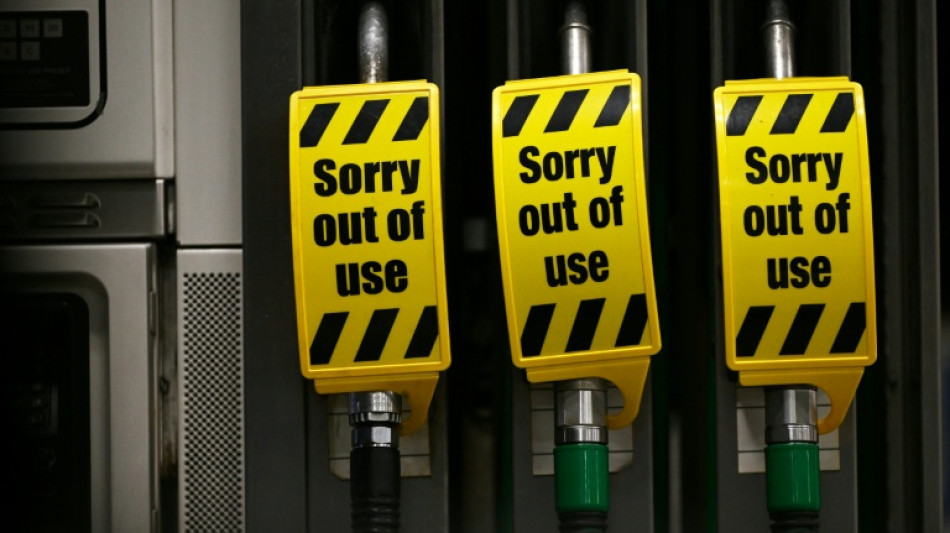
IEA says members to release 400 mn barrels from oil reserves / Photo: Paul ELLIS - AFP

 Japan's busiest rail station tests robot bins

 Backpackers fret over Australian visa crackdown

 Bank of Japan hikes rates to 31-year high to battle inflation

 AI doomsday warnings unlikely to slow IPOs but questions linger

 In Brazil's Amazon, the hunt for oil fuels hopes and fears

 Baby orangutans in India expose 'frightening' scale of trafficking

 Oversight Board blasts 'inadequate' Meta safeguards for AI deepfakes

 Harry makes first public appearance since return to UK

 Princess Diana's brother makes new explosive claims against Charles

 Trump admin overhauls key protection for endangered species

 Mbappe draws political fire over Ceuta t-shirt controversy

 Third malaria death in Germany from outbreak tied to Frankfurt airport

 AtlasClear Holdings Reports Preliminary Fiscal 2026 Revenue of Approximately $20.1 Million, Up 85%; Revenue Plus Interest Income of Approximately $21.9 Million

 'Another arrow to the quiver': World Bank posts record private capital mobilization

 Ireland to boycott Eurovision 2027 over Gaza

 India's Tata Sons reappoints N. Chandrasekaran as chairman

 Germany urges EU action against China to defend carmakers

 Japan eyes changing prostitution law to punish sex buyers

 Modi pitches India as global chipmaking hub

 Ukraine plans record defence spending in 2027

 NASA scan discovers new, 'once in a century' Moon crater

 Most stocks rise as Fed hikes and indicates drive to curb inflation

 UK-Sudanese author pens book to give children 'African history of Africa'

 Argentine judge orders suspension of Falklands oil project

 US Fed raises rates to tackle 'too high' inflation, irking Trump

The International Energy Agency said Wednesday its member countries would unlock 400 million barrels of oil from their reserves to ease the impact of the Middle East war, the biggest such release ever.
"The oil market challenges we are facing are unprecedented in scale, therefore I am very glad that IEA member countries have responded with an emergency collective action of unprecedented size," IEA Executive Director Fatih Birol said.
The IEA-coordinated release exceeded the 182 million barrels of oil that member countries of the Paris-based global energy body released in 2022 when Russian leader Vladimir Putin invaded Ukraine.
"The emergency stocks will be made available to the market over a timeframe that is appropriate to the national circumstances of each member country and will be supplemented by additional emergency measures by some countries," the IEA said.
The announcement came as leaders of the Group of Seven advanced economies discussed the widespread economic fallout from the US-Israeli war with Iran, now into its second week, at a video conference meeting chaired by French President Emmanuel Macron.
Earlier Wednesday, Japan -- whose strategic oil reserves are among the world's largest -- and Germany said they would tap into their oil reserves.
Prime Minister Sanae Takaichi said Japan would release reserves as early as Monday, while Germany's Economy and Energy Minister Katherina Reiche said her country planned to do the same, without specifying a date.
"Without waiting for a formal decision on coordinated international stock releases with the IEA, Japan has decided to take the lead in easing supply and demand in the international energy market by releasing strategic reserves as early as the 16th of this month," Takaichi told reporters.
"Given Japan's exceptionally high dependence on the Middle East (for oil) and as we will be severely impacted, we plan to utilise Japan's strategic petroleum reserves," she said.
Reiche said a total of 2.4 million tons would be released.
- 'Perfect time' -
The crude market has been hit by wild volatility since the United States and Israel began striking Iran at the end of last month, with Tehran retaliating by attacking targets across the oil-rich Gulf and effectively shutting down the Strait of Hormuz.
The strait normally carries about 20 percent of the world's oil and gas supplies.
US Interior Secretary Doug Burgum said the transit problem was "temporary."
"What we have here is not a shortage of energy in the world. We've got a transit problem," he said.
A French official said earlier G7 members wanted to move in lockstep.
"There is no oil shortage today, but a price problem, so the idea is more to send a signal to the markets, and for that signal to be strong, it is better if it is coordinated," he said.
- 'Pumping less oil' -
Ipek Ozkardeskaya, a senior analyst at trading platform Swissquote Bank, said 400 million barrels would still be a "meagre" amount compared with the roughly 45 million barrels that IEA countries consume every day.
"It would therefore be a temporary fix," she said, adding the announcement helped keep oil prices in check on Wednesday.
"The Middle East is now pumping less oil -- around six percent less -- in reaction to the Iran war."
Countries around the world have been left scrambling in response to the oil price spikes.
The 32 members of the IEA hold over 1.2 billion barrels of public emergency oil stocks, with a further 600 million barrels of industry stocks held under government mandates.
J.Bondarev--CPN