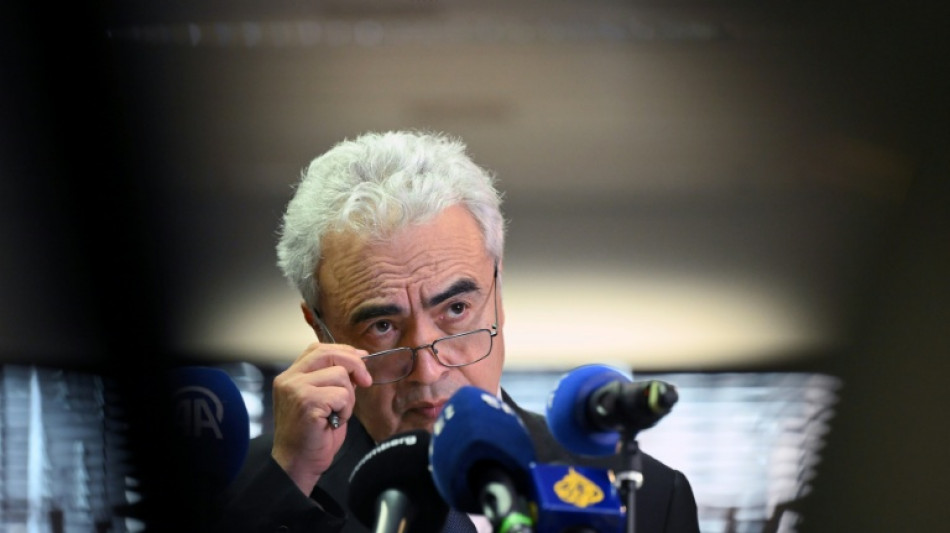
Global energy body discusses releasing strategic oil reserves / Photo: Nicolas TUCAT - AFP

 Japan's busiest rail station tests robot bins

 Backpackers fret over Australian visa crackdown

 Bank of Japan hikes rates to 31-year high to battle inflation

 AI doomsday warnings unlikely to slow IPOs but questions linger

 In Brazil's Amazon, the hunt for oil fuels hopes and fears

 Baby orangutans in India expose 'frightening' scale of trafficking

 Oversight Board blasts 'inadequate' Meta safeguards for AI deepfakes

 Harry makes first public appearance since return to UK

 Princess Diana's brother makes new explosive claims against Charles

 Trump admin overhauls key protection for endangered species

 Mbappe draws political fire over Ceuta t-shirt controversy

 Third malaria death in Germany from outbreak tied to Frankfurt airport

 AtlasClear Holdings Reports Preliminary Fiscal 2026 Revenue of Approximately $20.1 Million, Up 85%; Revenue Plus Interest Income of Approximately $21.9 Million

 'Another arrow to the quiver': World Bank posts record private capital mobilization

 Ireland to boycott Eurovision 2027 over Gaza

 India's Tata Sons reappoints N. Chandrasekaran as chairman

 Germany urges EU action against China to defend carmakers

 Japan eyes changing prostitution law to punish sex buyers

 Modi pitches India as global chipmaking hub

 Ukraine plans record defence spending in 2027

 NASA scan discovers new, 'once in a century' Moon crater

 Most stocks rise as Fed hikes and indicates drive to curb inflation

 UK-Sudanese author pens book to give children 'African history of Africa'

 Argentine judge orders suspension of Falklands oil project

 US Fed raises rates to tackle 'too high' inflation, irking Trump

Member states of the International Energy Agency (IEA) were set to meet on Tuesday for crisis talks to assess security of supply and the potential release of emergency stocks as the Middle East war roils markets, the body's chief said.
In a statement following a Paris meeting of G7 energy ministers on the economic fallout of the conflict, IEA executive director Fatih Birol said he was "in close contact" with energy ministers from key energy producers and consumers regarding the situation.
"In oil markets, conditions have deteriorated in recent days. In addition to the challenges of transit through the Strait of Hormuz, a substantial amount of oil production has been curtailed. This is creating significant and growing risks for the market," he said.
"I have convened an extraordinary meeting of IEA member governments, which will take place later today to assess the current security of supply and market conditions to inform a subsequent decision on whether to make emergency stocks of IEA countries available to the market," Birol added.
He said the G7 meeting addressed "all the available options, including making IEA emergency oil stocks available to the market".
Crude prices have seen sharp fluctuations due to supply disruptions, jumping 30 percent on Monday to nearly $120 per barrel before retreating later that day.
But risks remain, with Iran vowing on Tuesday that not one litre of oil would be exported from the Gulf while the United States and Israel press ahead with their bombardment of the country.
IEA member countries currently hold over 1.2 billion barrels of public emergency oil stocks, with a further 600 million barrels of industry stocks held under government mandates.
- 'We want to be ready' -
A meeting of G7 finance ministers on Monday discussed a possible release of strategic oil reserves, but French Finance Minister Roland Lescure, whose country holds the rotating presidency of the Group of Seven advanced economies, said later the situation was "not there yet".
On Tuesday, Lescure said the G7 nations wanted to prepare for any developments.
"We have asked the International Energy Agency to start working on scenarios and, of course, to update its stock data so that we have the most recent information," he told reporters.
"We want to be ready to react at any moment," he added.
He said there were no supply issues in North America and Europe, unlike in Asia, which is dependent on oil supplies flowing through the Strait of Hormuz.
About 100 million barrels of oil are consumed globally every day.
The Paris-based IEA was created to coordinate responses to major supply disruptions after the 1973 oil crisis.
In order to ensure energy security, the IEA imposes on its members an obligation to hold emergency oil stocks equivalent to at least 90 days of net oil imports.
bur-hrc-nal-dlm-as/cc/rl
Y.Uduike--CPN