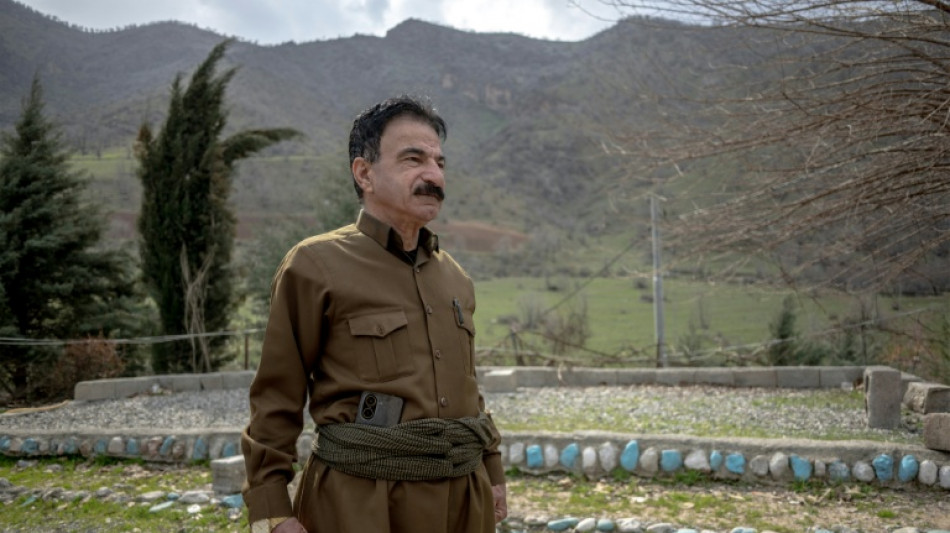
As Iran conflict spills over, Iraq's Kurds say 'this war is not mine' / Photo: Ozan KOSE - AFP

 UK actor Naomi Watts honoured at Spain film festival
 Trump signs bill authorizing sweeping Russia sanctions

 Anthropic picks Accenture for in-house AI safety evaluation

 Hushing and hedging: US companies retreat on climate

 Crisis-wracked Volkswagen warns of 10-bn-euro hit to profits

 Shakira to cap off world tour with Madrid 12-gig run

 Isolated Syrian-Druze city shortages

 UNESCO can be 'moderator' in AI debate: chief to AFP

 Russia seizes assets of Nestle, French firms

 Anthropic says AI systems moving towards building themselves

 Asian stocks boosted by falling oil, yen weakens after BoJ rate hike

 Afghan medical students in Pakistan hope court stops college expulsions

 Australia to detain tourists who overstay visa, minister says

 Asian stocks track Wall St rally as oil prices drop

 Prized Mexican relic returns on loan, two centuries on

 'In our lane': Fed's Warsh defies Trump but still fighting for credibility

 Trump admin makes major cut to endangered species protections

 GM delivers first components for US interceptor missiles

 Travis Scott and Keith Richards feature on GTA VI soundtrack

 King Charles warns tech bosses of 'existential dangers' of AI

 French fishermen block ports over petrol prices

 Micron's Taiwan workers say 68 months' bonus not enough

 Canada's Carney pushes 'new alliance' with EU despite Trump threats

 Beyond Investment Returns: Families Are Measuring Wealth by Freedom, Continuity, and Legacy, According to Nour Private Wealth

 King Charles disputes claims in book by Princess Diana's brother

On a deserted road not too far from the border between Iran and Iraqi Kurdistan, Satar Barsirini looked up at the sky, now streaked with jets and drones.
Iraq's Kurdish region has found itself caught in the crossfire of a regional war triggered by US and Israeli attacks on the Islamic republic.
Dressed like the Kurdish fighters he once served alongside, Barsirini still wears the khaki shalwar, fitted jacket and scarf wrapped around his waist.
Though recently retired, he refuses to give up his peshmerga uniform as he tills his small plot of land.
The rumble of jets and hum of drones "come from everywhere. Especially at night", he told AFP in the hamlet of Barsirini, dozens of kilometres from the border.
He described the "shiver in our flesh" as the drones hit the ground outside.
"I feel bad for the people, because we have paid a lot in blood to liberate Kurdistan... We just want to live."
Erbil, the autonomous region's capital, and the valleys leading to the border have been targeted by Tehran and the Iraqi armed groups it supports.
American bases there have come under fire, as have positions held by Iranian Kurdish parties -- the same ones US President Donald Trump said it would be "wonderful" to see storm Iran.
But Iran warned on Friday it would target facilities in Iraqi Kurdistan if fighters crossed into its territory.
"This isn't my war," said 58-year-old Barsirini.
He recalled the brutal repression and flight into the snowy mountains after the 1991 Kurdish uprising that followed the first Gulf War.
- 'Dangerous people' -
The uprising was repressed, leading to an exodus of two million Kurds to Iran and Turkey.
"When we fled the cities for our lives, we went to Iran. They helped us, they gave us shelter and food," he said.
The Kurds would not forget that, Barsirini stressed, adding that they could not just "turn against them" now to support the US and Israel.
"I don't trust (Americans). They are dangerous people," he said.
The Kurds, an ethnic minority with a distinct culture and language, are rooted in the mountainous region spread across Turkey, Syria, Iraq and Iran.
They have long fought for their own homeland, but for decades suffered defeats on the battlefield and massacres in their hometowns.
They make up one of Iran's most important non-Persian ethnic minority groups.
A week of war has gripped daily life in Iraqi Kurdistan, residents told AFP.
"People are afraid," said Nasr al-Din, a 42-year-old policeman who, as a child, lived through the 1991 exodus -- "thrown on a donkey's back with my sister".
"This generation is different from the older ones" that have seen "seen fighting".
Now, he said, you could be "sitting down in your home... and all of a sudden a drone hits your house".
"We may have to go into town or somewhere safer," said Issa Diayri, 31, a truck driver waiting in a roadside garage, his lorry idle for lack of deliveries from Iran.
- 'Shouldn't get involved' -
Soran, a small town of 3,000 people about 65 kilometres (40 miles) from the border, was hit Thursday by a drone that fell in the middle of a street.
There, baker Yussef Ramazan, 42, and his three apprentices, hurriedly made bread before breaking their fast.
But, living so close to the Iranian border, he said "people are afraid to come and buy it".
He told AFP he did not think it was a good idea "for the Kurdish region to get involved in this war".
"We are not even an independent country yet. We would like to become one, but we are nothing for now, so we shouldn't get involved in these situations."
Across the street, Hajji watched from his empty dry cleaning shop as the road cleared.
Before the war, the town was crowded as evening fell, he said, declining to give his full name.
"But after the drone explosion, no one was here. In five minutes, everyone left the street and no one was out."
L.K.Baumgartner--CPN