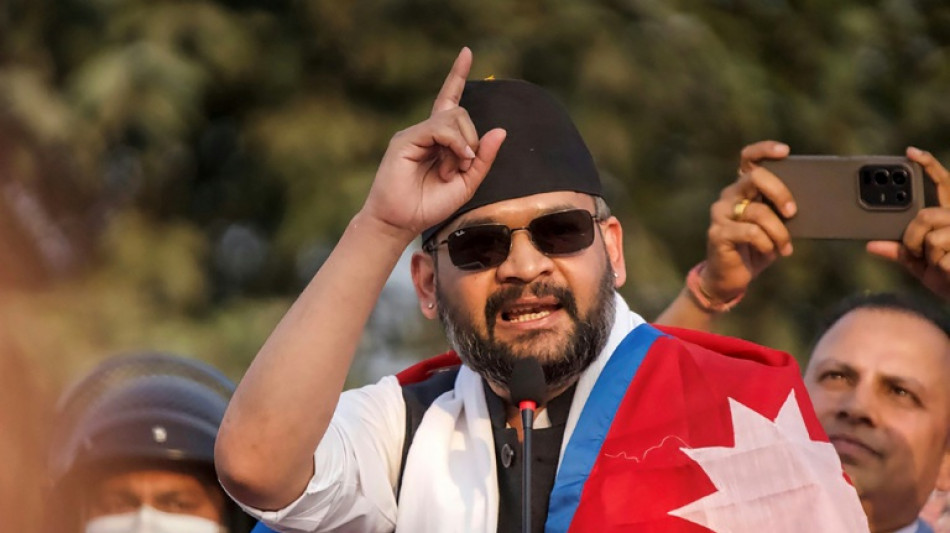
Nepal's rapper politician who took on the old guard and won / Photo: Sumit MISHRA - AFP/File

 UK actor Naomi Watts honoured at Spain film festival
 Trump signs bill authorizing sweeping Russia sanctions
 Anthropic picks Accenture for in-house AI safety evaluation
 Hushing and hedging: US companies retreat on climate

 Crisis-wracked Volkswagen warns of 10-bn-euro hit to profits

 Shakira to cap off world tour with Madrid 12-gig run

 Isolated Syrian-Druze city shortages

 UNESCO can be 'moderator' in AI debate: chief to AFP

 Russia seizes assets of Nestle, French firms

 Anthropic says AI systems moving towards building themselves

 Asian stocks boosted by falling oil, yen weakens after BoJ rate hike

 Afghan medical students in Pakistan hope court stops college expulsions

 Australia to detain tourists who overstay visa, minister says

 Asian stocks track Wall St rally as oil prices drop

 Prized Mexican relic returns on loan, two centuries on

 'In our lane': Fed's Warsh defies Trump but still fighting for credibility

 Trump admin makes major cut to endangered species protections

 GM delivers first components for US interceptor missiles

 Travis Scott and Keith Richards feature on GTA VI soundtrack

 King Charles warns tech bosses of 'existential dangers' of AI

 French fishermen block ports over petrol prices

 Micron's Taiwan workers say 68 months' bonus not enough

 Canada's Carney pushes 'new alliance' with EU despite Trump threats

 Beyond Investment Returns: Families Are Measuring Wealth by Freedom, Continuity, and Legacy, According to Nour Private Wealth

 King Charles disputes claims in book by Princess Diana's brother

Nepal's rapper-turned-mayor Balendra Shah won a dramatic parliamentary contest on Saturday, defeating veteran leader KP Sharma Oli in the former prime minister's own constituency after staking his political future on the challenge.
Shah's victory over the veteran Marxist leader marks one of the most symbolic results of Nepal's high-stakes parliamentary election, held six months after mass anti-corruption protests toppled the government.
His win caps a bold gamble by the 35-year-old reformist, who resigned as Kathmandu mayor to challenge Oli, the 74-year-old four-time premier, in his own stronghold.
Shah had taken an unassailable lead on Saturday, according to Election Commission figures.
He will become prime minister if his Rastriya Swatantra Party (RSP) party secures a parliamentary majority, as Election Commission trends on Saturday put it on course to do.
Better known as Balen, the sharply dressed 35-year-old has emerged as a symbol of youth-driven political change.
Born in Kathmandu in 1990, he was a schoolboy during Nepal's 1996-2006 Maoist civil war, which killed thousands and eventually ended the monarchy.
Shah trained as a civil engineer but first gained national attention through Nepal's underground hip-hop scene, releasing songs that railed against corruption and inequality.
Those themes, he says, still guide his politics.
"If a person involved in politics also engages in literature or music, it becomes emotionally driven," Shah told AFP during his campaign for Thursday's elections in the Himalayan nation of 30 million people.
"We also need to nurture the emotional aspect of our lives, and a politician should possess that sensitivity."
His music, which has drawn millions of views online, helped him cultivate a devoted following on social media -- a platform he continues to favour over traditional outlets for communicating with supporters.
That popularity translated into a political shock in 2022, when Shah became the first independent candidate elected mayor of Kathmandu, stunning Nepal's entrenched political establishment.
He built a reputation as a blunt, often confrontational reformer as mayor, launching campaigns against tax evasion, traffic congestion and mismanagement.
However, his tenure also attracted criticism for heavy-handed enforcement and for bypassing journalists in favour of broadcasting directly to millions of followers online.
- 'Social justice' -
Shah resigned as mayor in January to run in the general elections, the first since mass protests in September overthrew Oli.
Rather than running from his Kathmandu base, Shah chose to challenge Oli directly in Jhapa-5, a largely rural constituency around 300 kilometres (185 miles) southeast of the capital.
He said that "contesting against a major figure" signalled that he was "not taking the easy way out" to win a seat.
"It demonstrates that, despite the problems or betrayals that have affected the country, we are moving towards addressing them," he said.
Shah joined the centrist RSP, led by television host Rabi Lamichhane, which became parliament's fourth-largest force in the last elections in 2022 after challenging parties that had dominated Nepal since the end of the civil war.
"We share the same ideology," Shah said, describing a vision of "a liberal economic system with social justice", including free education and healthcare for the poor.
Shah emerged as a central figure during the September protests, which were initially sparked by anger over a brief ban on social media platforms under a loose "Gen Z" banner.
They quickly grew into a broader movement against corruption and economic stagnation. At least 77 people were killed during the unrest.
"Gen Z's number one demand is good governance, because there is a high level of corruption in the country," Shah said.
He insists music will remain part of his identity, despite his political ambitions.
"Music is a medium to express oneself," he said. "I will continue it, even if I am elected as prime minister."
J.Bondarev--CPN