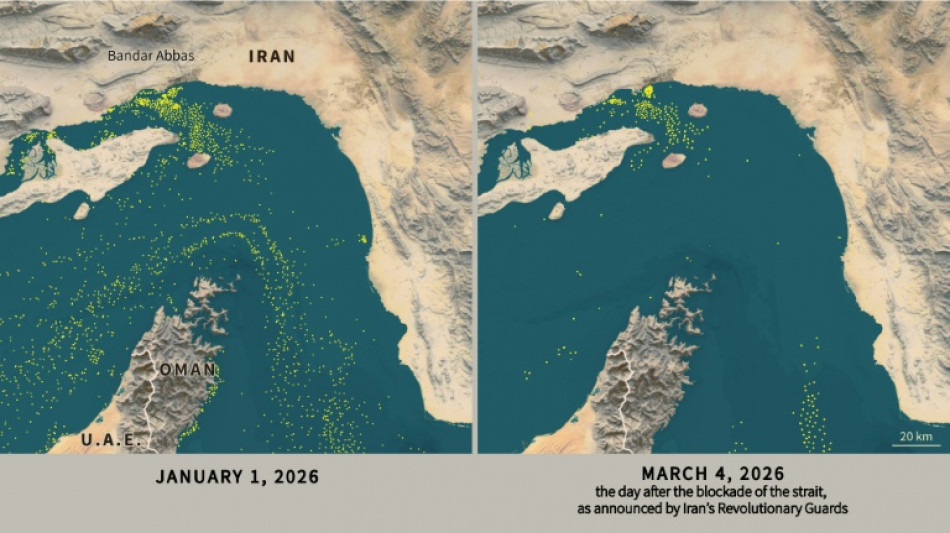
Only nine commercial ships detected crossing the Hormuz Strait since Monday / Photo: Valentin RAKOVSKY, Julie PEREIRA - AFP

 UK actor Naomi Watts honoured at Spain film festival
 Trump signs bill authorizing sweeping Russia sanctions

 Anthropic picks Accenture for in-house AI safety evaluation

 Hushing and hedging: US companies retreat on climate

 Crisis-wracked Volkswagen warns of 10-bn-euro hit to profits

 Shakira to cap off world tour with Madrid 12-gig run

 Isolated Syrian-Druze city shortages

 UNESCO can be 'moderator' in AI debate: chief to AFP

 Russia seizes assets of Nestle, French firms

 Anthropic says AI systems moving towards building themselves

 Asian stocks boosted by falling oil, yen weakens after BoJ rate hike

 Afghan medical students in Pakistan hope court stops college expulsions

 Australia to detain tourists who overstay visa, minister says

 Asian stocks track Wall St rally as oil prices drop

 Prized Mexican relic returns on loan, two centuries on

 'In our lane': Fed's Warsh defies Trump but still fighting for credibility

 Trump admin makes major cut to endangered species protections

 GM delivers first components for US interceptor missiles

 Travis Scott and Keith Richards feature on GTA VI soundtrack

 King Charles warns tech bosses of 'existential dangers' of AI

 French fishermen block ports over petrol prices

 Micron's Taiwan workers say 68 months' bonus not enough

 Canada's Carney pushes 'new alliance' with EU despite Trump threats

 Beyond Investment Returns: Families Are Measuring Wealth by Freedom, Continuity, and Legacy, According to Nour Private Wealth

 King Charles disputes claims in book by Princess Diana's brother

Only nine oil tankers, cargo and container ships, some of which at times concealed their position, have been recorded crossing the Strait of Hormuz since Monday, according to MarineTraffic data analysed by AFP.
After three ships were attacked on Sunday, at least three tankers and a vessel carrying gas have crossed this chokepoint.
Nearly 20 percent of the world's crude oil and about 20 percent of liquefied natural gas (LNG) usually transit through Strait of Hormuz.
Only vessels that emitted at least one signal on either side of the Strait of Hormuz were counted by AFP, excluding any others that may have travelled with their signals entirely concealed for a long period of time.
Attacks since Sunday have multiplied against ships navigating Hormuz, raising concerns about a lasting impact on the global economy as the US-Israel war on Iran and Tehran's retaliatory attacks across the Gulf region have upended the world's energy sector.
"Some tankers are still travelling east and west through the strait, with a number of voyages occurring under AIS blackouts," noted Matt Wright, an analyst at Kpler, which publishes MarineTraffic, on Wednesday.
One example is the tanker Kavomaleas, which emitted a signal east of the straight on March 3 and then another in the Gulf about 14 hours later.
-- Sanctioned ships --
Another example is a 130-meter container ship registered in Panama, which left Pakistan on Monday. Having arrived at the entrance to the Gulf on Wednesday night, it has been inside the strait since Thursday morning.
The Pushpak, a vessel designed for transporting petroleum products, left the Gulf on Thursday evening, having departed from an Iraqi port.
The Hout, a cargo ship registered in the Comoros, left Dubai on Tuesday bound for a port in southeastern Iran.
The Danuta I, a 225-meter natural gas carrier under US sanctions, crossed the Strait of Hormuz at dawn on Friday.
The Athina, spotted by the Financial Times, was east of the strait on February 28 and transmitted a position to MarineTraffic west of Hormuz on March 1.
It loaded oil in Bahrain before resuming its journey towards the strait but has not transmitted any signal since Thursday afternoon.
It is one of at least five ships belonging to the Dynacom company that have crossed the strait since the start of the war, all with their transponders switched off, according to the FT.
Most carriers have suspended their operations and the passage remains perilous, as demonstrated by the Safeen Prestige, which was hit by projectiles while sailing east from the Gulf on Tuesday, according to the British Maritime Safety Organisation (UKMTO).
lam-vr-jwp-ys/lmc/giv
P.Kolisnyk--CPN