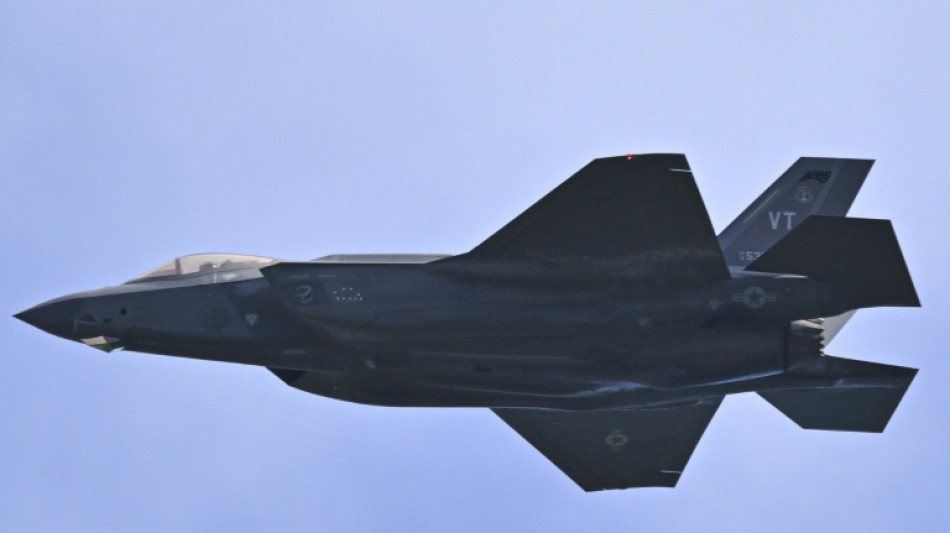
Swiss eyeing fewer F-35 fighters, reshaping defence set-up / Photo: Miguel J. Rodriguez Carrillo - AFP

 UK actor Naomi Watts honoured at Spain film festival
 Trump signs bill authorizing sweeping Russia sanctions
 Anthropic picks Accenture for in-house AI safety evaluation
 Hushing and hedging: US companies retreat on climate

 Crisis-wracked Volkswagen warns of 10-bn-euro hit to profits

 Shakira to cap off world tour with Madrid 12-gig run

 Isolated Syrian-Druze city shortages

 UNESCO can be 'moderator' in AI debate: chief to AFP

 Russia seizes assets of Nestle, French firms

 Anthropic says AI systems moving towards building themselves

 Asian stocks boosted by falling oil, yen weakens after BoJ rate hike

 Afghan medical students in Pakistan hope court stops college expulsions

 Australia to detain tourists who overstay visa, minister says

 Asian stocks track Wall St rally as oil prices drop

 Prized Mexican relic returns on loan, two centuries on

 'In our lane': Fed's Warsh defies Trump but still fighting for credibility

 Trump admin makes major cut to endangered species protections

 GM delivers first components for US interceptor missiles

 Travis Scott and Keith Richards feature on GTA VI soundtrack

 King Charles warns tech bosses of 'existential dangers' of AI

 French fishermen block ports over petrol prices

 Micron's Taiwan workers say 68 months' bonus not enough

 Canada's Carney pushes 'new alliance' with EU despite Trump threats

 Beyond Investment Returns: Families Are Measuring Wealth by Freedom, Continuity, and Legacy, According to Nour Private Wealth

 King Charles disputes claims in book by Princess Diana's brother

Switzerland announced Friday it wanted to buy 30 US F-35A fighter jets rather than 36 after Washington hiked the price, and said its broader defence set-up needed repurposing to face current threats.
The militarily neutral country also said it was looking at buying a European surface-to-air defence system to go alongside the delayed Patriot system on order from the United States.
Outlining the tense geopolitical situation in Europe, the landlocked nation furthermore said it needed to gear up to face hybrid threats.
The F-35A combat aircraft -- already used by the US Air Force and several European countries -- was chosen by Switzerland in June 2021, over the Airbus Eurofighter, the F/A-18 Super Hornet by Boeing, and French firm Dassault's Rafale.
But Bern and Washington have been quibbling over the final price of the jets, bought to replace the ageing Swiss fleet.
In June last year, Switzerland said the United States wanted Bern to assume additional costs -- cited as high inflation and surging raw material and energy prices.
However, Bern wanted to stick to the agreed price of just over six billion Swiss francs ($7.7 billion) -- an amount that was approved in a 2020 referendum.
Defence Minister Martin Pfister told a press conference Friday that an additional 1.1 billion francs would have been required "for the 36 aircraft initially planned".
The government is now looking at buying "approximately 30 F-35As", said Pfister.
The exact number will depend on contract negotiations between the US government and manufacturers Lockheed Martin.
- Hybrid threats -
Switzerland's long-standing position has been one of well-armed military neutrality and the European country has mandatory conscription for men.
Bern painted a grim picture of the current security climate.
"The global security situation and Switzerland's geopolitical environment have deteriorated in recent years," the government said.
"The war in Ukraine, increasing hybrid threats, cyberattacks, disinformation and espionage are also having an impact on Switzerland."
But the Alpine country is "not sufficiently equipped to counter the most likely threats," which it said were hybrid warfare and attacks from a distance.
It blamed previous cost-cutting, price increases and long delivery times on the international arms market.
- Patriot wait time -
Last July, Washington told Bern that the five Patriot units it had on order were being reprioritised and heading to Ukraine.
"According to current knowledge, the delay is four to five years," the government said Friday.
While Switzerland "is sticking to the procurement of Patriot systems due to the importance of the ability to defend against attacks from a distance," it will look for an additional system.
"This reduces dependence on a single supply chain or a single country, and on the other hand, it can be used to better ensure availability," it said.
The government said the Swiss military reckons it needs 31 billion Swiss francs to strengthen the country's defence and security.
"A temporary increase in VAT is intended to make it possible to provide the armed forces... with the financial resources to better protect the population and the country against the most likely threats," it said.
The government is therefore proposing raising the VAT rate by 0.8 percentage points for 10 years, and by creating an "armament fund, which would be financed by the VAT rise and a slice of the army's regular budget".
The government hopes a referendum on plan can be held in mid-2027 so that the temporary VAT increase can take effect in 2028.
Ch.Lefebvre--CPN