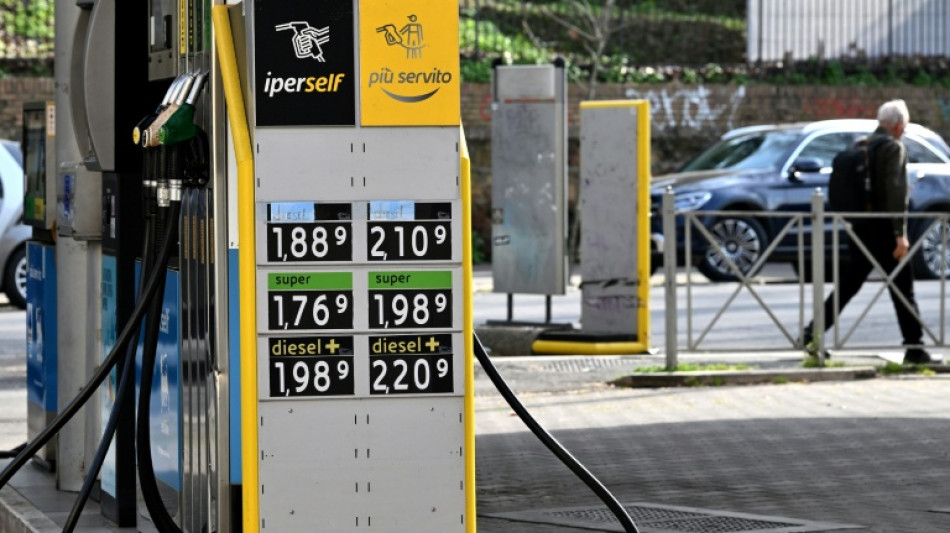
War in Middle East raises stagflation fears in Europe and beyond / Photo: Alberto PIZZOLI - AFP

 UK actor Naomi Watts honoured at Spain film festival
 Trump signs bill authorizing sweeping Russia sanctions

 Anthropic picks Accenture for in-house AI safety evaluation
 Hushing and hedging: US companies retreat on climate

 Crisis-wracked Volkswagen warns of 10-bn-euro hit to profits

 Shakira to cap off world tour with Madrid 12-gig run

 Isolated Syrian-Druze city shortages

 UNESCO can be 'moderator' in AI debate: chief to AFP

 Russia seizes assets of Nestle, French firms

 Anthropic says AI systems moving towards building themselves

 Asian stocks boosted by falling oil, yen weakens after BoJ rate hike

 Afghan medical students in Pakistan hope court stops college expulsions

 Australia to detain tourists who overstay visa, minister says

 Asian stocks track Wall St rally as oil prices drop

 Prized Mexican relic returns on loan, two centuries on

 'In our lane': Fed's Warsh defies Trump but still fighting for credibility

 Trump admin makes major cut to endangered species protections

 GM delivers first components for US interceptor missiles

 Travis Scott and Keith Richards feature on GTA VI soundtrack

 King Charles warns tech bosses of 'existential dangers' of AI

 French fishermen block ports over petrol prices

 Micron's Taiwan workers say 68 months' bonus not enough

 Canada's Carney pushes 'new alliance' with EU despite Trump threats

 Beyond Investment Returns: Families Are Measuring Wealth by Freedom, Continuity, and Legacy, According to Nour Private Wealth

 King Charles disputes claims in book by Princess Diana's brother

Global energy prices have shot upwards after the US and Israel unleashed war in the Middle East, but just how far those shocks will ripple across the economy remains unclear.
Still, the spectre of "stagflation" -- high inflation coupled with stagnant economic growth -- once again looms over the global economy in the event of a prolonged conflict.
- What is the global risk of inflation? -
The risks are still highly uncertain at this stage, as they largely depend on how long conflict lasts.
"It is still too soon to determine whether the current crisis will translate into sustained global inflation," said economist Paola Subacchi of the University of Bologna and Sciences Po in Paris.
"Much depends on how far and how long oil and gas prices rise, and whether those increases feed through broadly into production and transport costs," she added.
Bank of America economists wrote that their baseline scenario was a shorter conflict, which would limit how much further oil prices might rise and see "the shock fading in the next few weeks".
Paul Chollet, chief economist at the French banking group Credit Mutuel Arkea, said a short conflict -- such as a four- or five-week war, as US President Donald Trump has suggested -- would mean that "prices, particularly energy prices, will return to their pre-bombing levels within two months".
"That doesn't mean that you won't see inflation in the short term," he added, noting that price increases are already evident for fuels such as petrol.
But "if the conflict drags on," Chollet added, then "we could see stagflation" in Europe.
That risk would rise "if production facilities" such as oil and gas installations in the Middle East "were permanently damaged" in the fighting.
"Overall, I am concerned about low-income countries, countries with high level of debt, in this environment," International Monetary Fund (IMF) Managing Director Kristalina Georgieva said Thursday in Bangkok. "It will become so much harder for them."
- Echoes of Russia's 2022 invasion of Ukraine? -
For now, at least, most economists do not see strong parallels to 2022, when Russia's full-scale invasion of Ukraine sent gas prices surging, plunged much of Europe into an energy crisis and spiked inflation.
"2026 is not 2022," said the governor of the Bank of France, Francois Villeroy de Galhau.
"It is difficult to make direct comparisons," Subacchi said. "However, while Ukraine mainly affected Europe, a Middle East crisis could affect both Europe and Asia."
Within Europe, however, the risks are not nearly as concentrated as in 2022, when Russia oil and gas imports were a dominant source of energy in many markets.
"What made us very vulnerable in 2022 was our dependence on Russia," Chollet said. Today, much of the continent has "diversified our supply sources", he added.
Chollet also noted that energy price increases had been more modest at this stage, with the benchmark Brent crude oil price at around $90 per barrel compared to nearly $140 in 2022.
For natural gas, Dutch TTF futures contract -- the main European benchmark -- have increased notably to around 50 euros ($58) per megawatt-hour, compared to around 30 euros last week.
But prices are still much lower than in 2022, Chollet said, when "they reached as high as 340 euros per megawatt-hour".
- Which economies are most vulnerable? -
Different parts of the world will likely feel the effects of the Middle East crisis more acutely.
"When it comes to oil shocks, the US is more sensitive on inflation while Europe is more sensitive on growth. However, the sharp rise in European natural gas prices does increase its exposure," wrote Luke Templeman, a Deutsche Bank analyst.
Subacchi said that the countries most vulnerable to inflation "are those heavily dependent on oil and gas imports from the Middle East, particularly in Europe and Asia".
"The United States," she added, "is relatively shielded thanks to strong domestic energy production and the strength of the dollar".
A.Zimmermann--CPN