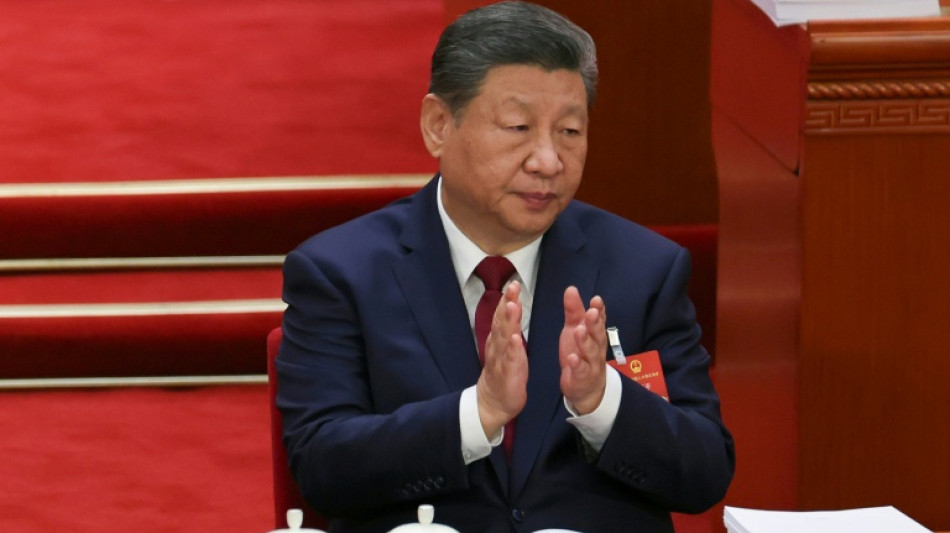
China sets lowest growth target in decades as consumption lags / Photo: FLORENCE LO - POOL/AFP

 UK actor Naomi Watts honoured at Spain film festival

 Trump signs bill authorizing sweeping Russia sanctions

 Anthropic picks Accenture for in-house AI safety evaluation

 Hushing and hedging: US companies retreat on climate

 Crisis-wracked Volkswagen warns of 10-bn-euro hit to profits

 Shakira to cap off world tour with Madrid 12-gig run

 Isolated Syrian-Druze city shortages

 UNESCO can be 'moderator' in AI debate: chief to AFP

 Russia seizes assets of Nestle, French firms

 Anthropic says AI systems moving towards building themselves

 Asian stocks boosted by falling oil, yen weakens after BoJ rate hike

 Afghan medical students in Pakistan hope court stops college expulsions

 Australia to detain tourists who overstay visa, minister says

 Asian stocks track Wall St rally as oil prices drop

 Prized Mexican relic returns on loan, two centuries on

 'In our lane': Fed's Warsh defies Trump but still fighting for credibility

 Trump admin makes major cut to endangered species protections

 GM delivers first components for US interceptor missiles

 Travis Scott and Keith Richards feature on GTA VI soundtrack

 King Charles warns tech bosses of 'existential dangers' of AI

 French fishermen block ports over petrol prices

 Micron's Taiwan workers say 68 months' bonus not enough

 Canada's Carney pushes 'new alliance' with EU despite Trump threats

 Beyond Investment Returns: Families Are Measuring Wealth by Freedom, Continuity, and Legacy, According to Nour Private Wealth

 King Charles disputes claims in book by Princess Diana's brother

China set its annual growth target at 4.5-5 percent on Thursday, its lowest figure in decades but at the centre of plans to tackle sluggish consumption and a flagging property market.
Beijing also used its showpiece annual political gathering to announce a seven percent increase in its defence budget, the second largest in the world, in line with previous years as it looks to counter the United States and enforce its claims over Taiwan and the South China Sea.
China is the world's second-largest economy and accounts for a third of global growth, but it faces serious structural imbalances and US trade pressures despite sustaining strong exports.
"The achievements of the past year were hard-won," Premier Li Qiang said, as he opened the annual meeting of the National People's Congress (NPC), China's parliament, on Thursday morning.
"Rarely in many years have we encountered such a grave and complex landscape, where external shocks and challenges were intertwined with domestic difficulties and tough policy choices."
This year's growth target is the lowest since 1991, according to AFP research.
The only exception was in 2020, when none was set as the economy reeled from the Covid-19 pandemic.
- Quality over speed -
Delegates from across China gathered in the cavernous Great Hall of the People for a series of highly orchestrated meetings in Beijing known as the Two Sessions, overseen by President Xi Jinping.
They will approve bills and reforms that have largely already been decided by Xi and the ruling Chinese Communist Party (CCP) during a week of political theatre in the capital.
The CCP has said repeatedly that China's economic growth model must shift away from traditional drivers, such as exports and manufacturing, and towards consumption.
Other "main projected targets for development" in 2026 include an increase in the consumer price index of around two percent and "growth in residents' income in step with economic growth", according to the report delivered by Li.
"The policymakers have been saying on many occasions that the quality of growth is more important than the speed of growth," Zhiwei Zhang, chief economist at Pinpoint Asset Management, wrote in a note on Thursday.
"The decision to cut the growth target for this year is a big step that signifies this shift of policy priority."
China's economic expansion has been slowing for years as the economy matures.
The government has said its focus is now on "high-quality" growth through upgrading industry, investing in new technologies and pursuing green development.
Strong exports drove the economy to expand five percent in 2025, with the trade surplus hitting a record $1.2 trillion, despite a months-long trade war with the United States.
- 'Strong headwinds' -
The CCP wants to rebalance the economy by boosting domestic demand, but analysts fear this year's plan will not divert from its current path and worsen over-production.
Consumption subsidies are set to decline slightly, Yue Su of the Economist Intelligence Unit noted, "reflecting the government's desire to use such tools more selectively... to curb destructive price competition".
"However, given that the current model still favours the supply side, pursuing higher growth could risk directing more resources toward production, potentially exacerbating existing economic imbalances," Su said.
Ting Lu, chief China economist at Nomura, warned: "We see strong headwinds in (the first half of) 2026 and believe even a lowered target of 4.5-5.0 percent could prove quite challenging to achieve".
The government also outlined stimulus measures for the year and set a budget deficit of around four percent of GDP, similar to last year.
"That means the demand from the private sector is not enough," Zhu Tian, economics professor at the China Europe International Business School, told AFP.
The public budget is set to reach 30.01 trillion yuan -- an increase of 4.4 percent over last year.
The report said 1.3 trillion yuan ($188.5 billion) of ultra-long special treasury bonds would be issued for "major national strategies", along with 4.4 trillion yuan of local government special-purpose bonds.
Beijing is also expected to publish its 15th Five-Year Plan during the Two Sessions, which began on Wednesday with the opening of the Chinese People's Political Consultative Conference, an advisory body.
Beijing is investing heavily in high-tech industries such as semiconductors and artificial intelligence to reduce its reliance on the United States.
P.Kolisnyk--CPN