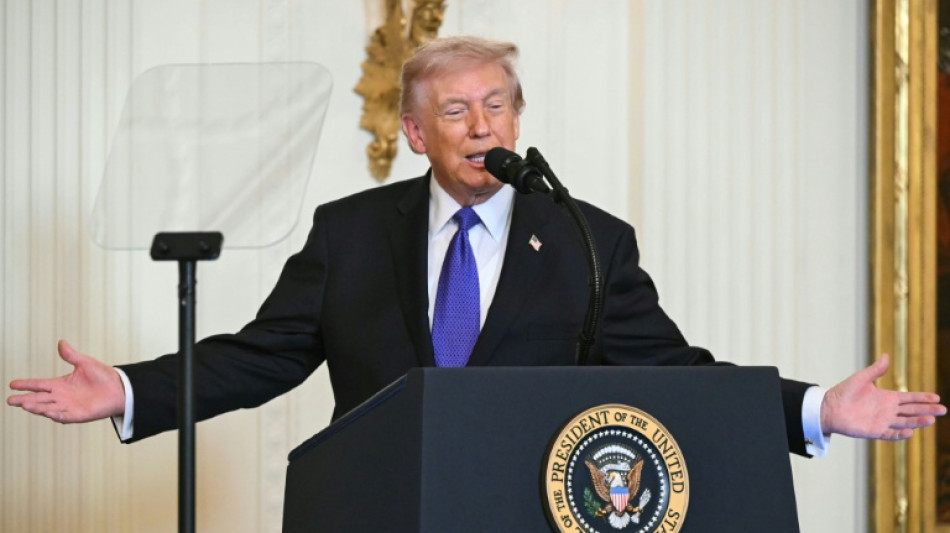
US Fed warns 'economic uncertainty' weighing on consumers / Photo: SAUL LOEB - AFP/File

 UK actor Naomi Watts honoured at Spain film festival

 Trump signs bill authorizing sweeping Russia sanctions

 Anthropic picks Accenture for in-house AI safety evaluation

 Hushing and hedging: US companies retreat on climate

 Crisis-wracked Volkswagen warns of 10-bn-euro hit to profits

 Shakira to cap off world tour with Madrid 12-gig run

 Isolated Syrian-Druze city shortages

 UNESCO can be 'moderator' in AI debate: chief to AFP

 Russia seizes assets of Nestle, French firms

 Anthropic says AI systems moving towards building themselves

 Asian stocks boosted by falling oil, yen weakens after BoJ rate hike

 Afghan medical students in Pakistan hope court stops college expulsions

 Australia to detain tourists who overstay visa, minister says

 Asian stocks track Wall St rally as oil prices drop

 Prized Mexican relic returns on loan, two centuries on

 'In our lane': Fed's Warsh defies Trump but still fighting for credibility

 Trump admin makes major cut to endangered species protections

 GM delivers first components for US interceptor missiles

 Travis Scott and Keith Richards feature on GTA VI soundtrack

 King Charles warns tech bosses of 'existential dangers' of AI

 French fishermen block ports over petrol prices

 Micron's Taiwan workers say 68 months' bonus not enough

 Canada's Carney pushes 'new alliance' with EU despite Trump threats

 Beyond Investment Returns: Families Are Measuring Wealth by Freedom, Continuity, and Legacy, According to Nour Private Wealth

 King Charles disputes claims in book by Princess Diana's brother

The US Federal Reserve warned Wednesday that increased economic uncertainty was impacting consumer sentiment, as President Donald Trump's administration presses on with an aggressive tariffs agenda despite recent setbacks.
In its "Beige Book" report on economic conditions, the central bank said that while consumer spending had increased slightly, many Fed districts "noted that sales were dampened by economic uncertainty, increased price sensitivity, and lower-income consumers pulling back on spending."
The report cited tariffs -- a key part of Trump's economic policy -- as contributing to increased costs in many areas, since many companies are raising their prices for consumers as a result.
"Some firms continued to pass tariff-related cost increases through to their customers, and others began to do so after having absorbed previous increases," the report said.
Still, some companies were "holding selling prices stable despite higher costs because their customers were increasingly price sensitive."
Since returning to office last year, Trump has levied a slew of tariffs against friend and foe alike, upending international trade and roiling financial markets.
Last month, however, the Supreme Court struck down his country-specific tariffs, delivering a stinging rebuke of his signature economic policy.
Trump has since used a different law to impose a new 10-percent global duty. Earlier Wednesday, his Treasury secretary said an increase to 15 percent could be implemented this week.
Affordability has emerged as a political pain point for his administration, and Wednesday's report noted that business costs had "increased moderately," driven by insurance, utilities, energy and raw material prices.
Inflation was 2.9 percent in December, according to the Fed's preferred gauge, above the bank's long-term target of two percent.
The US labor market has remained largely stable in recent months, with unemployment at 4.3 percent in January.
"Contacts in several districts cited rising nonlabor input costs, softer demand, or uncertainty about overall economic conditions as reasons for flat or lower employment levels," the Fed said Wednesday.
Data for the report was collected until February 23, so does not include the full effect of the Supreme Court's tariffs ruling or the fallout from the US and Israeli bombing of Iran.
The report said overall economic expectations remained "optimistic, with most districts expecting slight to moderate growth in the coming months."
Economists and investors overwhelmingly expect the Fed to hold interest rates steady at its next meeting in two weeks, with the next cut likely not before July, according to CME FedWatch.
D.Goldberg--CPN