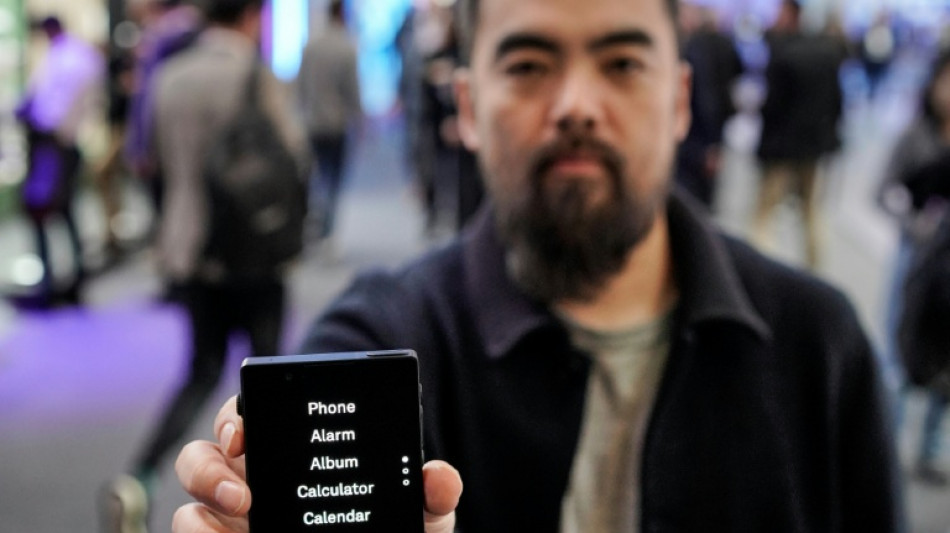
Privacy and attention promises from alternative phones at MWC / Photo: Manaure Quintero - AFP

 UK actor Naomi Watts honoured at Spain film festival

 Trump signs bill authorizing sweeping Russia sanctions
 Anthropic picks Accenture for in-house AI safety evaluation

 Hushing and hedging: US companies retreat on climate

 Crisis-wracked Volkswagen warns of 10-bn-euro hit to profits

 Shakira to cap off world tour with Madrid 12-gig run

 Isolated Syrian-Druze city shortages

 UNESCO can be 'moderator' in AI debate: chief to AFP

 Russia seizes assets of Nestle, French firms

 Anthropic says AI systems moving towards building themselves

 Asian stocks boosted by falling oil, yen weakens after BoJ rate hike

 Afghan medical students in Pakistan hope court stops college expulsions

 Australia to detain tourists who overstay visa, minister says

 Asian stocks track Wall St rally as oil prices drop

 Prized Mexican relic returns on loan, two centuries on

 'In our lane': Fed's Warsh defies Trump but still fighting for credibility

 Trump admin makes major cut to endangered species protections

 GM delivers first components for US interceptor missiles

 Travis Scott and Keith Richards feature on GTA VI soundtrack

 King Charles warns tech bosses of 'existential dangers' of AI

 French fishermen block ports over petrol prices

 Micron's Taiwan workers say 68 months' bonus not enough

 Canada's Carney pushes 'new alliance' with EU despite Trump threats

 Beyond Investment Returns: Families Are Measuring Wealth by Freedom, Continuity, and Legacy, According to Nour Private Wealth

 King Charles disputes claims in book by Princess Diana's brother

Alternative phones on offer at the Mobile World Congress (MWC) telecoms trade show in Barcelona this week aim to answer demand for devices that protect users' data and attention.
In the vein of Netherlands-based Fairphone, whose smartphones are marketed as ethical and environmentally friendly, other small companies have saddled up against the sector's giants like Apple and Samsung.
- Light Phone, designed not to be used -
With a black screen showing a few lines of text and no application logos, American company Light Phone's third model appears to have little in common with colourful mainstream devices.
With a $699 price tag, its creators intend it to be "used as little as possible", chief executive Kaiwei Tang told AFP.
Only basic functions are on offer: phone calls, messaging and 5G data, but no social networking.
Tang called the phone a response to the "attention economy" in which device and app developers attempt to keep their users online and engaged for as long as possible.
Given the attention-sucking power of mainstream devices and software, "this is not about self-control anymore," Tang added.
People aged 20-30 are especially drawn to the Light Phone, he said, as a tool to control their relationship to the tech in their lives.
With its limited functionality, Light Phone is also designed for a long life.
"Why would I need to upgrade it every two years?" Tang asked.
- Jolla, Finnish simplicity
Finland-based Jolla has just released its latest model, 13 years after the first.
Touting the device as thoroughly European, its price is similar to Light Phone's at 649 euros ($753).
Around 10,000 people had pre-ordered the device since its launch in December, with deliveries expected starting in June, the company said.
Those are small figures compared to the hundreds of millions shipped by sector giants, but enough to keep the company profitable, according to chief executive Sami Pienimaki.
"There is high demand for, in general, European technology," he said.
Built around former Nokia workers, the team behind the Jolla phone at first tackled software, building their own operating system for their devices -- a rarity on a market dominated by Apple's iOS and Google's Android.
"You can have your WhatsApp, your Signal, your Spotify, whatever, all the Android applications run without Google services," Pienimaki said.
Although the Jolla phone is assembled in Finland, the company remains dependent on parts manufactured elsewhere.
"Of course we get components from Asia," the chief executive said.
- 'Strongbox' Punkt -
Swiss sister companies Punkt and Apostrophy were in Barcelona to show a phone whose homescreen is divided in two.
By swiping from left to right, users can switch to a "strongbox" environment offering secure applications, many developed by fellow Swiss firm Proton.
The devices aim to be "tools that respect your attention", according to the company website.
Their Android-based operating system offers users centralised settings designed to control access to their data, with a selectable security level on a scale of one to five.
"Applications that you don't use for three days go automatically back to (security level) five," the highest, to avoid unnecessary data collection, sales chief Yanapi Senaud told AFP.
On top of the 699-euro phone, Punkt requires a 10-euro monthly subscription after one year of use, which the company says covers the costs of the operating system.
"If you aren't paying for the product, you are the product," it insists.
O.Ignatyev--CPN