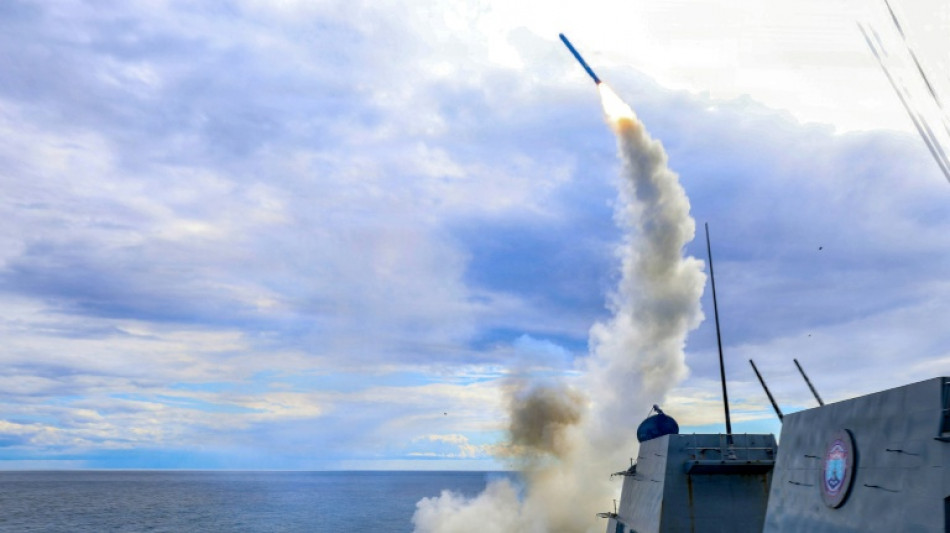
Mideast war risks sending global economy into stagflation / Photo: - - US NAVY/AFP

 Brigitte Bardot widower slams sale of star's belongings

 Indonesia accepts Malaysia's help to tackle wildfires
 Nvidia, OpenAI CEOs to attend Xi dinner at White House

 Cuba hit with seventh major blackout of the year
 Nigeria miners struggled to breathe in cell before 37 died: survivors

 Warren Buffett steps down as Berkshire Hathaway chairman

 Isolated Syrian-Druze city blames Damascus for shortages

 Kerry James Marshall: American 'blackness' painter celebrated in Europe

 Infantino 'must go', says German FA vice-president

 Japan's busiest rail station tests robot bins

 Backpackers fret over Australian visa crackdown

 Bank of Japan hikes rates to 31-year high to battle inflation

 AI doomsday warnings unlikely to slow IPOs but questions linger

 In Brazil's Amazon, the hunt for oil fuels hopes and fears

 Baby orangutans in India expose 'frightening' scale of trafficking

 Oversight Board blasts 'inadequate' Meta safeguards for AI deepfakes

 Harry makes first public appearance since return to UK

 Princess Diana's brother makes new explosive claims against Charles

 Trump admin overhauls key protection for endangered species

 Mbappe draws political fire over Ceuta t-shirt controversy

 Third malaria death in Germany from outbreak tied to Frankfurt airport

 AtlasClear Holdings Reports Preliminary Fiscal 2026 Revenue of Approximately $20.1 Million, Up 85%; Revenue Plus Interest Income of Approximately $21.9 Million

 'Another arrow to the quiver': World Bank posts record private capital mobilization

 Ireland to boycott Eurovision 2027 over Gaza

 India's Tata Sons reappoints N. Chandrasekaran as chairman

An extended conflict in the Middle East after the US and Israel launched strikes on Iran could trigger global stagflation -- a troublesome blend of high inflation and anaemic growth -- due to spiking oil and gas prices, economists warned.
- Will there be an oil shock ? -
The conflict has nearly halted traffic through the Strait of Hormuz, through which around 20 percent of global seaborne oil passes, with several ships attacked.
Global oil prices shot higher on Monday, with the Brent crude international reference oil contract up nearly nine percent at $79.30 per barrel at 1410 GMT.
It briefly surpassed $80 per barrel earlier in the day, and was up considerably from the $61 per barrel at the start of the year.
Economist Sylvain Bersinger said the war risks "creating a third oil shock after those in 1973 and 1979 and the 2022 gas shock".
Europe's benchmark gas price shot more than 50 percent higher on Monday.
He said the price of oil could rise to $110 per barrel, but added that was no longer exceptional as oil prices had risen over $140 in 2008 and were above $100 in the 2010s.
Adam Hetts at asset manager Janus Henderson said that while oil prices would certainly rise, the increase should remain "at reasonable levels".
- What impact on global trade? -
The conflict could act as a shock to trade "at the worst possible moment", said economists at ING bank.
The global trading system is already under stress from US President Donald Trump's tariff offensive as well as the fragmentation of supply chains since Covid and the war in Ukraine.
Moreover the closure of the Gulf airspace is disrupting aviation between European and Asia, they noted.
For Ruben Nizard, head of political risk research at Coface, a trade credit insurance company, this crisis could also "throw another wrench into the works by driving up maritime freight costs" and pushing up inflation.
"At the global level, this would open the door to an economic scenario of stagflation," he added, referring to a situation with high inflation and weak or non-existent growth.
- What impact on the global economy? -
According to economists at Natixis bank, a prolonged disruption of traffic in the Strait of Hormuz "would have major implications for markets, but also for inflation dynamics and overall economic stability".
They added that "China would be particularly affected by this war."
Cyrille Poirier-Coutansais, director of the research department at the French Navy's Centre for Strategic Studies, agreed that China is particularly dependent upon oil shipped through the Strait of Hormuz.
"The question is whether there will be enough fuel to keep the world's factory running," he told AFP.
For the economist Sylvain Bersinger the impact on Europe will likely be less than the 2022 gas shock, which would help France in particular to avoid a recession.
In a sign of declining investor confidence, the interest rate on European sovereign bonds climbed on Monday.
The yield on 10-year German government bonds, the benchmark in the eurozone, stood at 2.70 percent in afternoon trading, compared with 2.64 percent on Friday.
- What risks in a long war? -
The intensity and duration of the conflict will be key in determining its impact.
"In a prolonged conflict, the combination of higher energy costs, disrupted logistics, and a generalised confidence shock would constitute a meaningful drag on global trade volumes at precisely the moment the world economy was still digesting the inflationary and growth consequences of the tariff shock," said economists at ING bank.
Coface's Nizard said they estimated that "an increase of roughly 15 dollars in the price of Brent over a prolonged period could shave about 0.2 percentage points off global growth and add almost half a point to inflation."
These are "not insignificant" effects in a context of "fairly fragile global economic growth", he added.
X.Cheung--CPN