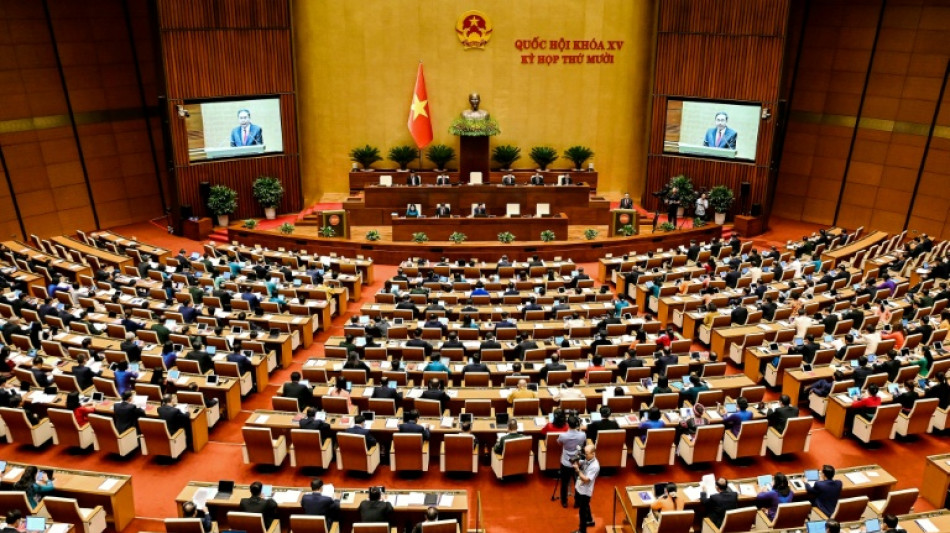
Vietnam AI law takes effect, first in Southeast Asia / Photo: Nhac NGUYEN - AFP

 Brigitte Bardot widower slams sale of star's belongings

 Indonesia accepts Malaysia's help to tackle wildfires

 Nvidia, OpenAI CEOs to attend Xi dinner at White House

 Cuba hit with seventh major blackout of the year

 Nigeria miners struggled to breathe in cell before 37 died: survivors

 Warren Buffett steps down as Berkshire Hathaway chairman

 Isolated Syrian-Druze city blames Damascus for shortages

 Kerry James Marshall: American 'blackness' painter celebrated in Europe

 Infantino 'must go', says German FA vice-president

 Japan's busiest rail station tests robot bins

 Backpackers fret over Australian visa crackdown

 Bank of Japan hikes rates to 31-year high to battle inflation

 AI doomsday warnings unlikely to slow IPOs but questions linger

 In Brazil's Amazon, the hunt for oil fuels hopes and fears

 Baby orangutans in India expose 'frightening' scale of trafficking

 Oversight Board blasts 'inadequate' Meta safeguards for AI deepfakes

 Harry makes first public appearance since return to UK

 Princess Diana's brother makes new explosive claims against Charles

 Trump admin overhauls key protection for endangered species

 Mbappe draws political fire over Ceuta t-shirt controversy

 Third malaria death in Germany from outbreak tied to Frankfurt airport

 AtlasClear Holdings Reports Preliminary Fiscal 2026 Revenue of Approximately $20.1 Million, Up 85%; Revenue Plus Interest Income of Approximately $21.9 Million

 'Another arrow to the quiver': World Bank posts record private capital mobilization

 Ireland to boycott Eurovision 2027 over Gaza

 India's Tata Sons reappoints N. Chandrasekaran as chairman

A law regulating artificial intelligence went into effect in Vietnam on Sunday, making it the first country in Southeast Asia with a comprehensive framework on the booming technology.
Passed by the National Assembly in December, the law focuses on the risks posed by generative AI, requiring human oversight and control along the lines of the European Union's landmark AI Act.
Many nations are moving to address the dangers of chatbots and image generators -- from misinformation to online abuse and copyright violations -- but few have enacted legislation.
The legislation, which is in force as of March 1, "paves the way for Vietnam to deeply integrate with international standards while maintaining digital sovereignty", the government said in a December report.
It requires companies to clearly label AI-generated content such as deepfakes that cannot readily be differentiated from reality.
It also requires them to disclose to customers when they are interacting with an artificial rather than human agent.
The law applies to developers as well as providers and deployers of the technology, whether they are Vietnamese organisations or foreign entities operating in the country.
Vietnam has set ambitious double-digit growth targets for the next five years, with expansion of the digital economy a key part of its development strategy.
AI and the data economy are "pillars" of a "more sustainable and smarter new development" model, Prime Minister Pham Minh Chinh was quoted as saying Wednesday on the government's website.
Under the law, the government will establish a national AI computing centre, improved data resources and large language models in Vietnamese.
- 'Not the final word' -
So far only a handful of countries have implemented far-reaching regulatory frameworks on AI.
The United States has opposed what Vice President JD Vance called "excessive regulation", warning it could stifle innovation in the key sector.
In January, South Korea became the first country to have an AI law take full effect, while the European Union is gradually phasing in a set of rules that will become completely applicable in 2027.
While Vietnam's law is a regulatory milestone, analysts said its impact would depend on how the government enforces it and on what guidance it issues on implementation.
The law is "not the final word" but rather a "decisive starting point", Vietnam-based LNT & Partners law firm said in an analysis on its website.
"It establishes responsibility, human control, and risk management as the governing themes of AI regulation," the firm said.
However, it added, "the true impact will depend on implementing decrees, sectoral regulations, and enforcement practice".
Patrick Keil, senior legal adviser at law firm DFDL, called the law "a significant statement of national ambition" but told AFP businesses will continue to face some uncertainty about their obligations until the government issues further guidance.
At an AI summit hosted by New Delhi in February, 91 countries and international organisations called for "secure, trustworthy and robust" AI.
But their declaration, signed by the United States and China, was criticised by AI safety campaigners for being too generic to protect the public.
A.Zimmermann--CPN