'Without ports, Ukraine will be destroyed': Odesa buckles under Russian bombs / Photo: Oleksandr GIMANOV - AFP

 Thousands protest inaction over climate crisis in Switzerland

 UK actor Naomi Watts honoured at Spain film festival

 Trump signs bill authorizing sweeping Russia sanctions

 Anthropic picks Accenture for in-house AI safety evaluation

 Hushing and hedging: US companies retreat on climate

 Crisis-wracked Volkswagen warns of 10-bn-euro hit to profits

 Shakira to cap off world tour with Madrid 12-gig run

 Isolated Syrian-Druze city shortages

 UNESCO can be 'moderator' in AI debate: chief to AFP

 Russia seizes assets of Nestle, French firms

 Anthropic says AI systems moving towards building themselves

 Asian stocks boosted by falling oil, yen weakens after BoJ rate hike

 Afghan medical students in Pakistan hope court stops college expulsions

 Australia to detain tourists who overstay visa, minister says

 Asian stocks track Wall St rally as oil prices drop

 Prized Mexican relic returns on loan, two centuries on

 'In our lane': Fed's Warsh defies Trump but still fighting for credibility

 Trump admin makes major cut to endangered species protections

 GM delivers first components for US interceptor missiles

 Travis Scott and Keith Richards feature on GTA VI soundtrack

 King Charles warns tech bosses of 'existential dangers' of AI

 French fishermen block ports over petrol prices

 Micron's Taiwan workers say 68 months' bonus not enough

 Canada's Carney pushes 'new alliance' with EU despite Trump threats

 Beyond Investment Returns: Families Are Measuring Wealth by Freedom, Continuity, and Legacy, According to Nour Private Wealth

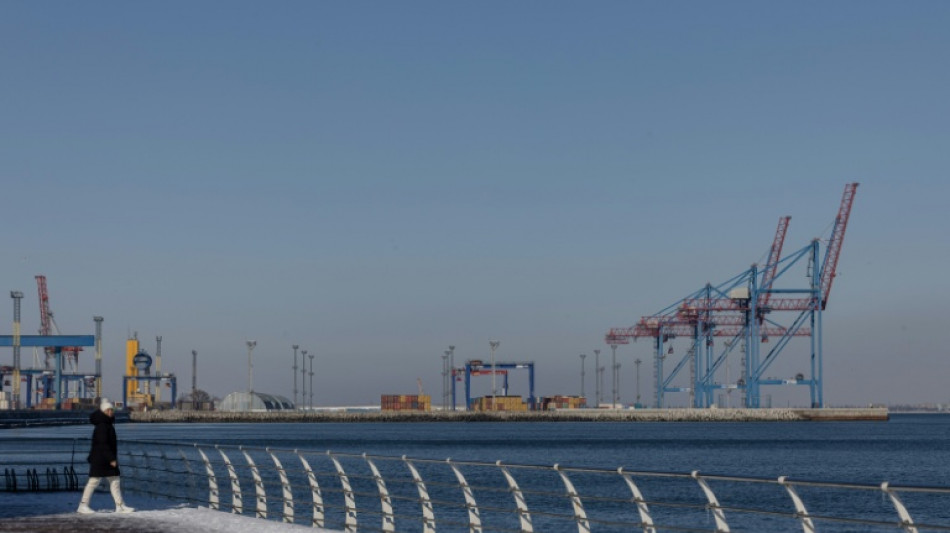
Looking out at the blue and yellow cranes towering over the Black Sea horizon, Viktor Berestenko worries about the relentless Russian bombardment of Odesa, Ukraine's southern port city.
"It's war, every night," the head of the Inter Trans logistics company told AFP.
The main gateway to the Black Sea and beyond, Odesa is a key logistics hub for Ukraine, one of the world's top agricultural exporters.
Russia has intensified its attacks on the region -- tripling the number of missile and drone strikes over the last year in what officials call an attempt to cut Ukraine off from the sea.
"Without ports, Ukraine will be destroyed," said Berestenko.
The escalation comes four years into Russia's invasion, in which Ukraine's maritime infrastructure has been a target for Moscow.
The attacks are accepted as part of daily life for the city of around one million people, dotted with ornate 19th-century architecture and where luxury cars pass mobile air defence units along the bustling seaside.
Russia's army occupies much of Ukraine's southern coast, including key port cities of Mariupol and Berdiansk further to the east.
And in 2023 Moscow walked away from a deal, brokered by the UN and Turkey, that facilitated the safe passage of Ukrainian agricultural exports across the Black Sea.
In response, Kyiv set up an alternative route with vessels hugging the sea's western coastline from Odesa, along Romania, Bulgaria and through the Bosphorus into the Mediterranean.
Ukraine touts it as a success, with more than 170 million tonnes of cargo transported through the route, including grain to some 55 countries, mostly in Africa.
The sales provide a vital source of income for the economy, decimated by the Russian invasion.
But the surge in strikes is taking a toll.
Volumes were down 15 percent last year, when some 57 ships and 336 pieces of port equipment were damaged, according to Mykola Kravchuk, head of the state-run Ukrainian Sea Ports Authority in the city.
There were more than 800 air raid alerts in Odesa in 2025 -- "this amounts to more than a month of operational time lost over the course of the year," Kravchuk told AFP.
The vast majority of Ukraine's grain exports go through Odesa.
- Two-minute warning -
Incoming ballistic missiles can hit Odesa within two minutes of being launched from Crimea, which Russia annexed in 2014.
It takes some 45 seconds for a crane operator to climb down, let alone reach a shelter, Berestenko said.
He scrolled through photos on his phone of burned-out trucks and warehouses damaged by strikes.
"It's scary, to put it briefly," said Iryna, who works at the port's container terminal.
"When the alarm sounds, we go down... we put our trust in God," the 41-year-old said.
"Sometimes alerts can last for three hours, and we sit there."
Several strikes have killed port employees or ship crew members.
In December, a ballistic missile attack killed eight people.
The strikes also have an environmental toll. Last year an attack on the nearby port of Pivdennyi hit a sunflower oil storage tank, polluting the Black Sea coast.
Thousands of birds and seahorses were killed as a result, ecologist Vladyslav Belinsky said.
Ukraine classifies its ports as strategically important infrastructure, limiting access to them.
Kravchuk said the port industry's top two priorities are protecting people, "specifically our employees" and making sure the ports stay open.
After an overnight attack on Friday Deputy Prime Minister Oleksiy Kuleba repeated that the maritime corridor was still operational despite another massive attack on Ukraine's port facilities.
But the surge in the attacks has many in the industry and the city on edge.
"What will be the next steps?" asked logistics chief Berestenko.
"To occupy Odesa? To cut Ukraine from the sea?"
M.Anderson--CPN