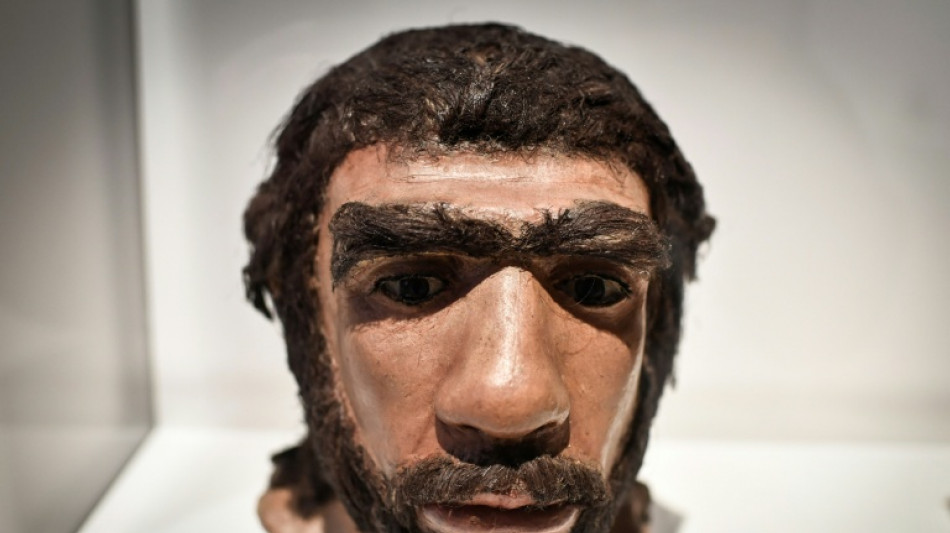
The sex lives of Neanderthal males - and human females / Photo: STEPHANE DE SAKUTIN - AFP

 Thousands protest inaction over climate crisis in Switzerland
 UK actor Naomi Watts honoured at Spain film festival

 Trump signs bill authorizing sweeping Russia sanctions

 Anthropic picks Accenture for in-house AI safety evaluation

 Hushing and hedging: US companies retreat on climate

 Crisis-wracked Volkswagen warns of 10-bn-euro hit to profits

 Shakira to cap off world tour with Madrid 12-gig run

 Isolated Syrian-Druze city shortages

 UNESCO can be 'moderator' in AI debate: chief to AFP

 Russia seizes assets of Nestle, French firms

 Anthropic says AI systems moving towards building themselves

 Asian stocks boosted by falling oil, yen weakens after BoJ rate hike

 Afghan medical students in Pakistan hope court stops college expulsions

 Australia to detain tourists who overstay visa, minister says

 Asian stocks track Wall St rally as oil prices drop

 Prized Mexican relic returns on loan, two centuries on

 'In our lane': Fed's Warsh defies Trump but still fighting for credibility

 Trump admin makes major cut to endangered species protections

 GM delivers first components for US interceptor missiles

 Travis Scott and Keith Richards feature on GTA VI soundtrack

 King Charles warns tech bosses of 'existential dangers' of AI

 French fishermen block ports over petrol prices

 Micron's Taiwan workers say 68 months' bonus not enough

 Canada's Carney pushes 'new alliance' with EU despite Trump threats

 Beyond Investment Returns: Families Are Measuring Wealth by Freedom, Continuity, and Legacy, According to Nour Private Wealth

Dating out of your league? New research says it's a tale as old as time.
A study out Thursday in Science argues that Neanderthal men and human women were particularly inclined to mate, a sexual habit that offers insight into the evolution of the modern human genome.
In 2010 scientists reconstructed the Neanderthal genome -- blockbuster research that allowed for analysis making clear that the species interbred.
Most people living today have some residual fragments of DNA from our ancient evolutionary cousins.
Research indicates both groups descended from a population living in Africa some million years ago.
They eventually diverged, with anatomically modern humans evolving in Africa, and Neanderthals migrating across Eurasia.
But over hundreds of millenia, human migrations resulted in interbreeding, researchers say.
Yet humans have little to no Neanderthal DNA on our X chromosomes -- one of two human chromosomes that determines an embryo's sex.
That was assumed to be the result of a natural selection.
The genes were biologically "toxic" to humans, researchers hypothesized, and eventually purged out -- in essence, the children who inherited those traits might not have lived to pass them on.
But the new study from geneticists at the University of Pennsylvania suggests the phenomenon has more social origins, and were actually the result of "long-standing mating preferences."
The team analyzed modern human DNA preserved in Neanderthals, and found an abundance on the X chromosome -- the mirror opposite of humans.
That result allowed them to rule out that reproduction between the species was incompatible.
Instead the gene flow "occurred predominantly between Neanderthal males and anatomically modern human females," said Alexander Platt, a senior research scientist on the study.
Since females have two X chromosomes and males just one, the math adds up: If Neanderthal males and modern human females were mating, more Neanderthal X chromosomes would enter the human gene pool, and vice versa.
Researchers said that sex-biased migration could also offer clues. But ancient mating habits "provided the simplest explanation," Platt said.
The larger "why" is unknown: Neanderthal men and modern human women might have been mating by choice, or violence and coercion could have been involved.
Researchers say they now hope to analyze the development of this mating pattern.
Possibilities include probing gender dynamics within Neanderthal society, or migration habits -- perhaps males were likely to leave their societies while females stayed with their families, for example.
A.Levy--CPN