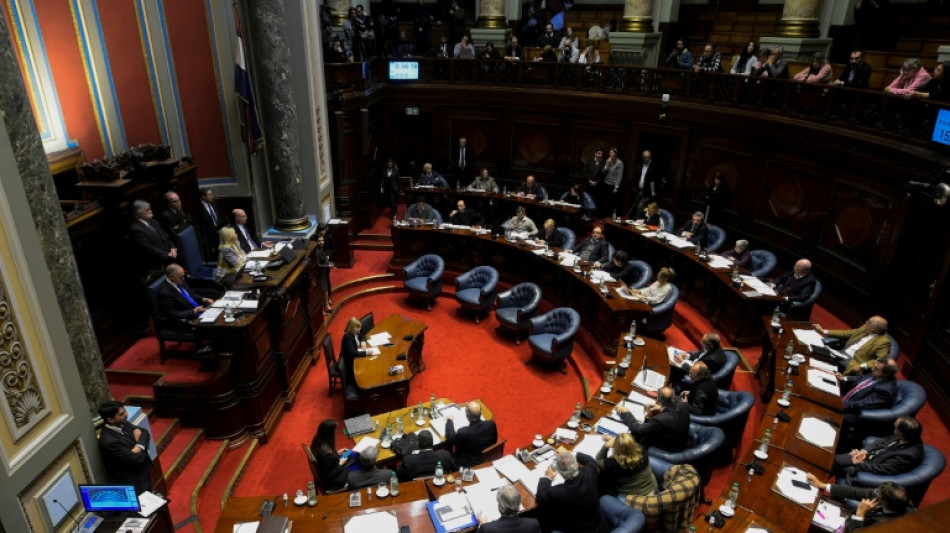
Argentina, Uruguay ratify EU-South America trade deal / Photo: Dante Fernandez - AFP

 Thousands protest inaction over climate crisis in Switzerland

 UK actor Naomi Watts honoured at Spain film festival

 Trump signs bill authorizing sweeping Russia sanctions

 Anthropic picks Accenture for in-house AI safety evaluation

 Hushing and hedging: US companies retreat on climate

 Crisis-wracked Volkswagen warns of 10-bn-euro hit to profits

 Shakira to cap off world tour with Madrid 12-gig run

 Isolated Syrian-Druze city shortages

 UNESCO can be 'moderator' in AI debate: chief to AFP

 Russia seizes assets of Nestle, French firms

 Anthropic says AI systems moving towards building themselves

 Asian stocks boosted by falling oil, yen weakens after BoJ rate hike

 Afghan medical students in Pakistan hope court stops college expulsions

 Australia to detain tourists who overstay visa, minister says

 Asian stocks track Wall St rally as oil prices drop

 Prized Mexican relic returns on loan, two centuries on

 'In our lane': Fed's Warsh defies Trump but still fighting for credibility

 Trump admin makes major cut to endangered species protections

 GM delivers first components for US interceptor missiles

 Travis Scott and Keith Richards feature on GTA VI soundtrack

 King Charles warns tech bosses of 'existential dangers' of AI

 French fishermen block ports over petrol prices

 Micron's Taiwan workers say 68 months' bonus not enough

 Canada's Carney pushes 'new alliance' with EU despite Trump threats

 Beyond Investment Returns: Families Are Measuring Wealth by Freedom, Continuity, and Legacy, According to Nour Private Wealth

Argentina on Thursday became the second South American country to ratify a massive trade deal with the European Union that has generated enthusiasm from Brasilia to Buenos Aires but sparked protests and legal challenges in Europe.
Argentine senators voted 69-3 in favor of the agreement to create one of the world's biggest free trade zones, sealing its adoption days after it passed the lower house.
Hours earlier, neighboring Uruguay was first out of the blocks to ratify the deal, which has been fiercely opposed by farmers in some EU countries.
It still requires approval from lawmakers in the European Parliament, which referred it to the EU's top court within days of being inked in January.
The deal between the EU and the four founding members of the Mercosur bloc -- Argentina, Brazil, Paraguay and Uruguay -- was a quarter century in the making.
It eliminates tariffs on more than 90 percent of trade between the two blocs, which together account for 30 percent of global GDP and more than 700 million consumers.
The South Americans have moved to quickly enshrine it in their legislation, in an apparent bid to pressure Brussels to follow suit.
In Brazil, the lower house of parliament backed it by a large majority on Wednesday.
Paraguay has also moved to ratify it.
The accord, which was energetically promoted by EU chief Ursula von der Leyen and Brazilian President Luiz Inacio Lula da Silva as well as the leaders of Germany and Spain, aims to boost EU exports of vehicles, machinery and wines and spirits.
In return, South American producers of meat, sugar, rice, honey and soybeans gain easier access to one of the world's largest economies.
Brussels can decide to implement it provisionally while waiting for an EU court ruling on its legality, but has not yet taken a decision on doing so.
South American countries in the meantime are ploughing ahead.
Uruguayan Foreign Minister Mario Lubetkin hailed his country's ratification on Thursday as "a signal" to Europe, which the South Americans have accused of foot-dragging.
Argentine Senator Francisco Paoltroni hailed the accord as representing "the path to the definitive development of our republic."
Some EU nations hope the pact that could help boost exports at a time of global trade tensions.
France, however, unsuccessfully tried to block the deal over concerns for its farmers, who fear being undercut by cheaper goods from Brazil and its neighbors.
The European Commission reacted to those concerns by adopting a series of safeguards for its producers.
P.Gonzales--CPN
