Cuban Americans keep sending help to the island, but some cry foul / Photo: GIORGIO VIERA - AFP

 France's debt climbs to highest since 1978: ministry

 Thousands protest inaction over climate crisis in Switzerland

 UK actor Naomi Watts honoured at Spain film festival

 Trump signs bill authorizing sweeping Russia sanctions

 Anthropic picks Accenture for in-house AI safety evaluation

 Hushing and hedging: US companies retreat on climate

 Crisis-wracked Volkswagen warns of 10-bn-euro hit to profits

 Shakira to cap off world tour with Madrid 12-gig run

 Isolated Syrian-Druze city shortages

 UNESCO can be 'moderator' in AI debate: chief to AFP

 Russia seizes assets of Nestle, French firms

 Anthropic says AI systems moving towards building themselves

 Asian stocks boosted by falling oil, yen weakens after BoJ rate hike

 Afghan medical students in Pakistan hope court stops college expulsions

 Australia to detain tourists who overstay visa, minister says

 Asian stocks track Wall St rally as oil prices drop

 Prized Mexican relic returns on loan, two centuries on

 'In our lane': Fed's Warsh defies Trump but still fighting for credibility

 Trump admin makes major cut to endangered species protections

 GM delivers first components for US interceptor missiles

 Travis Scott and Keith Richards feature on GTA VI soundtrack

 King Charles warns tech bosses of 'existential dangers' of AI

 French fishermen block ports over petrol prices

 Micron's Taiwan workers say 68 months' bonus not enough

 Canada's Carney pushes 'new alliance' with EU despite Trump threats

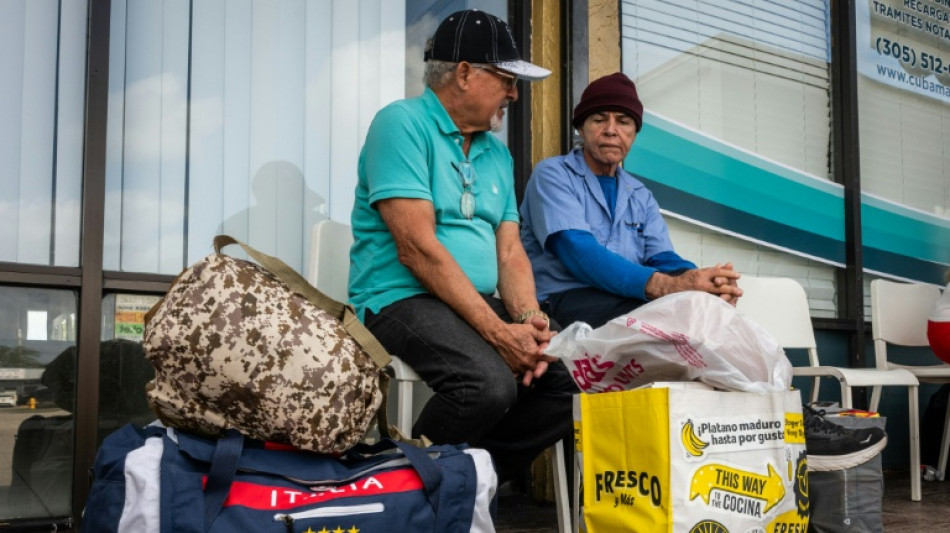
In the early morning, Florida resident Gisela Salgado headed to a local store with a bag stuffed with clothes, coffee and powdered milk to send to her brother in Cuba. She was not alone.
Even though some shipping agents in the Sunshine State have restricted the mailing of packages to the nearby crisis-wracked, Communist-ruled island due to logistical problems caused by fuel shortages there, customers keep showing up.
In the Miami area, the economic and energy emergency in Cuba has revived an old debate: should Cuban Americans keep sending remittances and basic goods to loved ones, or cut off shipments seen by some as keeping the government in Havana afloat?
After the ouster of Venezuelan leader Nicolas Maduro, US President Donald Trump's administration has forced Caracas to halt oil shipments to Cuba, and threatened tariffs on other countries who would step in to send crude, effectively creating a blockade.
At the main office of the Cubamax company in Hialeah, northwest of Miami, which handles remittances, shipping and travel, about 10 customers lined up before opening time.
Some were carrying bags or pushing carts filled with basic necessities, while others just had envelopes filled with cash.
In Hialeah, where nearly three out of four residents are of Cuban descent, there is no question that shipments are a must.
"Things there are terrible. People are starving, there's nothing," said Salgado, a 72-year-old who emigrated to the United States four decades ago.
"As long as my brother is there, I'll keep sending him things. He has nothing to do with the government, and if I don't send him anything, how will he eat?"
Standing near her, 81-year-old Jose Rosell is at Cubamax to send food and toiletries to his 55-year-old son, a taxi driver in Santiago de Cuba who lost his job due to the fuel shortage.
Rosell said he is worried that he won't be able to keep helping him.
- Total blockade? -
Last week, Cubamax -- one of the main agencies facilitating shipments and remittances to the Caribbean island nation of about 10 million people -- suspended deliveries to residences and began enforcing a one package per customer limit, due to lack of fuel.
Some of those restrictions have since been lifted, but customers are still fearful that the pipeline to their relatives could soon be cut off entirely.
Other businesses such as Supermarket23, which sells packages of food and basic goods for delivery to Cuba, have said they will no longer accept new orders until further notice.
Shipments of basic necessities are possible due to an exemption to the US trade embargo on Cuba that allows for exchanges between family members.
But many in the Cuban diaspora have targeted businesses specializing in these transactions.
Three US lawmakers with Cuban roots -- Mario Diaz-Balart, Carlos Gimenez and Maria Elvira Salazar -- asked the Trump administration to revoke the licenses of US businesses they say are dealing with entities controlled by authorities in Havana.
Alex Otaola, a Cuban American influencer and activist, advocates cutting off all support to the island, even from family members, with his "Stoppage" campaign -- an initiative that is hotly debated on social media.
For Emilio Morales, who leads the Havana Consulting Group, which specializes in the Cuban economy, cutting off shipments "won't change the equation."
The government in Havana has very little access to remittances, because they usually arrive via private travelers known as money "mules," he told AFP.
And packages sent from abroad only help a small minority of Cubans, with little overall effect islandwide.
At a cafe in Hialeah, 59-year-old Reina Carvallo said critics need to make a clear distinction between the government and regular people like her two brothers, to whom she sends medication and other items.
"The regime should be beheaded, which is what it deserves," Carvallo said. "But the people should not have to suffer."
S.F.Lacroix--CPN
