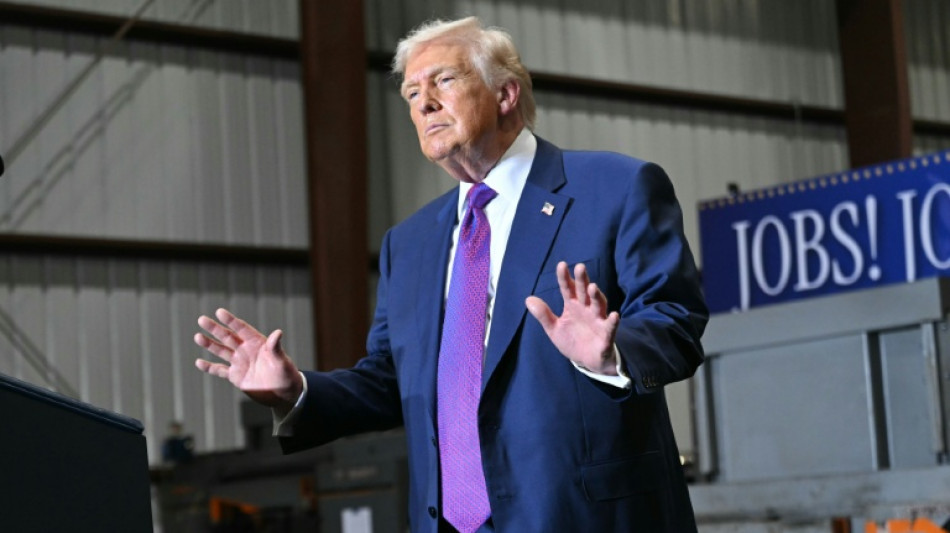
US Supreme Court strikes down swath of Trump global tariffs / Photo: SAUL LOEB - AFP/File

 France's debt climbs to highest since 1978: ministry
 Thousands protest inaction over climate crisis in Switzerland

 UK actor Naomi Watts honoured at Spain film festival

 Trump signs bill authorizing sweeping Russia sanctions

 Anthropic picks Accenture for in-house AI safety evaluation

 Hushing and hedging: US companies retreat on climate

 Crisis-wracked Volkswagen warns of 10-bn-euro hit to profits

 Shakira to cap off world tour with Madrid 12-gig run

 Isolated Syrian-Druze city shortages

 UNESCO can be 'moderator' in AI debate: chief to AFP

 Russia seizes assets of Nestle, French firms

 Anthropic says AI systems moving towards building themselves

 Asian stocks boosted by falling oil, yen weakens after BoJ rate hike

 Afghan medical students in Pakistan hope court stops college expulsions

 Australia to detain tourists who overstay visa, minister says

 Asian stocks track Wall St rally as oil prices drop

 Prized Mexican relic returns on loan, two centuries on

 'In our lane': Fed's Warsh defies Trump but still fighting for credibility

 Trump admin makes major cut to endangered species protections

 GM delivers first components for US interceptor missiles

 Travis Scott and Keith Richards feature on GTA VI soundtrack

 King Charles warns tech bosses of 'existential dangers' of AI

 French fishermen block ports over petrol prices

 Micron's Taiwan workers say 68 months' bonus not enough

 Canada's Carney pushes 'new alliance' with EU despite Trump threats

The US Supreme Court ruled Friday that Donald Trump exceeded his authority in imposing a swath of tariffs that upended global trade, blocking a key tool the president has wielded to impose his economic agenda.
The conservative-majority high court ruled six-three in the judgment, saying the International Emergency Economic Powers Act (IEEPA) "does not authorize the President to impose tariffs."
While Trump has long used tariffs as a lever for pressure and negotiations, he made unprecedented use of emergency economic powers upon returning to the presidency last year to slap new duties on virtually all US trading partners.
These included "reciprocal" tariffs over trade practices that Washington deemed unfair, alongside separate sets of duties targeting major partners Mexico, Canada and China over illicit drug flows and immigration.
The court on Friday noted that "had Congress intended to convey the distinct and extraordinary power to impose tariffs" with IEEPA, "it would have done so expressly, as it consistently has in other tariff statutes."
The ruling does not impact sector-specific duties that Trump has separately imposed on imports of steel, aluminum and various other goods.
Several government probes which could ultimately lead to more such sectoral tariffs remain in the works.
The Supreme Court's three liberal justices joined three conservatives in Friday's ruling, which upheld lower court decisions that tariffs Trump imposed under IEEPA were illegal.
Conservative Justices Brett Kavanaugh, Clarence Thomas and Samuel Alito dissented.
Chief Justice John Roberts, in delivering his opinion, noted that "IEEPA contains no reference to tariffs or duties."
A lower trade court had ruled in May that Trump overstepped his authority with across-the-board levies and blocked most of them from taking effect, but that outcome had been put on hold as the government sought an appeal.
- Constrained ambition -
The strike down of these tariffs will likely bring the average tariff rate from 16.8 percent to around 9.5 percent, EY-Parthenon chief economist Gregory Daco told AFP ahead of the ruling.
But this could prove to be temporary as the government seeks other ways to reimpose sweeping duties, he added.
Also at stake are tariff revenues for the government, Daco said, estimating a loss in government revenues of around $100 billion to $120 billion.
The justices did not address the degree to which importers can receive refunds.
But Kavanaugh warned that this process -- as acknowledged during oral arguments -- could be a "mess."
Striking down the emergency tariffs "would constrain the president's ambitions to impose across-the-board tariffs on a whim," said Erica York of tax policy nonprofit the Tax Foundation.
But it still leaves him other statutes to tap for tariffs, even if they tend to be more limited in scope -- or require specific processes such as investigations -- York told AFP.
Ng.A.Adebayo--CPN