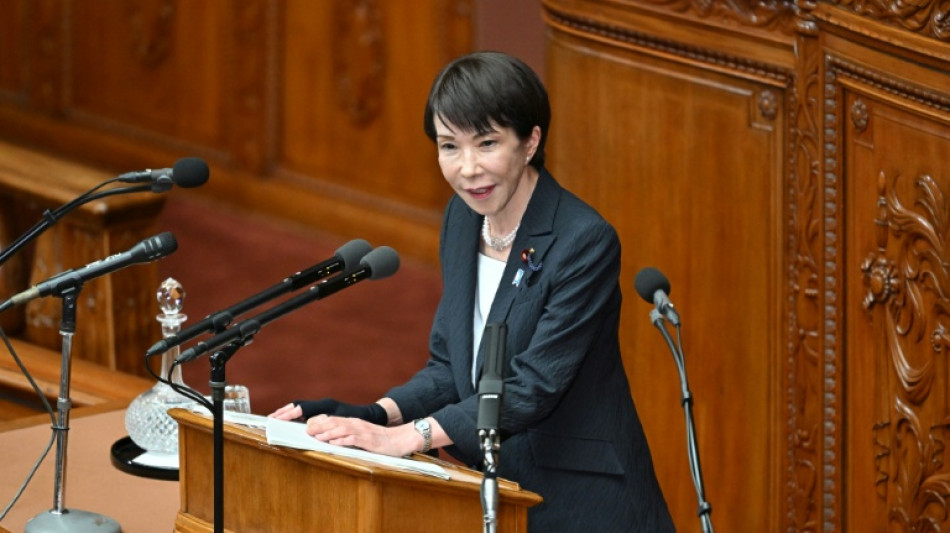
Victorious Takaichi promises 'strong and prosperous' Japan / Photo: Kazuhiro NOGI - AFP

 France's debt climbs to highest since 1978: ministry

 Thousands protest inaction over climate crisis in Switzerland

 UK actor Naomi Watts honoured at Spain film festival

 Trump signs bill authorizing sweeping Russia sanctions

 Anthropic picks Accenture for in-house AI safety evaluation

 Hushing and hedging: US companies retreat on climate

 Crisis-wracked Volkswagen warns of 10-bn-euro hit to profits

 Shakira to cap off world tour with Madrid 12-gig run

 Isolated Syrian-Druze city shortages

 UNESCO can be 'moderator' in AI debate: chief to AFP

 Russia seizes assets of Nestle, French firms

 Anthropic says AI systems moving towards building themselves

 Asian stocks boosted by falling oil, yen weakens after BoJ rate hike

 Afghan medical students in Pakistan hope court stops college expulsions

 Australia to detain tourists who overstay visa, minister says

 Asian stocks track Wall St rally as oil prices drop

 Prized Mexican relic returns on loan, two centuries on

 'In our lane': Fed's Warsh defies Trump but still fighting for credibility

 Trump admin makes major cut to endangered species protections

 GM delivers first components for US interceptor missiles

 Travis Scott and Keith Richards feature on GTA VI soundtrack

 King Charles warns tech bosses of 'existential dangers' of AI

 French fishermen block ports over petrol prices

 Micron's Taiwan workers say 68 months' bonus not enough

 Canada's Carney pushes 'new alliance' with EU despite Trump threats

Prime Minister Sanae Takaichi pledged Friday to make Japan "strong and prosperous", while hitting out at China and pledging to keep "hitting the growth button" following her party landslide election win.
"China is intensifying its attempts to unilaterally change the status quo by force or coercion in the East China Sea and the South China Sea, while also expanding and stepping up its military activities in the areas surrounding our country," Takaichi told parliament in a policy address.
Echoing her predecessor Shigeru Ishiba, Takaichi also said that Japan was facing "the most severe and complex security environment" since World War II, citing not just China but also Russia and North Korea.
As a result, Takaichi said she will aim this year to revise Japan's three key defence policy documents, as "changes in the security environment -- such as the emergence of new ways of warfare and the need to prepare for prolonged conflicts -- are accelerating across a wide range of fields."
She added that she wanted to accelerate discussions on further loosening Japan's self-imposed ban on the export of lethal weapons.
"This will contribute to strengthening the deterrence and response capabilities of our allies and like-minded partners, while also helping to reinforce Japan's defence production base and its foundation of civilian technologies," Takaichi said.
Takaichi, whose ruling LDP party won a two-thirds majority in February 8 snap elections, angered China by suggesting in November that Japan could intervene militarily if Beijing sought to take Taiwan by force.
China, which regards the democratic island as part of its territory and has not ruled out force to annex it, advised its citizens to avoid travel to Japan.
Beijing's top diplomat Wang Yi told the Munich Security Conference on Saturday that forces in Japan were seeking to "revive militarism".
- Growth button -
On the economy, Takaichi insisted that her fiscal policies will not be "reckless", as investors worry that her efforts to boost growth and help consumers with inflation will swell Japan's debts.
"We are not going to pursue a reckless fiscal policy that would undermine the market's confidence," Takaichi told parliament, undertaking to reduce Japan's ratio of debt to gross domestic product.
"I will keep hitting that growth switch -- again and again and again -- pushing it as much as I possibly can," she said.
She pledged to promote domestic investment in "risk management" areas such as energy, health, infrastructure and cyber security.
In addition, her government would focus on "growth" areas such as AI, chips and ship-building.
Japanese inflation slowed in January, government data showed earlier Friday, in welcome news for Takaichi.
Soaring inflation in Asia's number-two economy -- after decades of flat or falling prices -- contributed to the downfall of Takaichi's two predecessors and Japan's first woman premier has made helping households a priority.
Excluding fresh food, "core" consumer prices rose 2.0 percent year-on-year, the slowest rise in two years, down from 2.4 percent in December, and in line with market forecasts.
In the address, Takaichi repeated her campaign pledge to consider suspending consumption tax on food for two years to help households cope with inflation.
This has exacerbated market worries about Japan's Godzilla-sized debts, with yields on long-dated government bonds hitting record highs last month.
She also announced in her policy speech a cross-party "national council" to discuss taxation and how to fund ageing Japan's ballooning social security bill.
In addition, Takaichi said she wanted to "make maximum use of decarbonised power sources" to ensure energy security.
"Ensuring domestically produced energy is important from the viewpoint of energy security," Takaichi said.
kh-tmo-aph-stu/lb
T.Morelli--CPN