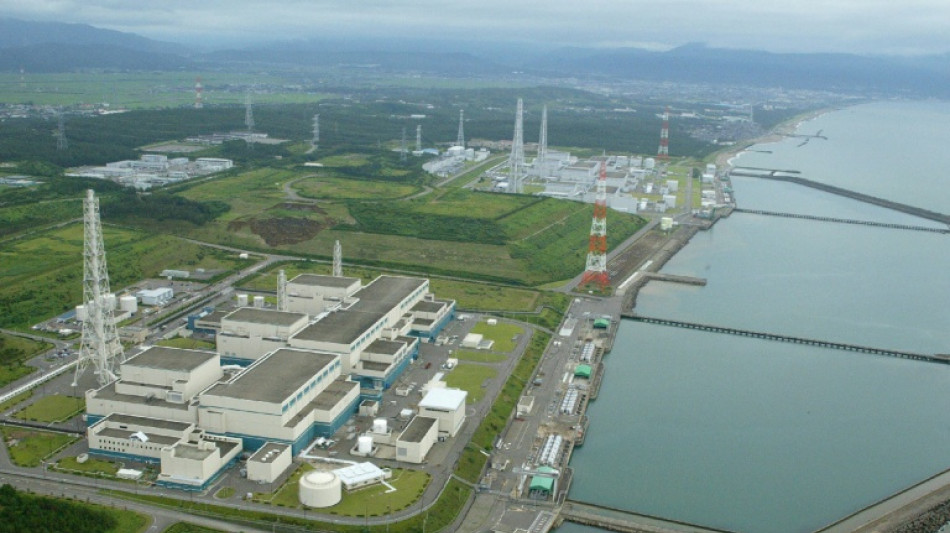
Japan suspends restart of world's biggest nuclear plant / Photo: STR - JIJI PRESS/AFP

 AI 'warning shots' focus Beijing on national security risks

 Philippine tribe in limbo over US-led tech hub

 Saudi-led coalition says Houthis fired ballistic missile at Riyadh
 Cuba works to restore power after another blackout

 Brigitte Bardot widower slams sale of star's belongings

 Indonesia accepts Malaysia's help to tackle wildfires

 Nvidia, OpenAI CEOs to attend Xi dinner at White House

 Cuba hit with seventh major blackout of the year

 Nigeria miners struggled to breathe in cell before 37 died: survivors

 Warren Buffett steps down as Berkshire Hathaway chairman

 Isolated Syrian-Druze city blames Damascus for shortages

 Kerry James Marshall: American 'blackness' painter celebrated in Europe

 Infantino 'must go', says German FA vice-president

 Japan's busiest rail station tests robot bins

 Backpackers fret over Australian visa crackdown

 Bank of Japan hikes rates to 31-year high to battle inflation

 AI doomsday warnings unlikely to slow IPOs but questions linger

 In Brazil's Amazon, the hunt for oil fuels hopes and fears

 Baby orangutans in India expose 'frightening' scale of trafficking

 Oversight Board blasts 'inadequate' Meta safeguards for AI deepfakes

 Harry makes first public appearance since return to UK

 Princess Diana's brother makes new explosive claims against Charles

 Trump admin overhauls key protection for endangered species

 Mbappe draws political fire over Ceuta t-shirt controversy

 Third malaria death in Germany from outbreak tied to Frankfurt airport

The restart of the world's largest nuclear power plant was suspended in Japan Thursday just hours after the process began, its operator said, but the reactor remains "stable".
Operations to relaunch a reactor at the Kashiwazaki-Kariwa plant in Niigata province, closed since the 2011 Fukushima disaster, began late Wednesday after it received the final green light from the nuclear regulator despite divided public opinion.
But its operator the Tokyo Electric Power Company (TEPCO) said that "an alarm from the monitoring system... sounded during the reactor startup procedures", causing them to suspend operations.
"We were investigating the malfunctioning electrical equipment," spokesperson Takashi Kobayashi told AFP, and "once it became clear that it would take time, we decided to reinsert the control rods in a planned manner".
The reactor "is stable and there is no radioactive impact outside", he said.
Control rods are a device used to control the nuclear chain reaction in the reactor core, which can be accelerated by slightly withdrawing them, or slowed down or stopped completely by inserting them deeper.
The restart, initially scheduled for Tuesday, had been pushed back after another technical issue related to the rods' removal was detected last weekend -- a problem that was resolved on Sunday, according to TEPCO.
Kashiwazaki-Kariwa is the world's biggest nuclear power plant by potential capacity, although just one reactor of seven was restarted.
The facility was taken offline when Japan pulled the plug on nuclear power after a colossal earthquake and tsunami sent three reactors at the Fukushima atomic plant into meltdown in 2011.
However, resource-poor Japan now wants to revive atomic energy to reduce its reliance on fossil fuels, achieve carbon neutrality by 2050 and meet growing energy needs from artificial intelligence.
Kashiwazaki-Kariwa is the first TEPCO-run unit to restart since 2011. The company also operates the stricken Fukushima Daiichi plant, now being decommissioned.
Public opinion in Niigata is deeply divided: Around 60 percent of residents oppose the restart, while 37 percent support it, according to a survey conducted in September.
"It's Tokyo's electricity that is produced in Kashiwazaki, so why should the people here be put at risk? That makes no sense," Yumiko Abe, a 73-year-old resident, told AFP this week during a protest in front of the plant.
Earlier this month, seven groups opposing the restart submitted a petition signed by nearly 40,000 people to TEPCO and Japan's Nuclear Regulation Authority, saying that the plant sits on an active seismic fault zone and noted it was struck by a strong quake in 2007.
C.Peyronnet--CPN