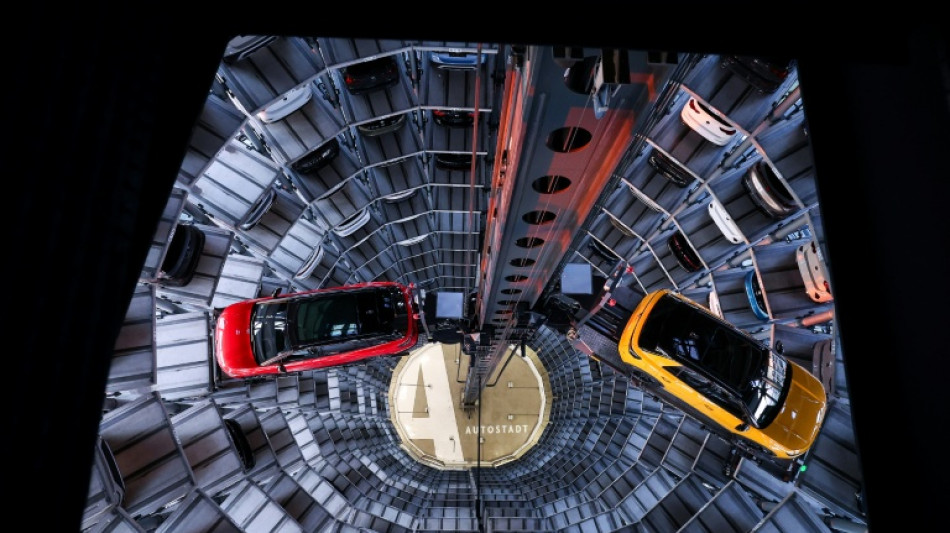
Germany brings back electric car subsidies to boost market / Photo: Ronny HARTMANN - AFP

 AI 'warning shots' focus Beijing on national security risks

 Philippine tribe in limbo over US-led tech hub
 Saudi-led coalition says Houthis fired ballistic missile at Riyadh

 Cuba works to restore power after another blackout

 Brigitte Bardot widower slams sale of star's belongings

 Indonesia accepts Malaysia's help to tackle wildfires

 Nvidia, OpenAI CEOs to attend Xi dinner at White House

 Cuba hit with seventh major blackout of the year

 Nigeria miners struggled to breathe in cell before 37 died: survivors

 Warren Buffett steps down as Berkshire Hathaway chairman

 Isolated Syrian-Druze city blames Damascus for shortages

 Kerry James Marshall: American 'blackness' painter celebrated in Europe

 Infantino 'must go', says German FA vice-president

 Japan's busiest rail station tests robot bins

 Backpackers fret over Australian visa crackdown

 Bank of Japan hikes rates to 31-year high to battle inflation

 AI doomsday warnings unlikely to slow IPOs but questions linger

 In Brazil's Amazon, the hunt for oil fuels hopes and fears

 Baby orangutans in India expose 'frightening' scale of trafficking

 Oversight Board blasts 'inadequate' Meta safeguards for AI deepfakes

 Harry makes first public appearance since return to UK

 Princess Diana's brother makes new explosive claims against Charles

 Trump admin overhauls key protection for endangered species

 Mbappe draws political fire over Ceuta t-shirt controversy

 Third malaria death in Germany from outbreak tied to Frankfurt airport

Germany on Monday reintroduced electric car subsidies as it seeks to accelerate the transition to less polluting vehicles, drawing praise from industry groups but criticism from environmentalists who demanded greater efforts.
Sales of electric vehicles (EVs) in Europe's biggest auto market are growing but progress has been patchy, and the government and the struggling auto sector are keen to speed up the shift.
The previous government scrapped an earlier subsidy scheme in 2023 due to a budget crisis, prompting a collapse in EV sales, although they have been recovering in recent times.
The new programme "helps the environment, the automotive industry, and in particular families who otherwise couldn't afford a new, environmentally friendly car," said Environment Minister Carsten Schneider.
Private households with a taxable income of no more than 80,000 euros ($93,000) will be eligible for subsidies, Schneider announced.
Car buyers can apply for the support from May, which will apply to EVs registered from the start of 2026, he said.
Fully electric cars are eligible for a subsidy of at least 3,000 euros. Plug-in hybrids and cars with range extenders -- in which a small combustion engine can charge the battery -- are covered by a basic subsidy of 1,500 euros.
There are extra subsidies for families with children as well as households on lower incomes.
The IG Metall union, which represents many auto sector workers, welcomed the scheme as an "an important step in the right direction".
The VDA auto industry group said the programme will "support the success of e-mobility in Germany" although it urged other steps, such as improving charging infrastructure.
But the group Environmental Action Germany voiced criticism, especially of subsidies for plug-in hybrids, which it said "offer hardly any climate benefits" over combustion engine cars.
"The government is still failing to implement effective climate protection policies in the transport sector," said the group's chief Juergen Resch.
German carmakers -- already struggling with slowing sales and fierce competition -- desperately need electric sales to rise as they invested hugely in the EV shift and also face strict new European environmental rules.
Though the European Union in December proposed scrapping a planned 2035 ban on new combustion-engine vehicles, carmakers would still face having to cut emissions by 90 percent from 2021 levels under its latest plan.
After plunging in 2024 following the end of the last subsidy programme, German EV sales rebounded in 2025 and represented almost a fifth of all new cars sold.
P.Schmidt--CPN